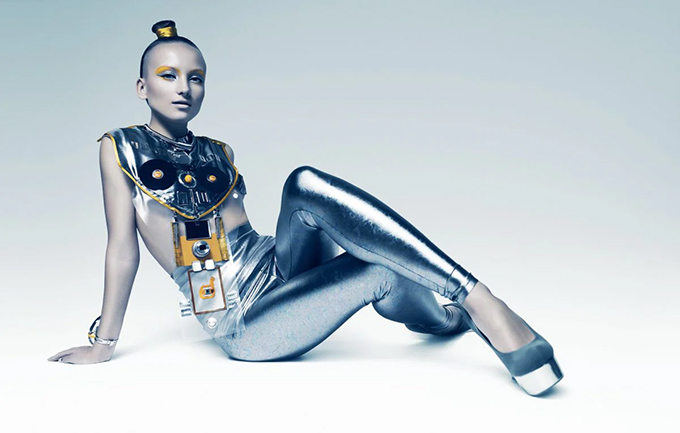
Content creators are ubiquitous in the audiovisual landscape and on social media, becoming essential intermediaries in accessing information and making purchases. Their ability to capture attention, shape opinions, and influence desires raises questions. This phenomenon becomes even more concerning with the emergence of virtual influencers, who lack a human presence and do not reveal who is truly behind “their” recommendations. Today, humans systematically prefer to trust other humans, even when the artificial agent is more effective ( Dietvorst et al. ), but what will the future hold?
In the United States, the Pew Research Center (2024) shows that 21% of adults regularly get their news from “news influencers,” and 65% of them believe these creators help them better understand current events. In France, the Reuters Institute (2025) identifies the same trend: content creators are now eclipsing traditional media brands in terms of attention on social networks. By 2025, 37% of French people use social media to get their news. Among those under 35, the creator Hugo Décrypte reaches 22% of this age group each week, as many as, or even more than, most traditional media outlets. At the same time, only 29% of French people say they trust the news , placing France 41st out of 48 countries studied.
Léna Situations, meanwhile, has been immortalized at the Grévin Museum. A first for a French influencer, and a powerful symbol. Digital influence is now firmly established in the cultural landscape as it is in brand strategies.
New intermediaries
The rise of influencers reveals a significant shift: information no longer flows solely from brands to audiences via media outlets (newspapers, radio, TV, etc.), but also from individual to individual, through intermediaries who select, interpret, and shape content for their targeted and engaged communities. This is what Lazarsfeld and Katz call “mediation,” which empowers opinion leaders to be key players in the circulation of ideas. The phenomenon itself is not new, but social media platforms have amplified its reach through their capacity for rapid, large-scale dissemination.
Today, an influencer is simultaneously a source of inspiration, a disseminator of information, and a commercial prescriber. Léna Situations doesn’t just recommend products: she promotes a role model, shares advice and values, and suggests lifestyles and ways of seeing the world. Influence is no longer limited to driving purchases; it also shapes benchmarks, norms, and access to information.
When the avatar becomes an influencer
Faced with the uncertainties of mediation by a human influencer (risks of controversy, excessive demands or unpredictable stances), some brands have taken a further step, using artificial intelligence-generated avatars as a communication intermediary.
Lil Miquela , created by the American startup Brud, has 2.3 million followers on Instagram. BMW featured her in a campaign called “Make It Real” to promote its iX2 electric model. In this campaign, the avatar explores the vehicle’s features in an immersive world blending real-world sets and digital elements. Everything is meticulously planned, controlled, and aligned with the brand’s identity, avoiding the unpredictable challenges of filming with a human.
The logic is primarily strategic: total control of the message, brand consistency, and constant availability. An avatar doesn’t get sick, doesn’t publicly take a stand on controversial topics, and doesn’t renegotiate its contract mid-campaign. There are no exclusivity clauses and no reputational risk. Each piece of content can be produced without the logistical costs of filming with a human. Virtual influencers allow for controlled mediation. But this control comes at a cost in terms of image and relationships, a cost that research is beginning to quantify.
The limitations of the avatar
Scientific research is converging: human influencers, who demonstrate empathy and can have real-life experiences, outperform avatars on key dimensions of persuasion. The experimental study by Dondapati and Dehury , published in *Computers in Human Behavior: Artificial Humans* and conducted with 624 participants, confirms this unequivocally. Audiences reported significantly lower levels of parasocial connection with virtual influencers (average score of 2.09 out of 5) than with humans (4.52). Perceived homophily—that is, the feeling of closeness and similarity to the creator—was also lower for avatars. And this effect translates directly into purchase intention.
While improved technology enhances the perceived authenticity of avatars by bringing their rendering closer to real-life content, the gap between humans and avatars remains significant. The parasocial relationship—that feeling of personal connection with a creator one regularly follows—only functions fully if one perceives a human being behind the screen, with a story, passions, desires, and emotions. An avatar, however well-designed, cannot replicate the vulnerability or personal growth that fuels the relationship between a human influencer and their community.
Other studies complete the picture. Li and Ma (2023), for example, identify a problem of corporeality: the absence of a real body in an avatar limits the audience’s emotional projection. Lou et al. (2022) reveal a perceived betrayal effect when the audience discovers the artificial nature of an influencer they thought was human: trust drops and, with it, engagement.
In short, influence is based on deeply human mechanisms (empathy, shared emotions, authenticity, vulnerability, lived experiences) that artificial intelligence (AI) imperfectly reproduces.
Exponential risks
If avatars are struggling to sell, why worry? Because even if the attachment a subscriber can feel towards them is still limited, these AIs introduce an idealized and distorted representation of reality, in terms of appearance, content, and format. In doing so, they alter consumer expectations and, in a more diffuse and less conscious way, social norms and representations.
Furthermore, when an avatar becomes a mediator of cultural or informational content, a novel question arises: who should verify the data? A human influencer has a background, identifiable expertise, a face, and an identifier to which one can refer. An avatar, on the other hand, does not connect to any interlocutor.
The case of Anne Kerdi is illuminating. This Breton virtual influencer, followed by nearly 13,000 subscribers on Instagram, promotes the culture, heritage, and environment of Brittany. An ambassador for the Océanopolis Act endowment fund for coastal protection, she selects topics, recounts traditions, and shares events. While this may seem harmless, the question of fact-checking arises. She herself warns on her profile: “As an AI, I can make mistakes. Check my information.” But how many users actually do this? It’s worth remembering that only 11% of French people report having received media literacy training.
These factors highlight two risks: an artificial mediator has no lived experience, no editorial responsibility, no accountability, and doesn’t disclose who designs the content, where the information is sourced, or how the responses are generated. The literature on trust in AI confirms this. Consequently, the trust that is generally based on expertise, empathy, and transparency is difficult to place in an avatar.
A global responsibility
According to a Semrush study (2026), generative AIs draw heavily on content from social media platforms (Reddit 11%, LinkedIn 11%, YouTube 9%) to construct their responses. Content produced by avatars can therefore be fueled by real-life experiences, which are then recycled into the responses of these tools. This blurring of boundaries can create a false impression of authenticity and gradually reduce the perceived distance between virtual and human influencers.
It is becoming increasingly difficult for consumers to know to what extent content reflects a genuine emotion, a lived experience, or a human opinion, or whether that content is an artificial synthesis created by a machine to appear authentic. Artificial mediation is not limited to those who follow an influencer; it permeates the entire information ecosystem.
In a landscape where trust in the media is at an all-time low, the question is no longer simply whether online influencers are effective. It’s whether consumers can identify who is speaking to them, where the information comes from, and whether the intermediaries shaping their reference points have lived experience, a sense of responsibility, and a strong ethical code. The real question posed by online influencers is not only technological; it is also democratic.
Author Bios: Gwarlann De Kerviler is Associate Professor – IÉSEG School of Management – LEM (Lille Economy Management, UMR 9221) at IÉSEG School of Management and Fabienne Torrès-Baranes is a Doctor of Information and Communication Sciences at the University of Paris-Panthéon-Assas
