
For a conversational AI, a chair might be a word, a definition, or an image. For a robot, a chair is an obstacle to avoid, an object to move, a surface on which someone can sit.
We analyzed 40 scientific studies published in the last ten years on cognitive robotics and human-robot interaction, and the conclusion is that we are still a long way from our lives resembling the film Ex Machina (2014). As robotics experts Alessandra Sciutti , Giulio Sandini , and Pietro Morasso argue , we have mastered artificial intelligences capable of processing information, but robotic cognition requires something more : a body, action, and situated experience. Robots do not understand the world as we do; they perceive and act within it in ways that are still partial.
For robots to coexist with us, it is not enough for them to have a lot of data; they need to understand the world as we experience it.
Multiple intelligences
Cognitive robotics aims to develop robots capable of perceiving, learning, reasoning, deciding, and adapting to changing environments. It’s not just about automating movements, but about building systems that can interpret information from their surroundings and act with flexibility.
In our systematic review, we analyzed 40 scientific studies, but it’s important to clarify something: these are not 40 different robots. In robotics, a single body can house different cognitive architectures: different ways of organizing perception, memory, learning, decision-making, or interaction.
An example of this is the iCub , a humanoid device from the Italian Institute of Technology, used as a platform to study how cognitive abilities are developed and integrated into a robotic body.
Can they tell when they’re wrong?
Based on previous classifications of cognition, we organize these abilities into two main groups: core cognitive skills and socio-cognitive skills. The former are the basic driving force behind robotic intelligence.
Perception allows them to transform data from cameras, microphones, or sensors into useful information. They can decide which signals matter among everything that is happening thanks to attention.
Action selection—what to do—allows them to choose whether to move, wait, stop, or change strategy. Memory retains relevant information, and they can adjust their behavior based on experience because they are capable of learning. Reasoning helps resolve situations when something doesn’t fit the planned course of action. Foresight allows them to anticipate possible futures. And finally, the more ambitious metacognition would enable the robot to monitor its own processes: detect uncertainty, correct itself, or recognize that it may be wrong.
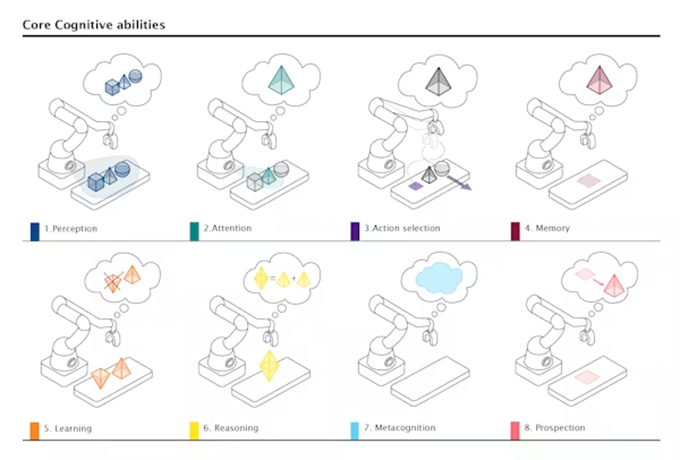
Core cognitive skills enable the robot to gather information from its environment, select it, learn from it, and decide how to act. They are the operational foundation of cognitive robotics: perception, attention, action selection, memory, learning, reasoning, metacognition, and foresight.
The smart wheelchair
One of the reviewed studies didn’t use a humanoid robot from a movie, but rather an intelligent wheelchair . Its cognitive architecture aimed to assist with navigation without diminishing the user’s autonomy: providing assistance when needed, but without turning the person into a passive passenger. In this case, the cognition wasn’t about “conversing” or appearing human, but about deciding when to intervene, how to move, and how to maintain the user’s control. In the evaluation, navigation time decreased from 124 to approximately 72 seconds for users with lower cognitive abilities.
Regarding the cognitive abilities developed in robots, the results map depicts a kind of pyramid. At the base are the most developed capabilities: perception in 35 of the 40 studies, attention and learning in 31, and action selection in 30.
Further up the list are reasoning and memory, present in less than half of the studies analyzed. At the very top are the most sophisticated skills: prospecting, with 7 studies, and metacognition, present in only 2.
We’re making great strides in robots that perceive, learn, and act, but far less in robots capable of anticipating, questioning, or correcting their own mistakes. While much has been achieved, it doesn’t equate to having robots with common sense, social understanding, or human-level intelligence.
Playing “rock paper scissors”
Now we will focus on socio-cognitive skills, those that allow the robot to function in an environment and to do so alongside others. These include reading intentions, that is, inferring what a person wants to do; communication, to exchange information in a comprehensible way; self-awareness, key to differentiating one’s own actions from those of others; and joint attention, which allows the robot and human to direct their attention toward the same object or task.
Reading intentions may seem abstract, but it’s easily understood through a game. In one of the reviewed studies, a social robot called RASA played rock-paper-scissors with people. The goal wasn’t to win by reflexes, but to test whether the robot could anticipate human intentions. When operating in predictive mode, it performed better than when acting randomly, and participants perceived it as more intelligent and engaging.
Try it with children with autism
There are also examples in social and assistive robotics. A social robot was tested with children with autism to work on emotional recognition and reciprocity. In these cases, the important skill is not lifting weights or moving with precision, but rather reading expressions, responding with understandable gestures, and maintaining a minimally legible social interaction.
Herein lies the gap. Reading intentions and communication each appear in 13 studies. Self-recognition and recognition of others appear in 6. Joint attention appears in only 2. Furthermore, while 39 of the 40 studies develop at least three core skills, only 8 incorporate more than one socio-cognitive skill.
We are primarily building the invisible engine of robots: that which allows them to see, calculate, learn, and act. But we are developing far less the part that, in our minds, makes us say “this seems intelligent”: interpreting others, coordinating with them, communicating doubts, anticipating gestures, becoming legible.
Side effects
This matters because a robot can have many core cognitive abilities and still be difficult for a person to understand. It can perceive an object, calculate a trajectory, and execute an action accurately, but not effectively communicate what it will do next. It can anticipate a human movement in a laboratory setting, but not necessarily generate more security, more confidence, less stress, or a greater sense of control.
Prospecting and intent reading are often presented as key capabilities for robots that share space with humans. However, in the reviewed studies, these capabilities do not always translate into clearly measured or reported safety improvements.
The history of automation reminds us that tools not only do things for us, they also transform us. A GPS changes how we navigate. An autocorrect modifies our relationship with writing. A cognitive robot can change how we pay attention, how we make decisions, and how we feel about our presence at work or in everyday life.
The important question is no longer just how much robots will be able to do, but what skills we are prioritizing and which ones we are leaving behind.
Author Bio: Nagore Osa Arzuaga is a Lecturer and Researcher in Innovation in Industrial Design, specializing in Human-Robot Interaction Design and Human Factors at Mondragon Unibertsitatea
Contributors: Ganix Lasa Erle is a Lecturer and researcher at Diseinu Berrikuntza Zentroa (DBZ), specializing in Interaction Design and Technology and Maitane Mazmela Etxabe is a Researcher and Lecturer in Industrial Design both at Mondragon Unibertsitatea
