
Quick answer: The best math apps for kids depend on your child’s age and what you need. For story-driven practice that keeps kids ages 5 to 10 coming back on their own, MathHero is the strongest pick. For the earliest counting and number recognition, Khan Academy Kids and Moose Math fit better. For skills beyond arithmetic like fractions and geometry, DragonBox is worth a look. Below, each app is broken down by who it actually helps, what it costs, and where it falls short.
Parents searching for the best math apps for kids usually hit the same wall: every list ranks the same names, and every app claims to be magic. This one is different. It tells you where each app is weak, not just where it shines, and it starts from a simple question you already know the answer to in your gut: whose idea is the next practice session going to be, yours or your child’s?
That question sorts good math apps from the ones that gather dust after a week.
What makes a math app actually worth using
Before the list, here is the short version of what separates a math app your child opens on their own from one you have to nag them to touch.
Motivation that is built in: not bolted on
Stars and badges glued on top of worksheets wear off fast. A real story, a character your child owns, and things to earn keep working for months. The apps that last treat math as the way you play, not the toll you pay to reach the fun part.
The right skill level for your child
The best math apps for kids meet a child where they are. An app aimed at a 4-year-old learning to count frustrates a third grader drilling times tables, and the reverse leaves a kindergartner lost. Match the app to the grade level and the specific math skills your child needs.
Immediate: low-stakes feedback
Kids learn math facts faster when a wrong answer costs little and a right one lands right away. Fear of failure kills practice. The strongest apps make mistakes cheap and quick to fix.
Progress you can actually see
Parents need a way to check what is happening. Progress tracking, per-topic settings, and clear signals of improvement turn a mystery box into a tool you can steer.
With that frame, here are the apps worth your time.
A note on what the research actually supports
It is easy to find bold claims that a given app boosts scores by some dramatic percentage. Treat those with care. Many are company marketing, not independent findings. What is well supported is narrower and more useful: math anxiety is real, it appears early in childhood, and it affects a meaningful share of people, around 17% of the general population by one widely cited estimate. Regular, low-stakes practice with immediate feedback is a sensible response to that. A math app helps most when it makes practice feel safe and voluntary, not when it promises a miracle. Keep that lens as you read any list, including this one.
1. MathHero: best for turning practice into a game kids ask for
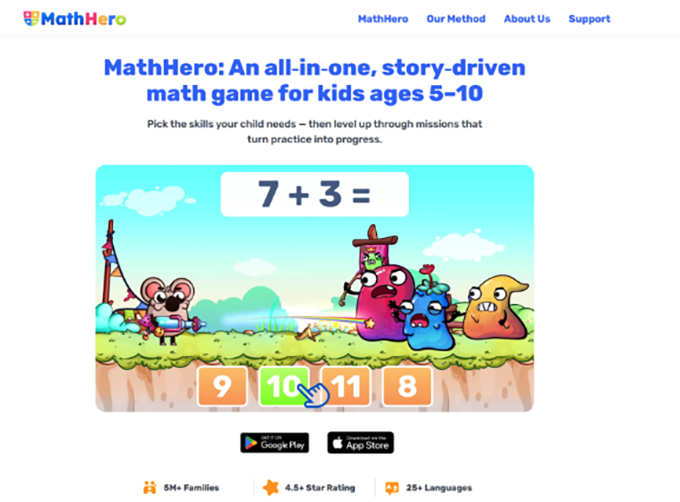
MathHero is a story-driven adventure where solving math is how you play. Kids ages 5 to 10 build addition, subtraction, times tables, and division by moving through a real game world with characters, coins, and gear to collect. The math is the action mechanic, not a gate in front of the fun.
That design is the whole point. The most repeated line in MathHero’s own store reviews is some version of “he doesn’t notice he’s learning.” Parents describe children who disliked math asking to play within a day or two. The engine is motivation: a child quietly does far more basic arithmetic than anyone could assign, because the next session is the child’s idea.
Where MathHero fits best. A child who is ready for their first addition problems through the end of elementary arithmetic, roughly grades K-4. It shines for reluctant learners and for kids who need regular math practice without a fight at the kitchen table.
Customization parents actually name. You choose the topic, the difficulty, whether answers are typed or multiple-choice, and how fast the monsters move. Per-operation and per-table control means one child can drill only times tables while a sibling works on subtraction. This fine-grained parent control is the lead reason families recommend it.
Free and premium, stated plainly. The whole game is completable for free with no locked content and no ads. The only limit is pace: five levels per day. A subscription with a free trial removes that daily cap. Five levels is a solid short daily session, which is exactly how math practice works best.
Where MathHero falls short. It does not teach counting or number recognition from scratch, so a child should already know their numbers before starting. It does not cover fractions, geometry, or equations. And new levels do not arrive as often as some families would like, so a fast player can finish the main content and need to replay or wait. For a child who needs those things, another app on this list is the better fit.
Ratings back up the experience: Google Play 4.6 (46k) and App Store 4.7 (11k).
2. Khan Academy Kids: best free app for the earliest years
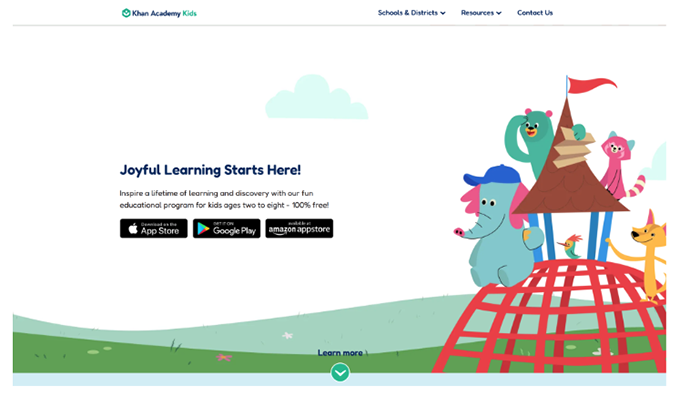
Khan Academy Kids is free, with no ads and no in-app purchases, and it is aimed at young learners roughly ages 2 to 8. It blends early literacy with basic math concepts through colorful characters and personalized learning paths.
Where it fits best. The stage before MathHero. Counting, number recognition, shapes, and first exposure to basic math skills. If your child is not yet ready to solve addition problems, this is a gentle, genuinely free starting point.
Where it falls short. It is broad rather than deep on arithmetic. Once a child is fluent with early numbers and ready to build real math fluency in addition, subtraction, and times tables, they will outgrow it. It is an on-ramp, not a destination.
3. SplashLearn: best for curriculum-aligned breadth

SplashLearn (formerly Splash Math) offers a large library of games and worksheets for early learners, aimed at Pre-K through Grade 5. Its content is curriculum aligned and covers reading alongside math.
Where it fits best. Families who want structured, grade-level coverage that maps to school and who like having worksheets and games in one place across a wide age band.
Where it falls short. Breadth comes at the cost of a single pulling story. The reward loops sit on top of exercises rather than inside a world, so motivation can fade the way it does with any drill-plus-graphics approach. Check the current subscription price in the app before you commit, since pricing changes.
4. Prodigy Math: best fantasy-based game for a wide grade range
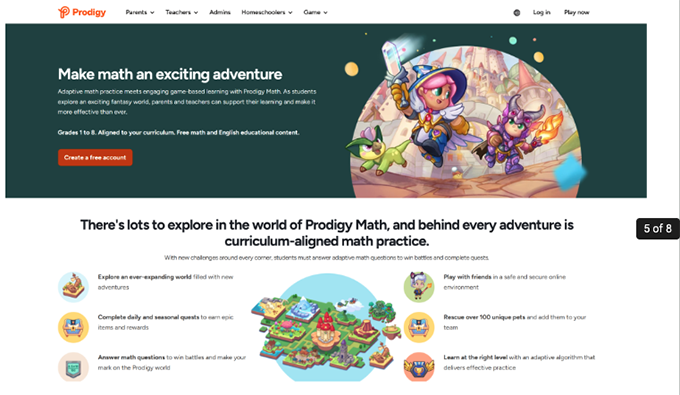
Prodigy Math is a fantasy based math game where kids battle and quest by answering questions, covering a wide span of skills from roughly 1st to 8th grade. It is the closest competitor to MathHero on the “math as gameplay” idea and the one direct rival in that niche.
Where it fits best. Older elementary and middle school students who want an ongoing role-playing world and whose parents want coverage that stretches past arithmetic into later grade levels.
Where it falls short. Much of the genuinely engaging content and rewards sit behind a paid membership, so free play can feel like a nudge toward subscribing. Prodigy offers a premium membership across several tiers; prices and tiers change and vary by term, so check the current price on Prodigy’s site or in the app rather than trusting a number from a list. For the youngest kids just starting addition, its world can be a lot.
5. DragonBox: best for concepts beyond arithmetic

DragonBox teaches algebra and geometry through clever puzzles that hide the math inside the mechanics. It is genuinely inventive at making abstract mathematical concepts feel like play.
Where it fits best. Kids ready to move past core arithmetic into algebra, geometry, and creative problem solving. It sits after MathHero’s range, not alongside it.
Where it falls short. It is not built for daily basic arithmetic practice or for building times-table fluency. If your child needs addition, subtraction, multiplication, and division reps, this is the wrong tool. If they have those and want a stretch, it is excellent.
6. Moose Math: best for playful preschool number sense
Moose Math engages preschoolers with colorful mini-games covering counting, sorting, and simple addition inside a friendly animal world. It is warm, low-pressure, and made for very young kids.
Where it fits best. Preschool and early kindergarten, building number sense before formal arithmetic begins. Like Khan Academy Kids, it lives in the stage before MathHero.
Where it falls short. Limited depth once a child is ready for structured addition and subtraction practice. Children move through it and then need something with more range.
How to choose the right math app for your child
The best math app is the one that matches your child’s skill level and keeps them coming back. A quick way to decide:
Match the app to the stage
For counting and number recognition, start with Khan Academy Kids or Moose Math. For first addition through elementary times tables and division, MathHero is built exactly for that window. For fractions, geometry, and algebra, look at DragonBox.
Watch for the motivation test
If your child needs pushing after the novelty fades, the motivation was bolted on. Apps built around a story and ownership, like MathHero, tend to survive past week one because the child wants the next session.
Check the real cost before you commit
Most of these apps use a freemium model, and prices change often. MathHero lets you complete the whole game free at five levels a day, with a subscription to lift the cap. For the paid apps, open the app or the developer’s site and confirm the current price rather than trusting any figure in an article, including this one.
How these math apps compare at a glance
It helps to see the apps side by side on the things that actually decide fit: the age they serve, what math they cover, and how motivation works.
By age and stage
Khan Academy Kids and Moose Math own the earliest years, roughly ages 2 to 5, when the job is counting and number recognition. MathHero takes the long middle, ages 5 to 10, when a child moves from first addition through subtraction, times tables, and division. Prodigy Math stretches from grade 1 into middle school for kids who want a persistent world. DragonBox sits at the far end, for children ready to leave arithmetic behind for algebra and geometry.
By math coverage
If you need core arithmetic practice, the apps built for it are MathHero, SplashLearn, and Prodigy Math, with IXL and DoodleMath reinforcing the school curriculum. If you need concepts beyond arithmetic, that is DragonBox. If you need the pre-math counting stage, that is Khan Academy Kids or Moose Math. No single app does all three stages well, which is why matching the app to your child’s current math skills matters more than picking the highest-rated name.
By how motivation works
This is the quiet dividing line. In most apps, the rewards, the stars, the badges, sit on top of exercises. In a story-driven game like MathHero, the motivation is the game itself, so the practice rides along inside something the child already wants to do. That difference is why some apps get abandoned after a week and others become the thing a child asks for.
Common questions about math apps for kids
Parents tend to ask the same handful of things when choosing among the best math apps for kids. Short, honest answers below.
Frequently asked questions
What is the best free math app for kids?
For the earliest years, Khan Academy Kids is fully free with no in app purchases. For elementary arithmetic, MathHero’s free mode lets a child complete the entire game at five levels per day with no locked content, which is more than most freemium apps offer before a paywall.
What is the best math app for kids who dislike math?
A story-driven game where math is the way you play tends to work best for reluctant learners, because the child’s motivation comes from the world and the rewards rather than from the math itself. Parents most often report this reversal with MathHero.
At what age should a child start using a math app?
Counting and number-recognition apps suit ages 2 to 5. Once a child can recognize numbers and is ready for first addition, an arithmetic game like MathHero fits ages 5 to 10. Match the app to what your child can already do.
Do math apps really help kids learn?
Game-based math practice helps when it delivers regular, low-stakes reps with immediate feedback. Math anxiety is real and appears early, affecting roughly 17% of the general population, so an app that makes practice feel safe and voluntary can matter as much as the content itself.
The bottom line
There is no single best math app for every kid. There is the right app for your child’s stage and temperament. For counting, start early with Khan Academy Kids or Moose Math. For the years when arithmetic is the whole job, ages 5 to 10, MathHero turns daily practice into something your child asks for, which is the rarest and most valuable thing a math app can do. Pick the one that fits, and let the next session be your child’s idea.
