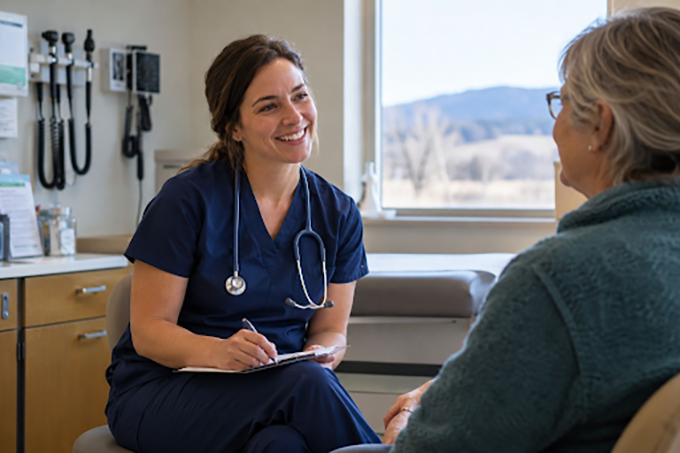
Across much of rural America, the nearest primary-care clinic is a long drive from home, the physicians who staff it are nearing retirement, and there aren’t many replacements in line.
The usual response is to call for training more clinicians. But the more useful question is often where they end up practicing, and that’s where regional universities, working with the education technology company Risepoint, have built an answer: online programs that train working adults in the communities short on care, close to the patients they will serve.
The primary-care shortage is really a shortage of places
The country is short of doctors, and the government expects the gap to widen. The Health Resources and Services Administration projects a shortage of 141,160 physicians by 2038, with 30 of 35 specialties running short and family medicine among the tightest, at 76% of the supply the country will need. The Association of American Medical Colleges puts the total shortfall as high as 86,000 physicians by 2036.
The distribution of where those shortages are felt is lopsided. Across all physician specialties, HRSA projects that rural areas will reach only 42% of the supply they need by 2038, against 95% in metro areas. In HRSA’s 2025 primary care workforce report, nonmetro adequacy lands at 61% against 83% in metro areas, 63.1% of the nation’s designated primary-care shortage areas are rural, and clearing every one of those designations would take roughly 15,628 additional primary-care physicians.
An aging population needs more care, a large share of the current physician workforce is heading toward retirement, and the pipeline that would replace them isn’t keeping pace, least of all in small towns. A national headcount can look manageable while a specific county has no one taking new patients. Averages are cold comfort to a patient who has to drive two counties over for care.
If nurse practitioners are in surplus, why does the gap persist?
The country isn’t short of nurse practitioners. HRSA’s primary care workforce report projects a growing surplus of them, an excess of roughly 72,910 full-time nurse practitioners by 2038, even as it counts about 374,970 already working in primary care. And demand for the role is still climbing: the Bureau of Labor Statistics expects nurse practitioner employment to grow 41% from 2025 to 2035, faster than almost any other occupation, at a median wage of $132,300.
So the constraint is geographic. Nurse practitioners, like physicians, tend to settle where the jobs, the training, and the amenities already cluster, and that leaves underserved areas short even in a national surplus. The same forces that pull new doctors toward big hospital systems and well-paid metro practices pull new nurse practitioners the same way. A surplus counted at the national level can sit hundreds of miles from the county that needs it.
The gap is also where nurse practitioners can do the most. HRSA’s own physician projections note that the shortages ahead can be eased, in part, by greater use of nurse practitioners and physician assistants. In many states, nurse practitioners already practice independently, and in rural clinics they are frequently the primary-care provider for a small community.
A nurse practitioner can be the difference between a town with a clinic and a town without one. Where state law lets them practice to the top of their training, they can carry a primary-care panel on their own, diagnosing, prescribing, and managing chronic conditions, which is exactly the coverage a county without a physician needs most. What decides that impact is location, and location is often set years earlier, by where a clinician trains and puts down roots.
How where a clinician trains shapes where a clinician practices
Career geography isn’t random. Clinicians tend to build practices near where they studied and already live, especially when work, family, and community ties hold them in place. Regional universities are unusually well placed to pull that lever. A university rooted in an underserved region, teaching students who already live there, produces the providers those communities struggle to attract from anywhere else.
But access has been an obstacle. A working nurse in a rural county usually can’t necessarily leave a job and commute to a distant campus for an advanced-nursing degree, and the residents who might have staffed a nearby program often left for school in urban areas and never came back.
Online course delivery can remove that obstacle. In theory, it can allow a nurse to earn the credential without leaving home or work, then move into advanced practice a few miles from where the coursework happened.
How do Risepoint-supported programs fit in?
More than 90% of graduates in Risepoint-supported programs are working adults, most stay employed while they study, and 92% continue living and working in their local communities after they finish.
Risepoint is an education technology company that helps universities build and grow online programs. The university owns the academics: its faculty, its curriculum, its admissions, and its standards, and the degrees are taught by the same faculty who teach on campus. Support from Risepoint covers the parts a regional university often can’t scale on its own: the technology behind the online programs, integrated marketing and initial student outreach, enrollment support, and student retention services.
The support is built for a specific student. Many of those working adults are already employed in or near the health systems that are short-staffed. The programs sit in exactly the fields those systems need: bridge programs that move working nurses into advanced practice, plus the nursing and health specialties that rural clinics can’t fill on their own. For a nurse in an underserved area who wants to move into advanced practice, an online program at a nearby regional university is often the only route that doesn’t require leaving the area they already serve. The result is a pipeline that runs through the communities with the deepest gaps, rather than around them.
None of this replaces the other tools. Loan-repayment incentives, rural residency slots, and telehealth all pull providers toward places that need them, and all of them matter. But those tools work on clinicians who already exist somewhere else and have to be moved. Regional online education works earlier in the chain, on who enters the profession and where they’re rooted from the start.
