
When we look at the brightest stars in the night sky, we can distinguish with the naked eye reddish-orange stars (like Aldebaran in the constellation Taurus ), white stars (our own Sun when observed from space) or bluish stars (like the star Vega in the constellation Lyra ).
Until now, the scientific community believed that stars of other colors, including green, did not exist. However, a recent study, led by researchers at the University of Warwick (England) , has analyzed WDJ1330+6435, a dwarf star located about 280 light-years away, in detail. It is too faint to see with the naked eye, but if we could get close enough to appreciate its disk, we would be seeing, for the first time, a pale green star.
The same study also found that a small group of white dwarfs glow in unusual colors such as pink, cyan, yellow, and purple. The researchers titled their scientific article “ Any Colour You Like, ” a charming reference to Pink Floyd’s famous instrumental track from the album The Dark Side of the Moon .

Dwarf stars analyzed by the University of Warwick research team, showing their associated emission spectra at the bottom. In addition to the aforementioned green star WDJ1330+6435, we identified the intense red star WDJ1011+2845 and the pink dwarf WDJ0902+2010, both with high concentrations of carbon in their atmospheres. Credits: Mark A. Garlick/University of Warwick. CC BY
What is a white dwarf?
The life of a star is similar to that of a living being. As they age, they undergo changes in their structure and composition.
Stars similar to our Sun grow in size until they become red giants. At the end of this stage, they expel their outer layers, which form colorful nebulae, while the stellar core contracts and is exposed as a white dwarf, an object similar in size to Earth but with a mass comparable to that of the Sun.
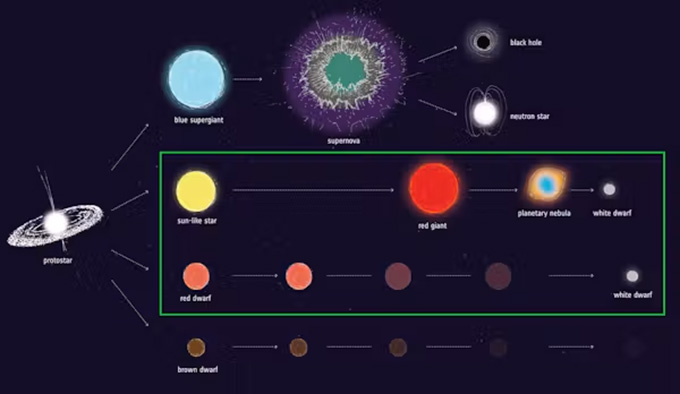
An artist’s impression of the possible evolutionary stages of stars based on their initial mass. In the green box, the evolution of our Sun and its final stage as a white dwarf star. Credits: ESA. CC BY
The first white dwarfs discovered were surprisingly hot and emitted a white or pale blue glow, hence their distinctive name. But their temperature evolves over time: a white dwarf no longer generates energy internally, so it slowly cools down over billions of years. This is why some white dwarfs are very hot and others are much cooler, even cooler than our Sun, and it is among these latter ones that the most unusual colors appear.
Turning starlight into color vision
To determine the color a human eye would perceive a star as, researchers subjected starlight to an algorithm based on a model of human color vision. This model replicates how the three types of retinal cells responsible for color would be stimulated: L cones (sensitive to long wavelengths or reddish tones), M cones (medium wavelengths or greenish tones), and S cones (short wavelengths or blue colors). It is a model of the average human eye, not of each person’s exact perception.
In the final stage of processing, each star is assigned (x, y) coordinates on the well-known CIE 1931 color diagram and, therefore, a color visible to the human eye. In this innovative way, the research team discovered that some dwarf stars (previously cataloged as white) would be observed in very different shades.
The first star that shines green
The key lies in the high atmospheric density of white dwarfs, which reaches values millions of times higher than that of the solar photosphere .
In such a compressed atmosphere, atoms and molecules constantly collide, continuously altering their energy levels, which are responsible for the emission and absorption of light. As a result, each element stops absorbing light at very specific wavelengths and begins to absorb it across much broader bands. Elements like carbon, calcium, and sodium are able to absorb light across a much wider range of colors than would be the case in less dense atmospheres.
Under these conditions, the emission spectrum of these white dwarfs appears fragmented across large chromatic regions, and the star’s color deviates from red, white, and blue hues. The most striking example is WDJ1330+6435, the first known star that would appear green to our eyes.
With a surface temperature of about 4,240 K (3,966.8 °C), it is a cool white dwarf, cooler than our Sun. Once its planetary system collapsed, this star absorbed rocky material and incorporated it into its atmosphere, resulting in high concentrations of calcium, sodium, and lithium. While calcium absorbed the shorter wavelengths (blue colors), sodium eliminated the orange colors from its spectrum, and lithium suppressed some reddish hues, giving WDJ1330+6435 a greenish appearance.
The results yielded coordinates (0.33; 0.41) for this star on the chromatic diagram, which is equivalent to a light greenish color to our eyes.
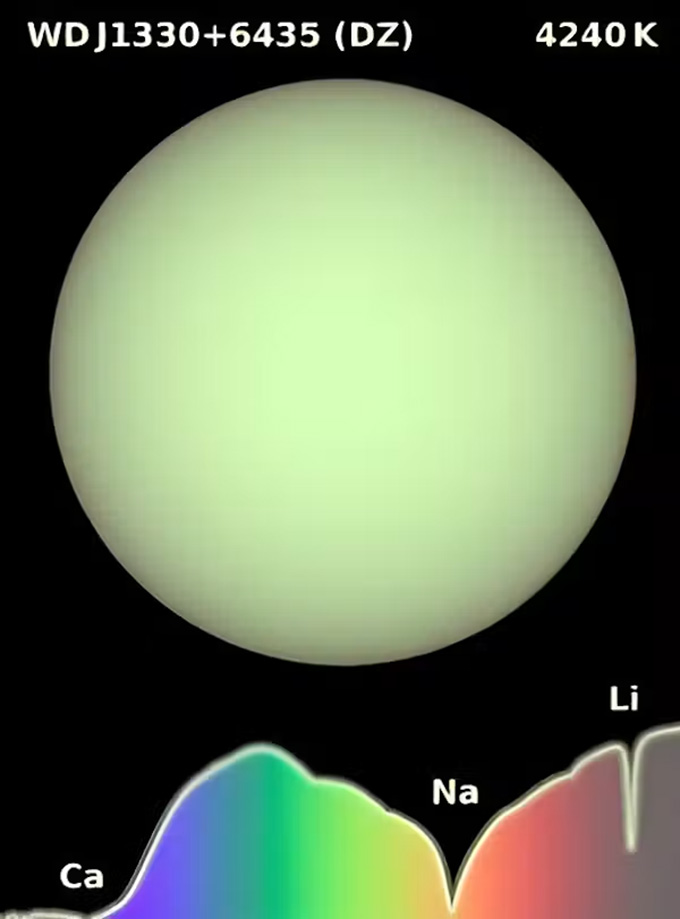
The white dwarf star WDJ1330+6435, as we would see it with the naked eye. The distinct greenish hue is due to the shape of its emission spectrum (lower part of the image), where each chemical element present in the star’s atmosphere (calcium, sodium, and lithium in high concentrations) removes a large portion of its spectrum. Credits: Mark A. Garlick/University of Warwick. CC BY
A wide range of colors, but with white as the main color.
By applying this method to white dwarfs scattered throughout the cosmos, researchers discovered that their colors cluster into categories linked to the composition of their dense stellar atmosphere. Thus, carbon-rich white dwarfs tend to exhibit pink or purple hues, while those enriched with the remnants of asteroids and comets tend toward yellow.
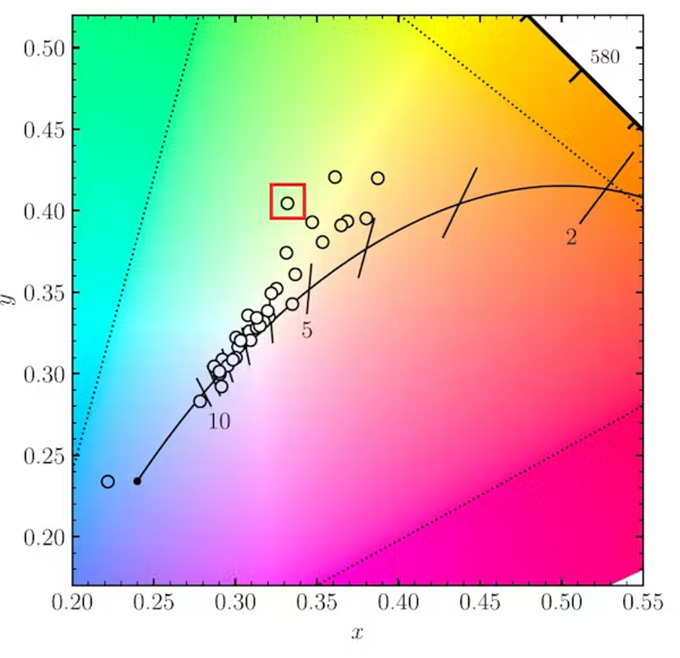
Chromaticity diagram of 36 dwarf stars studied by researchers. In the red box, the chromaticity coordinates of WDJ1330+6435 are shown, indicating a greenish hue. Credits: https://arxiv.org/abs/2610.18966. CC BY
In contrast to the green star, researchers identified what could be the reddest star known. Designated WDJ1011+2845, this white dwarf has a high concentration of carbon in its atmosphere, resulting in broad absorption bands across much of its spectrum. Virtually all of the light it emits is concentrated at wavelengths above 600 nanometers, giving it an intense reddish glow to the human eye.
Somehow, the universe has just been filled with unexpected colors, any color you like.
Author Bio: Oscar del Barco Novillo is Assistant Professor, PhD. Department of Physics (Astronomy and Astrophysics area) at the University of Murcia
