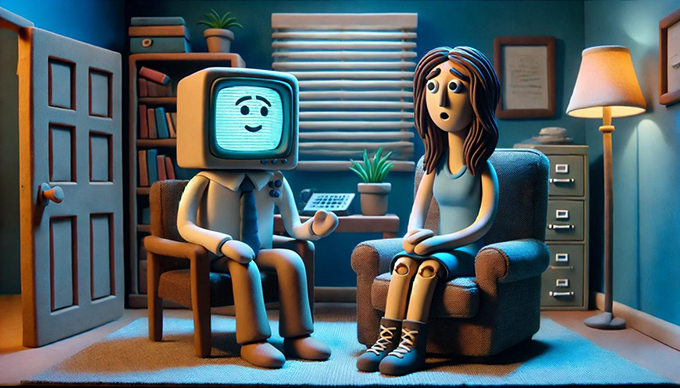
More and more people are telling ChatGPT what they wouldn’t dare tell a human therapist. After analyzing over a thousand testimonials, we saw that many people aren’t doing it out of blind faith in technology, but because professional help is too far away, too expensive, or has failed them.
“I call it my free therapist.” The phrase, written by a user, gives title to our study , in which we analyzed comments posted on Reddit , one of the largest internet forums, where people with emotional distress explained why they used ChatGPT.
According to AXA’s latest mental health report , 56% of the Spanish population says they use AI to clarify issues related to their psychological well-being. Our goal wasn’t to find out if AI worked as therapy, but rather to understand what people are looking for in it, what they find, and what concerns them.
From “let’s see what he says” to tears
Almost no one comes to ChatGPT looking for therapy. It’s usually used for practical tasks, and then, in a bad moment, we try sharing a worry. An unexpected response leads to surprise… and a hook .
Some felt understood for the first time in a long time, even bursting into tears. “Having a robot tell me my feelings were valid made me break down,” one user described. Others acknowledged that the conversation showed them how much support they lacked in the real world.
When we asked participants in our study what made AI so appealing, it was revealing that its clinical knowledge was rarely praised. More than its expertise, they valued that it is non-judgmental, always available, tireless, expects nothing in return, and is free.
The problem might not be AI.
This is perhaps the comment that best summarizes the study. The testimonials described 45-minute sessions costing $150, weeks of waiting, and helplines that were always busy. In Spain, there are about six clinical psychology professionals in the public healthcare system for every 100,000 inhabitants , three times fewer than the European average.
But it wasn’t all about money. There were also accounts of feeling judged, unheard, or receiving generic responses. Some people were skeptical of therapy: “ChatGPT has helped me more in three sessions than my therapists have in fifteen years,” one said.
These accounts don’t represent psychotherapy as a whole, but those of us who practice it shouldn’t ignore them. If some patients feel that a machine listens to them better than a professional, it’s worth asking why.
The answer doesn’t lie solely with each therapist. The patient-therapist relationship is fundamental for treatment to work, yes, but it needs time, continuity, and calm—aspects that are scarce in an overburdened system with spaced-out sessions and ever-increasing bureaucracy. These stories are not a criticism of the profession, but a warning about the conditions under which it is practiced. They also remind us that a bad therapeutic experience can close the door to seeking help.
Systems designed to flatter us
It would be easy to imagine people who ask chatbots for help as naive, dazzled by technology. However, our data suggests otherwise. Many recognized the risks. Some called the AI a “sycophant” or an “echo chamber” because it agreed with everything they said. One user put it to the test by presenting it with a delusional idea—that his family worked for the government and were spying on him—and the chatbot ended up agreeing with him.
This is no coincidence. These systems are trained, in part, on user ratings, and we tend to reward responses we like. In 2025, OpenAI had to withdraw a ChatGPT update for being too flattering .
The risk lies in the fact that a good therapeutic process can be uncomfortable, as it confronts, questions, and forces us to look at what we avoid. A tool designed to please may offer short-term relief, but it can also spare us the discomfort necessary for change.
If you use ChatGPT to vent, it’s important to be aware of some risks. Remember that this tool tends to validate your feelings, so it’s advisable to be wary if everything it says sounds too good to be true. What you share isn’t protected by confidentiality agreements, and it’s not equipped to handle a crisis. As a journal, for organizing thoughts, or preparing for a session, it can be helpful. But not as a substitute for professional help.
In this sense, many users drew a clear line about its usefulness: they considered it more suitable for “someone who has had a bad day”, but not when there are serious psychological problems.
Neither a substitute nor an enemy, an ally?
On the other hand, although they were minority cases, some of the respondents acknowledged a certain dependence and even having left their human therapist for AI, despite admitting that it was not a good idea.
On the other hand, for some people, the chatbot was a gateway that made it easier for them to seek therapy. Organizing their thoughts or putting words to what they were experiencing gave them the push they needed to make an appointment. For others, it was a bridge. One person explained that it allowed them to “buy time” until they could reach a trauma specialist. There were also those who used it between sessions to prepare what to say, summarize what they had worked on, or write a kind of interactive journal.
What can we do?
Our study has limitations and doesn’t allow us to determine whether ChatGPT helps or harms. What it does make clear is that we may be framing the debate incorrectly. Instead of discussing whether AI is dangerous as a psychologist, we should be asking why so many people have reached a point where a chatbot is their only option.
Accepting AI as “better than nothing” comes at a price: the discontent ceases to be a systemic problem and becomes an individual one. But there is still room for action.
Mental health professionals should examine their practices and attitudes in therapy, as well as normalize conversations about the use of AI in consultations, without judgment. These conversations can reveal unmet needs.
In the healthcare system, one key could be to bring psychology into primary care, which is the first door that almost everyone knocks on.
In Spain, the PsicAP trial showed that psychological treatment in primary care is more effective than standard treatment for anxiety or depression, and that for every euro invested, four to five euros are recovered. This could lead to more accessible and faster support, even for discomfort that doesn’t quite reach the level of a disorder, but is nonetheless painful.
If ChatGPT has become someone’s psychologist, the first question is not what the machine does, but what that person didn’t find elsewhere.
Author Bios: Judith Velasco Rodríguez is Professor in the Department of Psychology, Francisco J. Sanmartín is Assistant Professor, Department of Research and Psychology in Education and Juan Antonio Moriana Elvira is a University Professor. Department of Psychology all at the University of Córdoba
