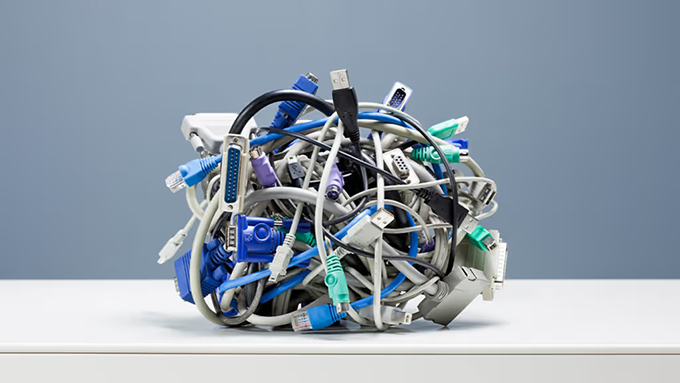
One day we wake up and realize we can’t pay with our phones, pick up our prescribed medication, or check when our train is leaving. The screens work, we have cell service, and the power hasn’t gone out. Yet something, somewhere we probably couldn’t pinpoint on a map, has stopped working.
Today, a normal life depends on systems that we neither see nor control, and often we don’t even know exist.
That happened on Friday, November 13. Thousands of people waiting to take off from U.S. airports discovered that their tickets, planes, and pilots weren’t enough to fly. The Federal Aviation Administration (FAA) had ordered a nationwide grounding of flights .
The day before , Microsoft 365 users across the globe were unable to access their emails, meetings, or documents normally . For those who needed to submit a project, attend a consultation, or get home, this wasn’t just an “IT” problem. It was a problem affecting their daily lives.
Nobody knows for sure what happened. And simply accepting it could lead us to come to see major digital outages as “normal.”
The paradox: fewer breakdowns, more consequences
The data does not, for now, support the idea of increasingly frequent technological outages. The Uptime Institute’s Annual Outage Analysis 2026 report indicates that, for the fifth consecutive year, the frequency of outages in data centers is decreasing.
In their 2025 survey , 57% of operators who had experienced a major outage estimated that the cost of the shutdown had resulted in a loss exceeding $100,000. One in five reported losses exceeding $1 million. This demonstrates that we can improve the reliability of our infrastructure—resulting in fewer system outages—while simultaneously exposing ourselves to enormous consequences when one component fails.
Therefore, it’s important to distinguish between the probability of a failure occurring and the risk it poses. The more we depend on an infrastructure, the greater the potential impact of an outage (even if the probability of experiencing it is small).
Three giants and millions of entry doors
There’s a common belief that the cloud is a virtually limitless pool of resources spread across the globe . However, according to Synergy Research Group , just three companies—Amazon, Microsoft, and Google—captured 61% of global revenue from cloud infrastructure services in the third quarter of 2026. This figure demonstrates the enormous concentration of ownership of data centers—and the cloud itself.
Efficiency plays a key role in this. Sharing data centers, software platforms , identity providers, and distribution networks reduces costs, facilitates innovation, and allows services to scale very quickly. What would be prohibitively expensive for any company to achieve on its own can be contracted with just a few clicks thanks to this infrastructure.
So where’s the problem? The problem arises when seemingly independent institutions unknowingly share the same critical component. A hospital and a bank might use different software, different servers, even different providers, but authenticate their employees through a common service, for example. If that service goes down, simply having computers powered on isn’t enough to continue working.
Digital dominoes also know how to restart
In engineering, “common cause failures” occur when a single issue affects components we thought were redundant. Having two copies of an application isn’t very useful if both require the same Domain Name System (DNS)—which translates the addresses we type into network destinations—or the same authentication mechanism… and these fail.
On the other hand, the safeguards themselves can become part of the problem. An unresponsive server triggers automatic retries, which shift the load to other servers. These other servers become overloaded and generate even more retries, creating a catastrophic vicious cycle, as happened on November 13th in US aviation . In other words, each recovery attempt can increase the pressure on the system we’re trying to save.
For example, in October 2025, a failure in Amazon Web Services’ automated DNS management in the United States affected other dependent services and complicated recovery. And in July 2024, a faulty CrowdStrike update rendered approximately 8.5 million Windows computers unusable . Although it affected less than 1% of the platform’s total users, according to Microsoft, that small percentage was enough to paralyze flights, healthcare, and financial services. The conclusion we can draw is that the size of the failure does not necessarily predict the extent of its consequences.
You don’t need a cybercriminal to stop the world
Another common mistake is associating any interruption with cybercrime or using the term “cyberattack.” These interruptions can also be caused by misconfiguration, a power outage, a software bug , or the use of outdated equipment . The effect on the user may seem identical, but the causes and solutions are different.
In Europe, the first report on serious incidents reported by financial institutions under the DORA Regulation (Digital Operational Resilience Act) recorded 3,383 cases. Approximately one-third had cross-border repercussions. But only 10% were related to cybersecurity. System failures and external factors predominated.
It is true that geopolitical pressure, navigational interference , and ransomware —cyberattacks where malicious software hijacks a victim’s data or system in exchange for a ransom—are real threats. But automatically attributing any service failure to hybrid warfare prevents us from understanding the more insidious risk: an architecture that can amplify both accidents and attacks.
Plan B cannot be in the same cloud
Digital resilience goes beyond installing antivirus software or purchasing a second copy. It means ensuring that an essential service can withstand disruption, function partially, and recover. This requires identifying shared dependencies, isolating points of failure, and rehearsing emergency procedures before they are needed.
If a healthcare facility loses access to an application, can it continue providing care securely? If digital verification fails, is there another way to identify oneself? If a company stores its backups in the same environment it has lost access to, will it be able to restore them? And, above all, have we actually tested these alternatives?
Europe has begun to address this issue. For example, the DORA regulation, applicable from January 2025, requires the financial sector to manage technological risk, test its resilience, and monitor dependencies on external providers . This represents a shift in approach. It is no longer sufficient to protect each entity separately when their risks may be interconnected.
The question is no longer whether it will fall, but what it will drag down with it.
For years we’ve measured digital success by speed, time savings, and the ability to do everything from a screen. We’ve celebrated the disappearance of paperwork, waiting times, and physical barriers. But perhaps we’ve paid less attention to what disappeared along with them. Do we have another option for moving forward when technology fails us?
A mature digital society shouldn’t promise that its systems will never fail. It should know how to keep functioning when something inevitably does fail.
Author Bio: Paula Lamo is a Professor and Researcher at the University of Cantabria
