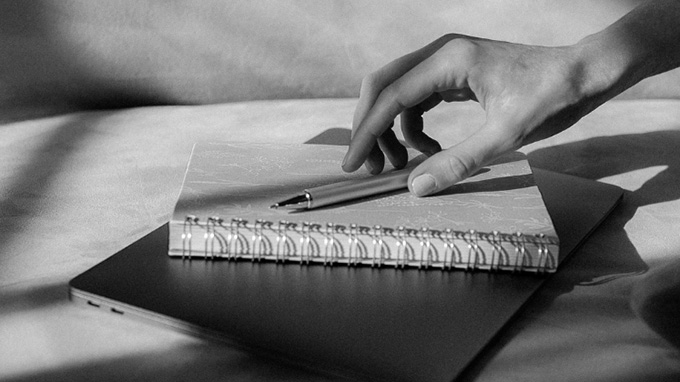
Most researchers are told early on to keep a research journal. The journal is a place to record stuff – ideas, possible lines of inquiry, potential analytic processes, quotes you don’t want to forget, reflections and responses to readings.
Journals can be digital or material. A lot of what ends up in an old-fashioned analog journal takes the form of hand-written jottings, rather than formally constructed entries. It’s a line or two about something odd in a transcript. Maybe a question that occurred halfway through a supervision meeting. Or a stray connection between two readings that do not obviously belong together. Whether digital or analog, these kinds of jottings are written to capture something before it disappears. They aren’t often even whole thoughts but gestures towards something that might take shape later.
But how often do we go back to those half-formed ideas? A journal full of jottings is only doing some of its job if you don’t reread it to see which of those jottings are worth more time.
Paul Atkinson is a fan of the notes you make about your jottings. You re-read and have a further thought and write in the margins. He calls these additional reflections marginal notes. He says:
Our marginal notes are the physical traces of thought. That is not the thought of analytic reflection in the study or in the library. It is thought captured in flight, as it were. We use such paratexts to shift our attention from fieldnotes to field-thoughts. They help us to think with and through our observations, sensations and memories.
Atkinson was writing about ethnography hence his reference to field notes. But I think that what he says holds for any research journal.
A field-thought is thinking that hasn’t yet been sorted into anything we could use or defend. It’s captured in flight, Atkinson says. A field note can be compared with analytic reflection, which is composed writing, done once we have sat down to deliberately think something through.
Analytic reflection requires revisiting material we have already encountered. Whether it is a book, a transcript a survey or a journal jotting, analytic reflection begins with a re-reading. And a decision about which field-thoughts deserve to become analytic reflection and which can stay a passing note.
Making that decision can be built into a habit rather than left to chance. Set aside time to reread a stretch of journal entries with no aim beyond seeing what is there. Some jottings will look thin on a second reading and can be left alone. Others will still have some pull to them, and it may be worth giving a small amount of deliberate attention to them. This doesn’t mean doing a full analysis. It means doing just enough writing to find out whether the thought has anything underneath it.
Here’s a few questions to help with sorting your jotted thoughts.
- Is there a feeling attached to this jotting, such as unease or surprise, that has not yet been accounted for anywhere else in my research/writing?
- Why did I think this was worth writing down at the time – is that reason still there on rereading?
- Does this jotting connect to anything else in this journal, perhaps from a different week or a different part of the project?
- Or does it connect to something Ive read or noticed elsewhere but haven’t yet recorded?
- What would it take to turn this into something substantial, and does my project actually need it?
Now, none of these questions ask you to justify your jotting. They just ask you to take a second look, at a distance, with enough time having passed that the thought can be judged on what it is rather than on how urgent it felt when you wrote it.
Some jottings will fail that test and stay as they are, a trace of a moment that did not lead anywhere. That’s fine, leaving something after reconsidering it is a legitimate outcome, not a wasted one.
If you build a habit of re-reading your jottings, your research journal will become a useful working document, something with a real purpose, with some entries carried forward into your research/ writing.
