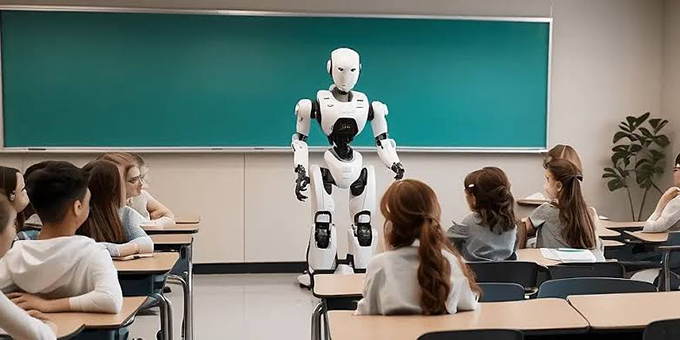
Artificial intelligence is already in university classrooms: many professors use these tools to prepare classes, design activities, and answer questions. They are also used to write student papers. Every day, this use involves making decisions that are not only technical but also ethical, and that affect large groups of people with very different backgrounds.
Several recent studies and reports have analyzed the main tensions of using generative artificial intelligence in the classroom, both for students and teachers.
Along these lines, for my doctoral thesis I investigated the perceptions of several university professors proficient in this technology regarding these types of decisions and how they affect their daily work. Both the previous research and the conclusions from my conversations raise three key dilemmas that explain why technology does not produce the same results everywhere.
1. Speed vs. fairness
Artificial intelligence is fast. It summarizes texts, drafts information, and creates questions in seconds. It can save a lot of time. That seems like an obvious advantage. However, if that speed isn’t accompanied by clear guidance, some students will ask precise questions and review what they receive, while others will accept the first result without checking. Therefore, more advanced students, or those who already master these tools, have a head start. Those who don’t may become completely dependent on the system or submit texts they don’t understand.
Protecting fairness requires teaching people how to ask questions, how to verify information, and how to detect errors. It also requires setting clear boundaries. Without such guidance, artificial intelligence can exacerbate inequalities , as the OECD warns in its report on AI, fairness, and inclusion .
2. Personalization vs. Privacy
Another promise is personalized learning. AI can recommend content or adjust exercises according to each student’s pace. This can help those who need extra support.
But to do this, it needs data. It records times, responses, and usage patterns. In some cases, it even analyzes how people write or solve problems.
At this point, a specific tension arises: the more personalized the AI-assisted support, the more information it needs to collect about the student. Therefore, the challenge lies in defining what data is truly necessary, for what purpose it is used, who can access it, and for how long it is retained, as outlined in the European Commission’s ethical guidelines for educators .
In many schools, there are no clear guidelines on this. Teachers must decide whether to use an external tool or limit the information they share. They can choose not to enter sensitive data or disable features that collect more information.
Innovation moves fast. Data protection moves slower. The dilemma isn’t choosing between innovating or not. It’s deciding how much data we’re willing to give up to improve learning. Every “tailor-made” adjustment leaves a digital trail.
Given this, a prudent course of action would be to apply the principle of data minimization: using only the strictly necessary information, avoiding entering sensitive or identifiable student data into external tools, clearly informing about the use of these platforms and prioritizing, where possible, institutional solutions with data protection guarantees, as recommended by the UK Information Commissioner’s Office (ICO) .
3. Automation vs. shared criteria
Assessment is a delicate matter. AI can detect similarities, suggest feedback, or propose an initial grade. It can also help students improve their writing before submission. This raises two questions: What should be done if it is suspected that a piece of work was created using this tool? Is it appropriate to use it for assessment?
Beyond the dilemma raised earlier (that using external platforms involves sharing student data and even a simple assignment can be stored outside the university), delegating to an automated system can diminish the teacher’s discretion if shared frameworks that preserve professional judgment are not established, as recent research on academic integrity and ChatGPT warns . Not all systems explain how they work. Nor do they respond the same way across all subjects.
Some teachers are changing their activities. They’re asking students to explain the process they followed or to defend their work aloud. Others are demanding clear rules about when and how to use AI in assessment. Without shared criteria, each classroom operates with different standards. This creates uncertainty.
Beyond individual ability
These dilemmas show that the debate cannot be resolved simply with more digital training. Even experienced teachers acknowledge that the tensions remain.
AI can improve learning and open new opportunities. But it can also widen inequalities, increase the use of personal data, and automate decisions that require human judgment.
If technology is already integrated into higher education, the next step is to establish clear rules regarding equitable use, data protection, and limits on automation, as recommended by UNESCO . Otherwise, structural dilemmas will continue to be resolved, day after day, in the isolation of the classroom.
Author Bios: Diego Fernando Avila Clavijo is a Researcher of Digital Teaching Competencies and Cristina Mercader is a Full Professor of Educational Technology both at the Autonomous University of Barcelona
