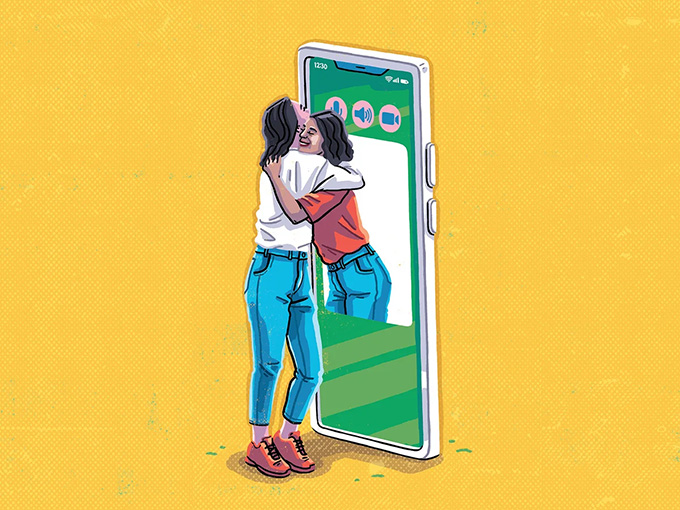
We live immersed in technology, without a doubt. Our spaces are filled with devices and gadgets that encompass a wide range of functions and sophistication. Interpersonal relationships don’t just draw from the waters of the digital age; they are immersed in them. Digital technologies shorten geographical and temporal distances, shape consumption, work, study, and entertainment habits, and introduce new ways of giving and receiving affection and attention.
Thinking about emotions in this context requires shedding prejudices and attachments to the past, and being open to new possibilities for building affective bonds mediated by technology. It’s not about displacement or replacement, but about other explorations that, although different, are already commonplace and familiar. In this sense, Javier Mercadé de Luna pointed out in 2017 :
“The internet and the other technologies connected to it (…) are our digital habitat. No one today can conceive of their life without its digital aspect. (…) the digital is our medium: a medium that acts in a totalizing way. It influences how we read, study, shop, relate to our loved ones (…), love, and conceive of ourselves.”
Digital friendships
It’s worth asking ourselves if there are differences in how friendship is perceived in digital environments. What for some signifies adaptation or resistance, for others is a spontaneous, comfortable, and even imperceptible process. For teenagers, the use of technology is a fundamental part of their daily lives, so much so that it goes unnoticed because its existence is taken for granted. Here, McLuhan’s words from 1969 are relevant:
“I call this form of self-hypnosis Narcissus narcosis, a syndrome in which man is unaware of the social and physical effects of his new technology, like a fish unaware of the water in which it swims. Because of this, precisely at the moment when a media-driven environment becomes pervasive and transforms our sensory equilibrium, it also becomes invisible.”
Paradoxically, to this invisibility we must add the omnipresence of technologies that extend through interpersonal relationships and even enable other ways of expressing affection through, for example, reactions in the form of emojis , stickers , avatars , gifs and memes as part of an iconography that synthesizes and communicates, while stimulating emotions and behaviors.
From video calls, social media interactions, and WhatsApp audio messages to virtual dates for watching movies together through apps and extensions, online multiplayer video games , viral challenges, Instagram selfies , Discord exchanges, and virtual pets, everything contributes to creating and fostering online communities where friendship, companionship, and socialization find new paths. TikTok streaks deserve special mention, as they offer insight into the dynamics that emerge in these environments.
Don’t break the streak
On TikTok, a streak is a sequence of consecutive days in which two friends exchange direct messages (videos, text, emojis ) in the chat . To activate it, you need to exchange messages for three consecutive days, and to maintain it, both must send at least one message each day so the fire emoji doesn’t turn gray. The streak is broken if more than 24 hours pass without the participants messaging each other, but it can be restarted if they resume messaging within 48 hours of it being broken.
This reveals a mode of interaction entirely based on technology. In this case, it’s an application that, while referencing a global community, allows for closer relationships between smaller groups, or even between just two people, where technology is both means and end, content and container, form and substance, structure and finish. The terms are also relevant because, as in friendship, streaks are activated, maintained, lost, and regained, indicating that they require attention, loyalty, and mutual interest . The relationship doesn’t work if it’s one-sided or neglected.
On the other hand, we find anti-friendship practices based on harassment , discrimination, bullying, and other ills disguised by current technologies. Online relationships are not without risks, abuses, and bad practices. In this sense, a critical and cautious perspective is preferable to a naive or idealistic one.
Fish in the liquid society
The passage of time can cause emotional bonds to change, shifting from a solid to a fluid state. This is one of the premises put forward by the Polish sociologist Zygmunt Bauman in his work Liquid Modernity (1999), and developed in detail in his book Liquid Love (2003), in which he analyzes the fragility of human relationships in postmodernity.
Although the concept focuses on romantic relationships and what is commonly assumed to be romantic love, its principles can be extrapolated to other types of interpersonal relationships characterized, it says, by superficiality, transience, instability, and consequently, less commitment, duration, and solidity. However, as Espíritu Ávila (2023) points out, it seems to be a state to which some adapt or go through, and not, as we have been arguing, a state specific to current generations.
“Liquid love is a subjectivity of temporary, circumstantial emotions and feelings that has to do with the desires, longings, and pleasures we want to consume in the liquid society in which we live; it is one more of the many subjective facets that allows us to give meaning and adaptation to the world we have to live in.”
These principles aim to explain relationships where technology is used as a complement or palliative, but not for those who experience it as an inherent part of their relationships. That is, not as a means, but as the very environment in which emotional bonds are formed, nurtured, and strengthened.
In this sense, technology is not an additional resource, but a central element that exists implicitly and requires no further explanation. It is implicit and understood, present and all-encompassing in the relationships of millions of teenagers in the contemporary digital environment.
The refusal to use these tools and applications represents a limitation, since they are practically an indispensable requirement to be functional and competent members of the groups and communities that are formed around technology, assumed as the fire taken from the gods around which everything happens, since it endows mere mortals with attributes that, otherwise, would be unattainable.
Author Bio: Johanna Pérez Daza is a Researcher at the Andrés Bello Catholic University (UCAB).
