Standing up from a chair five times in a row without using your arms for support seems like a simple task. However, the ease or difficulty with which you can do it, or the inability to complete it at all, can reveal a great deal about muscle strength and functional capacity. In just 30 seconds, this test shows something that doesn’t appear in a blood test: the body’s true ability to respond to everyday demands.
During consultations, blood pressure is measured and blood tests that record glucose, red blood cell, or cholesterol levels are reviewed. Muscle strength, however, is rarely assessed, even though decades of evidence have shown that it is consistently associated with all-cause mortality and provides prognostic information independent of other health indicators .
This is not an accidental omission. Historically, medicine has prioritized what can be easily measured with blood tests or imaging. Muscle strength leaves no trace on an X-ray or in a blood sample. However, its decline is one of the earliest and most silent changes of aging , and it begins long before its consequences become apparent.
The diagnosis that changes how we understand muscle
For years, the focus was on the amount of muscle. Today, the European consensus on sarcopenia (EWGSOP2) has reversed that order: low strength is the first warning sign; reduced muscle mass, only the confirmatory one.
Two people who look similar can differ radically in how they walk up a ramp or get up from the floor. Strength reflects the coordination between the brain, nerves, and muscle tissue. When that coordination begins to deteriorate, the risk of falls, frailty, hospitalization, and premature death increases , even in people who feel well and have no formal diagnosis. It’s not a death sentence: it’s a warning sign that can and should be addressed promptly.
What we discovered in more than 8,000 adults
In a study by our team involving more than 8,000 adults aged 50 to 105 , low grip strength was associated with a higher prevalence of falls, even in people aged 50 to 79, independently of other risk factors.
The study does not allow us to conclude that muscle weakness directly causes falls, but it serves as a real risk indicator even in middle age, not just in advanced old age. The effect was visible before formal diagnoses of frailty or sarcopenia, a disease characterized by the progressive loss of muscle mass, strength, and function, were available.
In terms of public health, this highlights a broad and often overlooked window of opportunity for intervention between the ages of 30 and 65, when functional decline can still be effectively reversed or slowed. Waiting until getting up from a chair becomes difficult before starting strength training is simply waiting too long.
The signs we ignore every day
Grip strength measured with a dynamometer is a quick, inexpensive, and clinically valuable test—something that could be included in any routine medical examination. Standing up five times from a chair without using your arms for support is another simple and reproducible indicator that doesn’t require specialized equipment.
But there are even more everyday signs: using armrests to stand up, avoiding stairs, carrying fewer bags than before, walking with a certain instability. These are often attributed to “age,” but in many cases, they mask a diminished functional capacity that can still be recovered and shouldn’t be lost in silence.
Added to this is a little-discussed effect: when the body feels insecure, the person tends to avoid strenuous situations. And this reactive sedentary lifestyle accelerates precisely the deterioration they were trying to avoid. A vicious cycle that, with the right intervention, can be broken.
Walking is good, but it’s not enough.
Walking improves cardiovascular health and helps you stay active. But it doesn’t always provide the necessary stimulus to maintain or develop muscle strength, which requires something more: resistance, endurance, deliberate effort.
In addition to preserving muscle mass and function, strength training improves bone mineral density, reduces the risk of type 2 diabetes, and has documented positive effects on cognitive well-being and mood. The World Health Organization recommends working the major muscle groups at least two days a week.
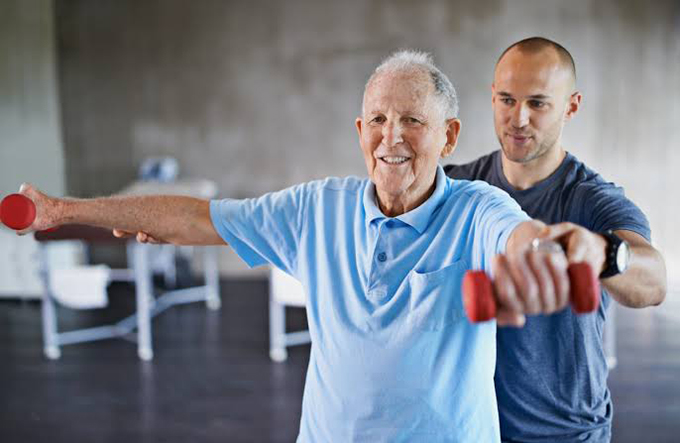
You don’t need a gym, you can do strength exercises at home or in a park: dumbbells, elastic bands, your own body weight or movements integrated into daily life, getting up and sitting down, pushing, pulling, standing on tiptoes are valid and accessible tools for most people.
What matters is that the exercise involves real effort, is performed with good technique, and progresses gradually. Evidence accumulated in recent years supports different approaches: the program doesn’t have to be complex to be effective.
A dose that must be adjusted to each person.
There is no one-size-fits-all routine. Intensity, volume, and progression must be tailored to each individual’s prior experience, health status, and goals. In cases of prolonged sedentary behavior , chronic illness, pain, or a history of falls, the prescription and planning of the training program should be supervised by a licensed professional in Exercise Science and Sports Science, in coordination with the healthcare team when necessary.
The good news is that muscle tissue has a remarkable capacity to respond to stimuli, even in advanced age . The benefits of strength training are seen in people aged 60, 70, 80, and even 90. Biology doesn’t close that door: we close it when we stop knocking.
People are living longer than previous generations. The challenge is no longer just adding time to life, but maintaining functional capacity and the autonomy to decide how to use that time. Muscle strength isn’t just for lifting weights. It’s for keeping us upright.
Author Bio: Pablo Jorge Marcos-Pardo is a University Professor at the University of Almería
