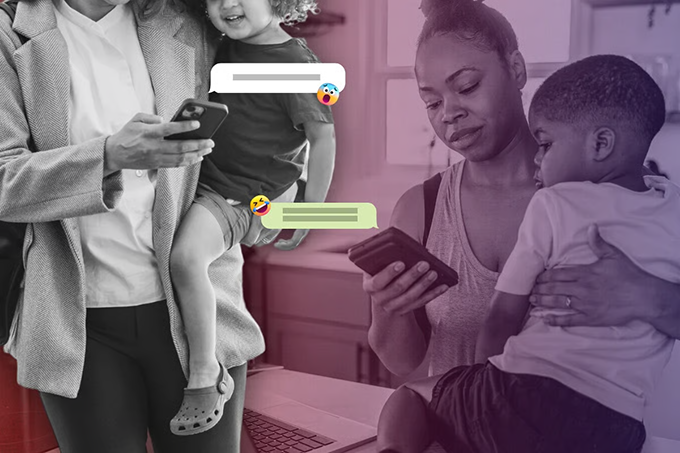
Miguel, a father of three, arrives home at the end of the day and, while preparing dinner, quickly checks his mobile phone. Among the various notifications, one stands out as particularly active: the WhatsApp group ” The Best Kids at School .” Upon opening it, he discovers that more than 150 messages have accumulated in just one hour.
It all started with a seemingly simple question: “When do we have to bring in the model of the planets?” Within minutes, a flood of answers of all kinds appeared. Some families remembered one date, others thought it was a different one. Soon, new questions arose about the size of the model, the permitted materials, whether it should be done individually or in groups, and whether it was mandatory to include all the planets of the solar system.
What had begun as a simple inquiry ended up becoming an extensive conversation in which correct information, personal interpretations, and new questions coexisted.
Digital communication and the school community
A few years ago, a question about the science project would probably have followed a very different path. Miguel would have waited until after school to ask another family or written the question in his planner to ask his teacher the next day. The answer would have come later, but also with fewer intermediaries.
Today, the same question about when to hand in the model of the planets, what materials to use, or whether the entire solar system should be included can generate dozens of messages, opinions, and new questions shared simultaneously by a large group of families in a matter of minutes. Information circulates faster than ever, and the challenge is to ensure that understanding and context are not left behind.
New spaces for interaction
Digital communication has created new spaces for interaction. In the case of schools, instant messaging groups (whether WhatsApp, Telegram, or other options) serve useful functions such as sharing information, resolving everyday questions, organizing activities, and, in short, fostering support among families. They often enhance mutual support and community collaboration.
However, research on digital citizenship warns that these new communication environments can also generate complex dynamics that require careful reflection. Constant connectivity fosters participation and collaboration, but it can also lead to social pressure and difficulties in interpreting messages accurately. Along these lines, Daniel Innerarity, in * A Critical Theory of Artificial Intelligence*, warns of the challenge of managing increasingly accelerated, automated environments conditioned by digital dynamics that affect how we interpret reality and relate to others.
How can WhatsApp groups for families contribute to or undermine school coexistence?
Immediacy and loss of context
Digital communication is fast, but this speed fosters biased interpretations and emotional amplification that is difficult to contextualize. Everyday situations that likely required more time, nuance, or even a direct conversation end up unfolding in environments conditioned by immediacy.
When the conversation moves faster than the possibility of verifying the information, the perception of uncertainty tends to multiply.
Furthermore, written communication eliminates essential elements of human interaction, such as tone of voice, gestures, and certain emotional nuances that emojis cannot capture. A short sentence can be interpreted differently by the recipient, and messages sent with constructive intent can produce unexpected effects. Technology facilitates connection, but connecting doesn’t always mean communicating better.
Effect on relationships in the educational environment
Although these digital spaces are populated by adults, their communicative dynamics can indirectly affect the students.
Children are not immune to the emotional climate that develops in family, school, and digital environments. When certain communication patterns persist, some children and adolescents may experience feelings of anxiety and vulnerability.
It’s not hard to imagine a girl arriving at school worried after overhearing comments at home about an argument between adults regarding a school activity or a conflict between classmates. Subconsciously, the emotion conveyed is more intense than the information actually understood, creating distress where perhaps there was only a temporary concern.
Biased perceptions
There is also another particularly delicate aspect: the construction of collective perceptions about school situations or conflicts without always having all the necessary information.
A seemingly innocent phrase like “I don’t think there will be a trip to the Planetarium after all” is enough to spark a lengthy online dialogue. What begins as an isolated comment ends up generating questions, interpretations, and alternative explanations that quickly circulate among families.
Inevitably, collective perception is formed even before information has been verified. Understanding these dynamics requires looking beyond technology and focusing on the responsibility each person assumes in shared spaces.
Digital citizenship and communicative co-responsibility
It is pertinent to propose the idea of digital civic leadership to refer to the responsibility that people assume in shaping online interaction spaces and in building communities based on trust, respect, and co-responsibility.
This refers not only to the formal leadership of institutions or management teams, but rather to the capacity any individual has to influence shared spaces, including virtual ones. Families play a significant role as role models for digital citizenship.
Research on psychosocial relationships shows that communicative contexts based on cooperation, respect, and co-responsibility promote prosocial behaviors in children , such as empathy, mutual help, and caring for the well-being of others.
Educating also in the way we communicate
Education doesn’t just happen inside the classroom. It’s also built through everyday relationships and the interaction patterns students observe in their immediate surroundings.
In a hyper-connected society , digital identity begins to take shape at increasingly younger ages. Children gradually learn that the way they communicate and interact in virtual spaces has emotional, social, and relational consequences. And they learn, above all, from their parents, teachers, and by observing them how to manage misunderstandings or respond to certain complex situations.
To help them develop skills related to online empathy, communicative responsibility, critical thinking, and awareness of the impact digital interactions can have on others. What should a parent do in their communications within school groups?
Often, small communication decisions can contribute to improving digital coexistence: verifying information before sharing it, avoiding impulsive responses, resorting to direct conversation when a situation requires it, and remembering that behind every message there are people and circumstances whose complexity we do not always know.
Author Bio: Laura Gasco Captain is Associate Professor (Theory and History of Education) at King Juan Carlos University
