
A week or so ago, I posted a little mini rant there about the humble em dash, complaining that it has become an AI ‘tell’ and that I was self censoring to avoid adding them:
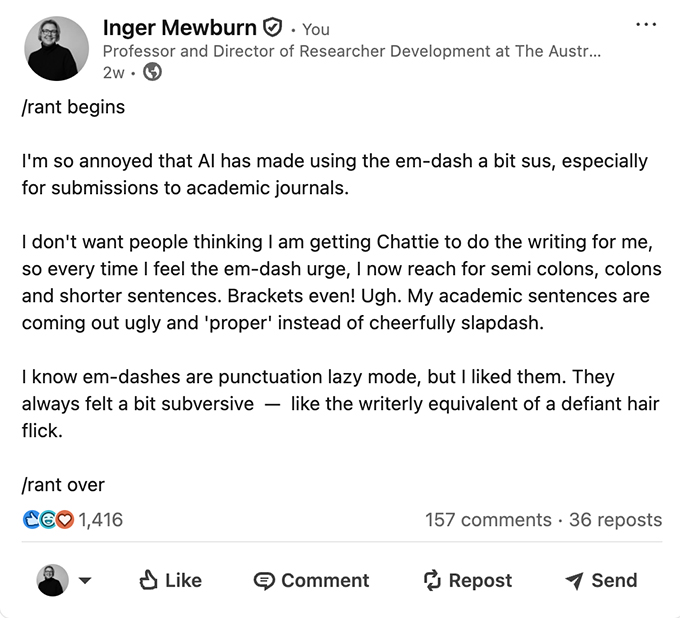
Look at those stats: I went LinkedIn viral! The most social media excitement I’ve had in a single day since I quit Twitter in 2023. (Everything is so terrible).
I’m not surprised I hit a nerve. As my friend Pat Thomson is fond of saying: “writing work is identity work”. How we write is almost as important as what we write. And not all punctuation is created equal. A well placed semicolon helps you join two closely related thoughts; it adds erudition and a touch of class to any sentence. I like to think of a colon like a drumroll: telling the reader the next part of the sentence matters. By contrast, the em dash is punctuation easy mode—it lets you add a thought wherever you like, without having to declare exactly how it relates to what came before.
(Full disclosure: I had to get ChatGPT to help me refine those sentence jokes. I had a 70s education and I’m quietly convinced my grammar teachers were smoking weed to cope with teaching year 9 English).
To the trained eye, a lot of em dashes in a piece of academic writing can signal an untidy mind. Maybe that’s why AI bloody loves them. Some claim AI’s em dash preference is the result of companies using exploited labour in Africa (not strictly true apparently, but it might explain why the word ‘delve’ can appear frequently). A more plausible explanation is machines have ingested a lot of journalistic writing on the internet and, possibly, essay writing by my fellow grammar-challenged humans.
I’m with AI on this one: I bloody love an em dash too. I love them because they’re sloppy (and maybe because my mind is untidy). The em dash leaves it up to the reader to decide how the ideas might relate to each other: one of the reasons they are big in poetry (AI being a problem poets now have to grapple with too. Is nowhere safe?).

In my Linkedin post I confessed to self censoring to avoid using em dashes, despite my love of them. I want to avoid looking like I used ChatGPT when I didn’t… but I also take em dashes out of stuff I do generate with ChattieG. I write the odd internal facing document to assist decision making in the university. I happily serve up good quality AI slop to committees because I seriously doubt anyone reads my briefing papers. I’m a professional, so I make sure they are good quality slop (and include disclaimers) but I feel no shame admitting I outsource this stuff to AI. I’d rather save the limited energy I have for writing for this blog, or on my actual research papers.
The tiny, largely silent internal struggles around the use (or not) of the em dash have become, in my mind at least, emblematic of the problems of AI writ large. It’s just so damn hard to live with it, but increasingly it’s difficult to live without it—even if you want to. Also, it’s damn useful. Take the literature review: the starting point of many a research project. Literature reviews are astoundingly difficult to write. There is so much to read on any topic it’s impossible to be comprehensive and concise at the same time, yet that’s the expectation. AI can help speed up the process in so many powerful ways.
For the record, I hate writing literature reviews: they make me anxious. Howard Becker, in his classic Writing for Social Scientists, diagnoses the reasons for my anxiety by describing literature reviews as a ‘scholarly defence ritual’. A well sourced literature review shows you are in possession of the facts and informed about the best opinions on the topic. Basically the ritual of the literature review is designed to defend you from future attacks by critical readers.
The problem with this defensive mind set, Becker argues, is that you feel like you must to read everything before you start writing. Despite over 25 years of experience, I still fall into defensive mode. I’ve lost count of the times I’ve got ‘stuck’ on literature review because I try to find everything remotely relevant, immediately feel daunted by the reading burden and abandon the paper altogether.
Until now, I have relied on Becker’s advice to ‘just write’ without looking at the literature at all. Of course, before I ‘just write’ I read widely, take notes and generate ideas. I start drafting a paper by transforming each of those ideas into a sentence with a verb.
For example, I’ll start with something like:
“Many argue that PhD students shouldn’t use AI because of the risk of deskilling”.
Then I look back in the literature I’ve gathered to see who, if anyone, agrees with my idea. If they do, and I think the evidence they give is solid, I cite them. If I can’t find anyone to back me up, I go on another hunt. If the hunt is fruitless, I change what I said—or delete it. Very occasionally I leave in an unsupported idea and tell the reader I will prove it later with my data.
In order not to get stuck reading and hunting through my notes at the end of every sentence, I stick a bit of place-holder text and keep writing, like this:
“Many argue that PhD students shouldn’t use AI because of the risk of deskilling” (ref? Mewburn I think?).
Becker’s method is basically “make a mess and then clean it up”. In practice, ‘cleaning up’ is a huge amount of work. The method of ‘just write’ works to get around analysis paralysis, but it’s terribly time consuming. The problem is the ‘technical debt’ of due diligence on all those (ref?) placeholders. To finalise a draft I must spend a LOT of time searching through my Obsidian and Zotero databases for exactly the right reference to defend a sentence. It takes even longer to work out which sentences are not defensible and must be junked or changed.
I now use NotebookLM for literature reviews, which has completely transformed my practice.
NotebookLM was developed with input from one of my favourite non-fiction writers, Steven Johnson. That writerly sensibility is deep in the digital bones. You simply add your own documents, notes, links and readings into a Notebook space. Then Google’s Gemini model helps you search across them, summarise them, spot patterns and make connections. The important thing is the fence around the paddock: NotebookLM is working inside a source environment you have curated. (Full disclosure: ChatGPT helped me with this paragraph and the paddock metaphor – I really struggled to explain the difference between NotebookLM and a Chatbot for some reason).
I now spend a lot more time reading and carefully curating the list of articles relevant to the task at hand before starting. I have let go of my forensic note taking systems in favour of writing random thoughts and ideas in Obsidian, or speaking into the notes app on my phone. I find this freeing, honestly: I am not always worried about how to match my thoughts to the text so that I can find the connection later. When I am ready to write, Becker Styles, I pile all the notes and papers into the Google LM interface and start working.
Sometimes I start with a description of the theme or idea I want to write about and ask it for the papers in my pile that might help, like so:
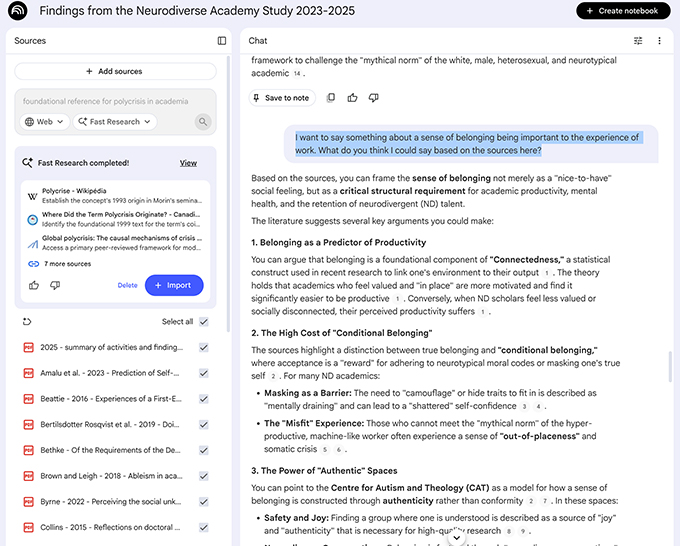
This kind of move challenges my initial ideas. It’s a bit like talking to a really smart research assistant who hovers next to my elbow, reading over my shoulder.
Other times, I dump in the sentence I have written and ask which source is a good back up. I can hover over the little ‘footnotes’ in the text and read exactly which parts of the papers it thinks are a good match:
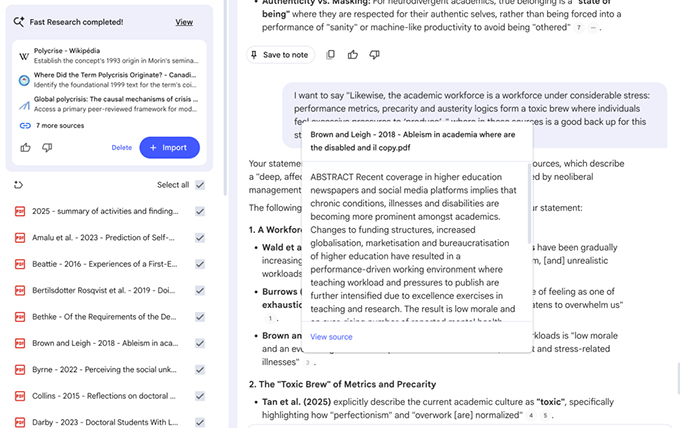
This ability to go right to the bit of the document that is potentially useful is a total game changer. I can punch through a literature review in about half a day this way—it used to take me weeks and weeks, with a high chance I would abandon the task altogether. The downside, I guess, is that I no longer rely as much on my own brain to make remember what I read. But I am less worried about writing a sentence I can’t prove and the ‘technical debt’ of having to rework or junk it, so I am more willing to try out ideas.
Building a useful workflow like this requires knowledge of the tools AND the kind of work that needs to be done. It’s but one example of about 40 I use within an average work week. I’ve measured my time on task and I’m saving at least 12 hours a week, maybe more. Some workflows are bespoke to a person and the way they work, others are generic. I do workshops for PhDs though to Professor to help people replicate my tool sets and stacks. I’ve done heaps of these over the last three years: at ANU, outside ANU through On The Reg Team (get in touch with Jason via the webpage if you are interested).
I also try to teach through my writing on Thesiswhisperer (see here, here, here and here) and in my books. Recently, Katherine Firth and I completed a rewrite of ‘How to Fix Your Academic Writing Trouble’ to include judicious use of AI — it has a lovely new cover too:
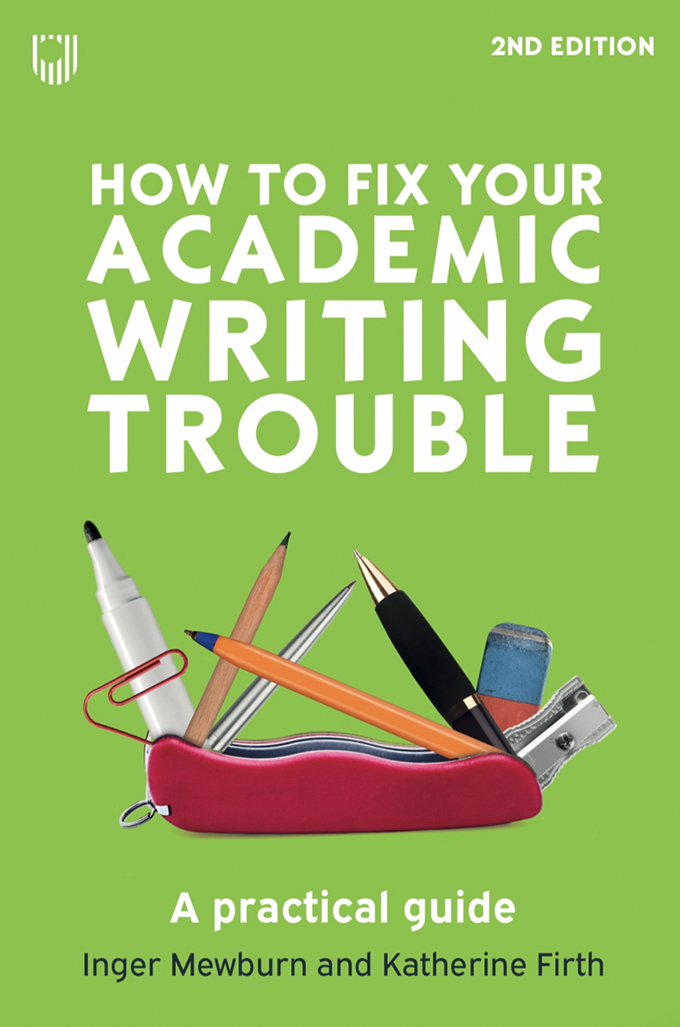
(Shameless plug: you can sign up here if you want release news and discount code when it comes out)
But, to get back to my point about em dashes and the unbearable lightness of AI assisted thinking: do you HAVE to use something like NotebookLM or be left behind in the academic productivity arms race?
Maybe.
The contemporary academic workplace is highly competitive and time is limited. My use of AI means I no longer do overtime on the weekends just to keep up. For the beleaguered postdoc or overworked middle manager, AI has the potential to bring a bit of sanity and balance back into a working week.
But when it comes to the PhD? Is this kind of use ok? Maybe. The problems start when the machine tries to help. It’s so primed to be a useful tool that it will start to do the thinking for you, in the case of ChatGPT, often without you even asking. The line between the machine generated ideas and your own can quickly become blurry. In the hands of a professor like myself, maybe that’s ok, but when you are studying for a PhD? Shouldn’t you learn to think on your own, unassisted?
And what about writing itself? Is it ok to put a bunch of thoughts in the machine and as it to make it into prose? The academic genre is awful to read and worse to teach. If a machine does it better, why bother? Is teaching academic writing a bit like teaching long division – well meaning, but ultimately pointless? These are the questions that are keeping me up at night at the moment (along with the menopause).
I share my enthusiasm and write about AI hacks here because my aim is to create the digital equivalent of a safe injecting room. PhD students are smart and curious. Some (most?) are going to use the technology at one point or other. My job is to help them think through uses without deskilling themselves or opening themselves to a research integrity investigation.
Lately, however, I feel like a person who makes sure drug users have clean needles watching people take ketamine overdoses in front of them.
At a recent new PhD student induction at ANU, I told a room full of newbies that we can take their PhD off them if they are found to be in breach of research integrity rules, which now include transparency about their AI use. We can’t reliably detect AI generated text now, but it doesn’t mean we won’t in the future. Your PhD dissertation will be put online. Anyone —a jealous colleague or jilted lover—can download it and put it into a future hypothetical tool (Or, you could be blackmailed with evidence of your AI chats… and if you don’t think blackmail can happen in academia, read this and have a stiff drink). If you lose your PhD in the future, might you also lose your job? This has happened.
I could feel the mood in the room change when I planted this scary thought in their brains. Many had exposure to and used AI during their undergraduate or Masters degrees. I suspect a whole lot of people had been sitting there, thinking they had the difficult writing stuff figured out until I burst their bubble. After this talk, a student approached me and admitted he had been using AI to read papers and summarise them because he didn’t particularly like reading. He asked if this was ok and, honestly, I had no words. I don’t like writing academic papers and, if I’m honest I don’t particularly like reading them either, but … that’s the job? The P in PhD does not stand for ‘Prompt’.
In 2023 I remember telling a room at the Australian Tax Department my worst fear would be that we would be illiterate in 20 years time. I fear I vastly underestimated how fast this would happen: we’re seeing it already. As a professor, I am somewhat insulated from the true extent of use of AI at my university. People don’t want to tell a person in a position of authority they might be doing something naughty. I still hear stuff though. Colleagues, team mates and other students tell me what the know people are doing. For the record: giving ChattieG a list of dot points and telling it to ‘make it academic’, then putting it in your dissertation and not telling anyone is a breach of academic integrity at ANU. Yes: even if it’s ‘your own thoughts’. If you used it to write your PhD proposal to get into ANU, you are already starting out on the wrong foot.
And it’s not just PhD students that are being reckless! Recently, a prominent Australian academic was shamed in public for writing a newspaper article about, ironically, the perils of using AI instead of thinking for yourself. This case was a good example of how AI ethics are contextual. From subsequent reports, she probably used a process somewhat like I described with NotebookLM above. Using a tool to assist a literature review does not break university guidelines (although using it to actually write the piece and not disclosing might be—the press report is unclear on the extent of use). However, she did breach the newspaper’s guidelines, leading to the article being pulled.
You only have one reputation to lose with inappropriate AI use. This is why I have always disclosed my use on this blog, even though I don’t have to. But you also take a risk if you become too dependent on machines to write.
Just yesterday I heard about people using AI to write their PhD proposal, getting a year into program and struggling so much they can’t continue. Their prompt based writing got them all the way through an undergraduate degree, so they simply never developed the skills in writing necessary to start a PhD. But I think the problem is really a lack of developing the right kind of thinking process. Writing work is not just identity work: writing helps us organise thought. When we write, we are forced to put ourselves in the mind of our reader and argue for our ideas and theories.
It’s worrying that the proposal is not a reliable tool for recruitment, but it’s somewhat reassuring that a talent for prompting doesn’t take you all the way through a PhD. But soon I will be dealing with people who have used AI since high school and I’m going to have bigger problems than the em dash to deal with…
Tell me how many years there are to retirement again?
