THE ESSENTIALS
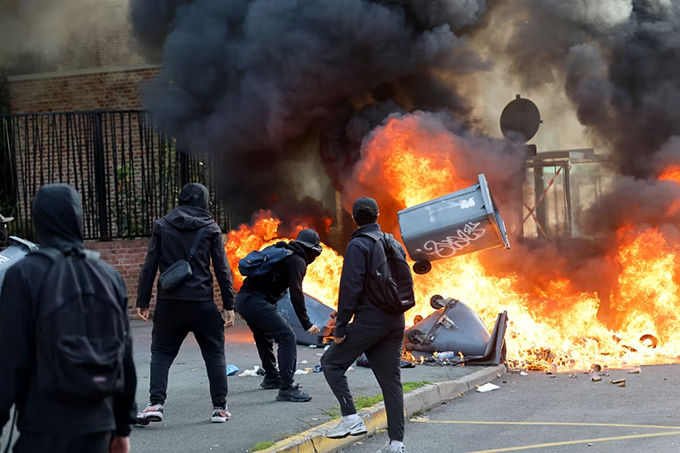
- In France, the autumn of 2026 is marked by a social movement punctuated by scenes of rioting, looting and clashes with the police.
- These scenes, strongly condemned by many media outlets and politicians, are likened to an incomprehensible act of violence targeting the Republic.
- Sociology explains the reasons for the riots and the anger they express – without condemning or excusing them.
Beginning in mid-September with the high school student movement, the nationwide protests in France have steadily intensified, marked by acts of vandalism and violence, particularly on October 17th. The executive branch felt compelled to draw a clear line between “good protesters” and “rioters,” whom Prime Minister Sébastien Lecornu categorized as belonging to the “camp of violence .” President Emmanuel Macron, in turn, questioned: “What are they thinking? How can French people do this to France?” This “riotous irrationality” justified the use of the utmost firmness , and to this end, the government did not hesitate to employ counter-terrorism measures .
Since the turn of the 20th century , sociology has made it possible to explain —without excusing or condemning—riotous motives as the expression of anger whose socio-economic roots cannot be reduced to senseless and irrational violence. If sociology were given even the slightest consideration in public debate, it would offer answers to political leaders.
Anomie rather than barbarism
Street demonstrations in the modern sense took shape in France during the 1880s and 1890s , in a Third Republic marked by the recent memory of the Paris Commune (1871), as well as by ongoing social conflicts (from workers’ strikes to Boulangist populism, culminating in the Dreyfus Affair) . Faced with these expressions of anger, conservatives of all stripes agreed in denouncing the irrationality, violence, and ultimately , the dangerousness of protesting crowds, most often likened to hordes as primitive as they were barbaric .
Among intellectuals, one of the dissenting voices was that of Émile Durkheim . As far removed from revolutionary Marxism as he was committed to defending a republic weakened by dissent, the founder of French sociology envisioned society as a social body whose health lay in its capacity to articulate, or “integrate,” its members— bound to this greater “whole” by the strength of institutions and their social ties . The opposite led to “anomie ,” which Durkheim conceived as a pathological state of deregulation and a normative void capable of causing the collapse of the institutions responsible for maintaining cohesion.
While remaining conservative in its view of republican power, this perspective does not place the responsibility for anomie solely on protesters or the excluded; primarily collective, this responsibility lies with the social body, which fails to guarantee the “proper integration” of society as a whole. Republican power is thus called into question, as much as, if not more than, the groups experiencing the ordeal of social disintegration. This idea of proper social integration , in the sense of a whole protected from the fissures of anomie, stands in stark contrast to the one found in many public debates where the most conservative voices demand that the most marginalized better integrate into a society toward which the accused individuals are supposedly failing.
After a brief period of neglect in the early decades of the 20th century, the American sociologist Robert K. Merton revived the concept of anomie in the 1930s , incorporating it into his explanatory framework of the tensions between culture and social structure . According to him, anomie arises from a disconnect between the cultural goals assigned by a society—such as material success in the West—and the institutionalized means available to individuals to achieve them. Because these means are unequally distributed, the most disadvantaged groups experience a structural gap that generates tension between culturally valued aspirations and the objective chances of fulfilling them ; rebellion is then one of the possible consequences of this frustration, which manifests itself daily.
The riots and looting that engulfed England in 2011 following the death of Mark Duggan—a young Black man killed in Tottenham during a police check —could thus be interpreted as a “Mertonian moment .” Rebellious anomie did indeed spread to neighborhoods and among groups within the British population most structurally distant from socially valued models of success . Sociologist Zygmunt Bauman extended this explanation in his own way. He saw the English rioters as “supernumeraries,” or outcasts of a consumer capitalism whose looting was not intended to destabilize it; rather, it was a matter of participating in it, even if by breaking and entering .
The idea stems from the following observation: breaking a shop window to steal coveted goods amounts to fraudulently seizing merchandise that society has fetishized, while simultaneously conditioning access to the power to purchase them . In burglary, this latter act is both literal and symbolic; literal because a shop door is forced open, symbolic because it also represents forced entry into the consumer community. According to Bauman, it is therefore less the power to buy that is contested than the power to consume that is claimed, despite the illegality of the means employed. We can go further and see these means as a way of restoring, if only momentarily, the socioeconomic balance in favor of those for whom it always tips unfavorably . What, then, of the violence inherent in such acts? Are they the cause or the effect?
What is violence the name of?
The mobilization of the concept of anomie allows us to question inequalities and, therefore, to explain the reasons for the riots by relating them to structural causes that break with the stereotypes of the irrationality of “barbaric hordes .” However, while the idea of ”structural violence” is certainly present implicitly, it is neither formulated nor confronted with the actual violence that a large part of the media and politicians accuse the rioters of.
This approach of attributing violence solely to the riot, without questioning the responsibility of the state and its police forces, reveals an asymmetry in (dis)qualification that can be understood through the lens of sociologist Pierre Bourdieu . It expresses the power a hegemonic order arrogates to itself when it names, classifies, and seeks to impose its vision of reality. Such power is grounded in the hierarchies that dominant groups assign to the dominated ; thus, the former exert a violence on the latter that is as structural as it is invisible and silent—an “inert violence,” always already present, as if inscribed in the order of things .
This inertia acts as an erosive force, gnawing away at the ambitions and will of the subaltern, most of whom, according to the sociologist, end up internalizing this sense of inferiority attributed to them by the dominant order. This is what Bourdieu calls “symbolic violence,” which he describes as a trivialization, or a form of unconscious acceptance, of the structural violence that inscribes social suffering and injustice at the heart of our lives . Until the moment this reality becomes unacceptable …
From this perspective, a riot can be described as a symptom, or a somatization, of everything that can no longer be accepted ; it being understood that the unacceptability lies less in the riotous acts themselves than in the cycle of social and structural violence that led to them . This is what sociology allows us to demonstrate, and this is how it attributes a political significance to the riot as an outburst of an expression as embodied as it is unrestrained : that of groups whose right to citizenship, and sometimes even to existence, is denied .
Author Bio: Jérôme Beauchez is a Sociologist and Anthropologist at the University of Strasbourg
