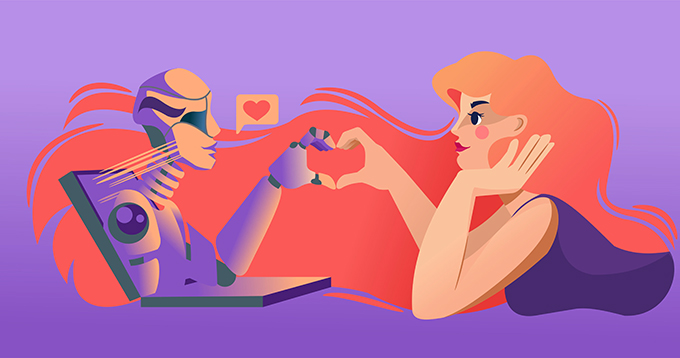
More and more people are talking to artificial intelligence (AI) systems as if they were friends, advisors, or confidants . Some users turn to chatbots for psychological help, and many rely on conversational assistants for tasks that were previously reserved for human experts.
We stopped considering these behaviors as oddities a long time ago. However, perhaps we haven’t given enough thought to whether what lies on the other side of that interaction deserves recognition or moral status.
Who matters morally?
Having moral status refers to the degree of moral consideration given to beings. If we recognize this status, we must take their well-being into account when making decisions.
A highly influential way to answer the question of who matters morally is to determine that something deserves moral consideration only if it possesses a certain property. Rationality, conscience, autonomy, or the capacity to feel pain help us define who belongs to our moral circle.
From this perspective, answering the question of AI’s moral status seems relatively straightforward. Large language models like ChatGPT or Gemini generate sophisticated texts and simulate complex human conversations, but there is no solid evidence that they do so intentionally or that they are aware of it. Nor is there any proof that they are conscious or capable of suffering. Consequently, these new technologies do not warrant any moral consideration. They are highly advanced tools that we may be too easily enamored with.
This position has intuitive force. However, when we consider how our moral circle has expanded throughout history, it proves less accurate. In practice, progress has rarely begun with the discovery of “hidden” properties in entities that did not merit moral consideration.
From properties to relationships
Let us consider two great historical examples in which the moral circle was expanded: the abolition of slavery and the inclusion of animals in our moral sphere.
In both cases, the recognition didn’t arise suddenly. No one “discovered” that certain beings possessed morally important properties. Human beings knew that enslaved people had always been rational and conscious . Their suffering was also very evident to many people. We also knew that animals were capable of suffering . However, for centuries this knowledge went hand in hand with extreme forms of moral exclusion toward these groups.
A fundamental change involved the relationships between these two oppressed groups. Enslaved people, for example, were gradually integrated into work, religious, and domestic spheres. This occurred before the moral revolution that precipitated the abolition of slavery. Although they remained legally excluded, and although their treatment in almost every context was inhumane, they began to occupy morally significant roles within the social fabric . And thus, relationships began to be reconfigured toward greater equality.
Although there are significant differences, we can trace similar dynamics in the case of animals . The difference in the moral consideration we assign to a domestic dog and an industrially raised pig cannot be explained by their “properties.” Both possess comparable cognitive and sensory capacities. What changes is the type of “relationship” we maintain with them. Dogs are part of our homes, at the center of strong emotional bonds and care practices. Pigs, on the other hand, are usually confined to impersonal industrial structures. Again, it is relationships that seem to explain how moral consideration is articulated and distributed.
AI is already relationally integrated
In a recently published article , we described this general phenomenon using the concept of “relational embedding.” Relational embedding describes how certain entities begin to occupy morally significant positions within human practices, institutions, and relationships without being assigned full moral status. When we consider this phenomenon, our interactions with artificial intelligence become particularly interesting. Current AI systems are not simply invisible tools operating in the background; they participate in and embed themselves in the spaces where we interact, such as homes, schools, and hospitals.
Social robots used for elderly care offer another clear example . Although they don’t possess real emotions, many people develop genuine feelings toward these technologies . Something similar happens with chatbots. Some users interact with ChatGPT as if it were their counselor, personal assistant, or even their partner or friend. Others confide personal problems in them, seek psychological support, or consider them “experts” in their daily lives.
Of course, the fact that these two technologies are already embedded in numerous relationships and institutional contexts does not imply that we should attribute rights or moral status to them. But it does indicate that partial, localized, and tentative forms of moral recognition are beginning to emerge. And these tentative forms of recognition are similar to those we have observed in other historical episodes in which we have expanded our moral circle.
What kind of relationship do we want to establish with AI?
Discussions about the moral status of AI cannot be resolved by questioning the properties of these new technologies. The history of moral progress shows us that ethical recognition does not arise from such abstract questions . It arises from numerous changes in the way we coexist with certain “entities . ”
Our moral compass has never been static. It has continually transformed as new forms of relationship, dependence, and coexistence have altered institutions and collective sensibilities. Artificial intelligence could become the next arena in which this transformation plays out once again.
Ultimately, the debate about the moral status of AI isn’t just about machines. It’s also about ourselves: about what kinds of relationships can enable us to continue expanding our moral circle.
Author Bio: Antonio Gaitán Torres is Full Professor in the Department of Humanities at Carlos III University
