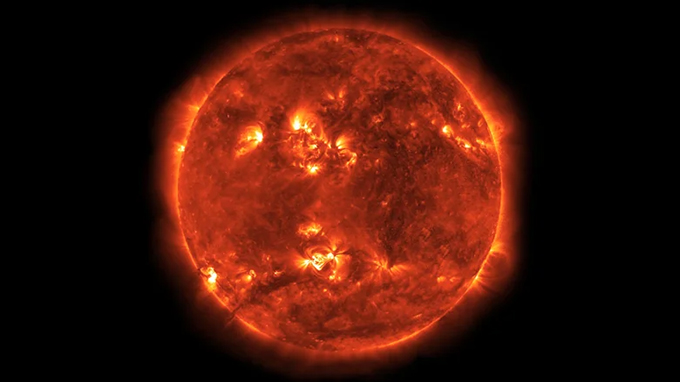
The death of the Sun is a distant but inevitable event. Understanding what will happen when our star runs out of fuel is one of the great questions of modern astronomy; its end determines the fate of the Solar System, and that of Earth.
Now, a new study from the University of St Andrews (UK), published in Nature , offers one of the clearest clues to date. Thanks to observations from the James Webb Space Telescope , an international team of astronomers has observed a giant planet orbiting a white dwarf and has managed to reconstruct its history. The result suggests that the death of a star does not necessarily mean the end of all the planets in the solar system.
The future of the Sun
In about 5 billion years, the Sun will exhaust the hydrogen in its core. From that moment on, it will become a red giant , increasing in size more than a hundred times its current size.
Mercury and Venus will almost certainly disappear. Earth could suffer the same fate. Afterward, the Sun’s outer layers will be ejected into space, leaving only its core: a white dwarf , an object about the size of our planet but enormously massive, with nearly half the Sun’s current mass concentrated in a tiny volume.
What the new study reveals is that the most distant planets, such as Jupiter, Saturn, Uranus, or Neptune, could survive the cataclysm.
A planet around a dead star
The key to the study is WD 1856 b , a giant exoplanet located about 80 light-years from Earth. It is similar in size to Jupiter , but between four and eleven times more massive. Most surprising is that it orbits a white dwarf every 1.4 days at a distance of just 0.02 astronomical units (or 0.02 times the distance between the Sun and Earth, which is about 3 million kilometers). This orbit seems impossible.
When the parent star went through its red giant phase, it occupied a region much larger than the planet’s current orbit. If WD 1856 b had always been there, it would have been destroyed.
For years astronomers debated two possibilities. The first was that the planet had survived inside the red giant’s envelope. The second was that it was initially much farther out and migrated inward after the star’s death.
The accuracy of the James Webb Space Telescope
To solve the mystery, researchers used the NIRSpec spectrograph on the James Webb Space Telescope during one of the planet’s brief astronomical transits in front of the white dwarf. The phenomenon lasts a mere eight minutes, which gives an idea of the precision required to obtain the data.
A carbon-rich atmosphere
The observations revealed something unexpected: the planetary atmosphere contains hydrocarbons, probably methane , in addition to hazes and clouds . The analysis suggests a remarkably high abundance of carbon . This is the first time the atmosphere of a planet orbiting a dead star has been characterized.
This chemical richness is especially interesting because it provides clues about the planet’s history. Some of this material may have been incorporated during its formation, although it is also possible that it accumulated carbon-rich compounds over billions of years of evolution.
But the most important discovery was another. The planet has a temperature of about 400 Kelvin (approximately 127 °C), much higher than the 160 Kelvin it should have if it only received energy from the faint white dwarf.
A reconstruction spanning billions of years
Gas giants cool in a predictable way over time. Using planetary cooling models , researchers reconstructed the thermal history of WD 1856 and calculated when the warming event must have occurred.
The answer was surprising: the warming occurred between 3 and 5.5 billion years after the star had already become a white dwarf.
That result practically rules out the possibility that the planet survived inside the red giant. If that had happened, the warming would have coincided with the star’s death.
Instead, the most likely explanation is that the planet remained in a safe, distant orbit for billions of years. Only much later did a planetary migration process , driven by gravitational interactions, alter its trajectory. During that process, tidal forces generated enormous amounts of heat within the planet.
The “to be continued” of the solar system
The discovery shows that the evolution of a planetary system does not end when its star dies. In fact, it can continue for billions of years. Surviving gas giants can change orbits, undergo gravitational encounters, and even migrate toward the stellar remnant long after the original star’s demise.
We don’t know if something similar will happen in our solar system. But WD 1856 b shows that Jupiter and the other gas giants could have a much longer and more complex history than we imagined.
For the first time, astronomers have observed a possible future for the solar system and managed to reconstruct it. And what they have discovered is that the death of the Sun may not be the end of the story, but the beginning of a new chapter.
Author Bio: Carlos Vázquez Monzón is an Assistant Professor, PhD, specializing in Astrophysics and Astrodynamics at Loyola University Andalusia
