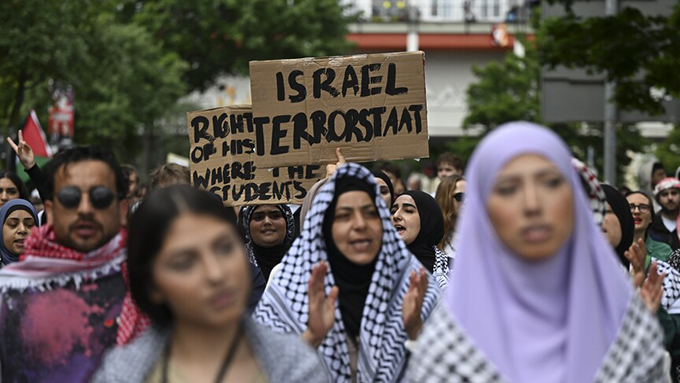
Following the intensification of the Israeli-Palestinian conflict, pro-Palestinian activists organized large-scale demonstrations at American universities in 2024. They denounced the genocide being committed in Gaza and demanded that academic institutions sever their ties with Israel.
This movement has spread to Europe . In response, the academic authorities of some universities have imposed an institutional boycott of Israeli universities . This article attempts to highlight the extent of this boycott in Europe and the arguments put forward by academic authorities to justify it.
History of academic boycotts
Calls to boycott a country’s universities to punish them or exert pressure on their government are not new. After the First World War, German and Austrian scientists were barred from participating in international scientific conferences and agencies. This punitive boycott only ended in 1926, when Germany was invited to join the League of Nations.
According to historian Michael D. Gordin , this boycott, like those against Nazi Germany or the USSR in retaliation for the invasion of Afghanistan, was partial and proved ineffective. The only boycott considered to have had an impact on both a scientific community and a political regime is the boycott against the apartheid regime in South Africa between 1960 and 1990.
The effectiveness of this boycott can be explained by its long duration, the consensus surrounding its necessity due to the racism of the South African political regime, and the small size of the South African scientific community. However, concluding that it played a decisive role in the fall of the apartheid regime seems exaggerated . Indeed, this boycott was associated with severe US economic sanctions as well as a profound internal structural crisis within South Africa’s socioeconomic system.
In the early 2000s, prominent academics advocating for the Palestinian cause called for an academic boycott of Israel . This demand intensified when Palestinian organizations united in the Boycott, Divestment, and Sanctions (BDS) movement. In response, the American Association of University Professors (AAUP) expressed its opposition to any systematic boycott of an academic institution . This rejection was also supported by some academic journals, such as the British Medical Journal .
The principle of academic boycott violates traditional academic norms and fundamental rights
Academic freedom, as formulated by the AAUP in 1915 , protects the teaching and research activities of professors. The institutional neutrality of the university—its refraining from taking a position on controversial subjects or becoming a political actor—is considered a necessary condition for academic freedom . Academic freedom itself is seen as essential to the advancement of scientific knowledge .
Academic freedom does not explicitly protect researchers’ right to freely choose their collaborators. However, scientific research relies on an autonomous level of organization involving international academic collaboration networks . It is also documented that a reduction in international scientific cooperation can lead to a decline in scientific output . Thus, the International Science Council , which comprises 135 scientific organizations, defends the universality of science and “opposes discrimination based on factors such as sex, ethnic origin, citizenship, and political opinion .” From the perspective of international law, the principle of boycotting scientists from a particular country also contradicts the “right to science” guaranteed by the 1948 Universal Declaration of Human Rights .
Based on this, researchers Blakemore, Dawkins, Noble, and Yudkin believe that an academic boycott should only be used as a last resort and only if the following conditions are met:
- There are good reasons to believe that a boycott would help to change the unacceptable behavior of a regime;
- The repulsion towards the regime must be widely shared…
- The boycott is part of a broader program of measures, which includes diplomatic measures, economic and cultural sanctions.
The institutional academic boycott against Israel is a minority view
Since these conditions were not met, it is not surprising that, as of August 2025, only 48 higher education institutions in Europe had officially adopted a partial or total boycott of Israeli institutions. This represents less than 6% of the approximately 900 institutions recognized by the European University Association .
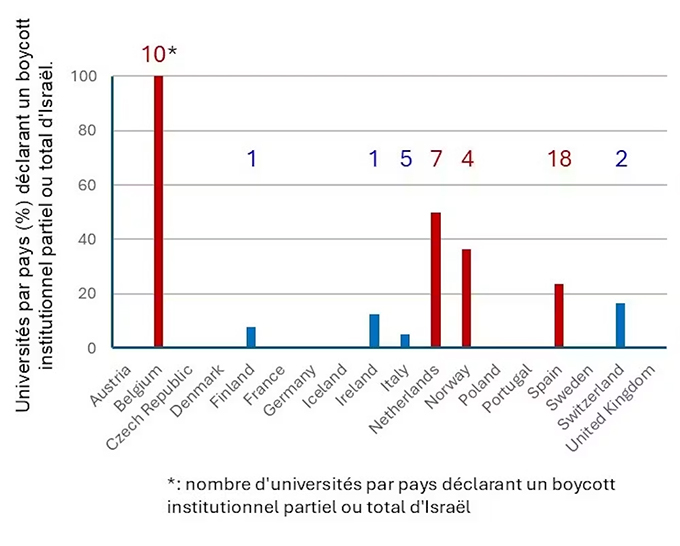
This chart illustrates the percentage of universities in each country that have adopted a partial or total academic boycott of Israel by July 2025. The figures indicate the total number of universities affected in each country. Provided by the author
The countries with the highest proportion of universities that have declared an official academic boycott of Israel are Belgium (100%), the Netherlands (50%), Norway (36.3%), and Spain (23.6%). Belgium’s exceptional situation is confirmed by the Samuel Neaman Institute report , which ranks Belgium as the European country with the highest rate of boycott incidents in 2024.
It should be noted that a ” hidden boycott ” against Israeli researchers has also been documented. This, by its very nature, is difficult to quantify.
The emergence of new academic standards inspired by the struggles of the Global South
In their joint statement , the rectors of Belgian universities assert that the choice to boycott Israel is a “morally responsible choice” and that “holding Israel accountable for persistent human rights violations is not an ideological position, but a moral and legal imperative.” The rhetoric of the Belgian rectors thus clearly reflects an appeal to “moral responsibility,” which they place above traditional academic norms that prohibit boycotts.
This stance reflects the influence in Europe of the Palestinian Campaign for the Academic and Cultural Boycott of Israel (PACBI), which has been adopted by the BDS movement. In its appeal, PACBI asserts that Israel exercises colonial domination over the Palestinians and argues that universities actively participate in maintaining this system. Therefore, the international scientific community has a moral responsibility to boycott Israeli academic institutions. This argument clashes with the traditional conception of academic freedom, where researchers are assumed to be independent of governments and cannot be held accountable for state policies.
The position of Belgian university rectors is also situated within the international order established after 1945 around universal human rights. The principle of the “responsibility to protect” (R2P), adopted by the United Nations General Assembly in 2005, reinforced the idea that there is a collective obligation to oppose serious forms of oppression and crimes against humanity. This legal obligation, however, rests with states, not with individuals or universities.
Thus, the debate surrounding academic boycotts opposes two very different conceptions of academic freedom and cannot be reduced to a simple opposition between supporters and opponents of Israel.
The dangers of universities transforming into political actors
New academic standards, including moral responsibility, could encourage academic authorities to adopt official positions on every international conflict. In a world increasingly marked by territorial disputes, academic boycotts could become commonplace and lead to the resurgence of nationalist scientific movements where they had disappeared—an outcome that would represent a profound regression.
Boycotts have a direct cost for universities. For example, Florida blacklisted Belgian universities for boycotting Israel . The rector of Ghent University, Petra De Sutter, admitted that her university has lost numerous partnerships and cited a decrease in the number of research projects, research funding, and doctoral degrees awarded .
The increasing politicization of universities could alter public and governmental perceptions of academic institutions and expertise. Universities could become political targets, impacting their funding. Trust in graduates could erode, fueling popular resentment toward elites and contributing to the rise of populism.
More importantly, if academic and scientific expertise were to become perceived as politically biased, its credibility as an objective basis for public deliberation would be severely compromised. The long-term consequences of universities abandoning institutional neutrality in favor of political activism therefore warrant thorough and sustained scrutiny.
Faced with these threats, more than 160 American universities , including Columbia, Cornell, Harvard, Princeton, and Stanford, officially adopted policies of institutional neutrality or restraint in 2024 and 2025. In France, Luis Vassy, director of Sciences Po Paris, imposed a principle of “institutional reserve” in 2025 to preserve the plurality of opinion and the organization of pluralistic debates on campus. Some authors denounce these choices as a “fear-based strategy” serving a conservative political agenda and a “mechanism for evading responsibility, masking power, and perpetuating inequality.”
The debates on institutional neutrality and academic boycotts are therefore far from over. They go beyond the framework of the Israeli-Palestinian conflict and concern the redefinition of the missions of universities.
Author Bios: Eric Muraille is a Biologist, Immunologist. Research Director at the FNRS at Université Libre de Bruxelles (ULB) and Joel Kotek is a Political scientist at the Free University of Brussels (ULB)
