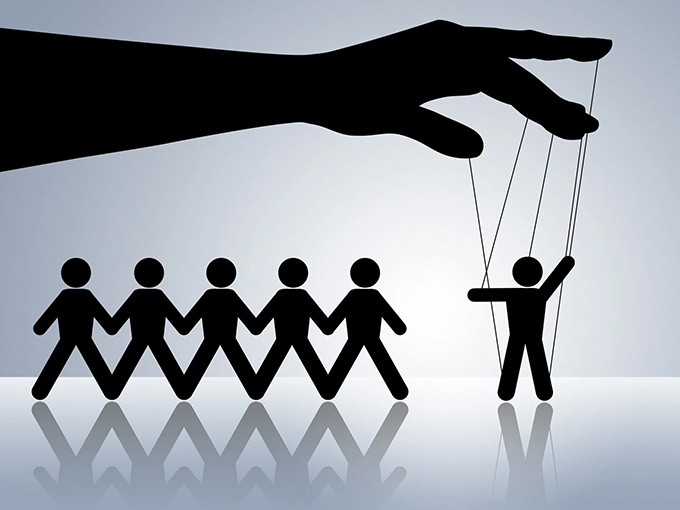
 Published in 1987, with over 500,000 copies sold in France, The Little Treatise on Manipulation for the Use of Honest People , by Robert-Vincent Joule and Jean-Léon Beauvois, is a true bookstore phenomenon. Based on research in social psychology, the book offers insight into the manipulation techniques we face daily or which enable us to convince.
How can you get someone to freely do what you want them to do? This is the question, which probably concerns all of us, that Robert-Vincent Joule and Jean-Léon Beauvois answer in their book, Petit Traité de manipulation à l’usage des honnêtes gens (1987, reissued 2024). They do so in light of the knowledge developed over the decades by social psychologists, from the pioneering work of Kurt Lewin to the present day, and therefore during seventy-five years of research.
One of the major merits of Joule and Beauvois’s work is that it has explored this experimental corpus within the French-speaking world, notably by making Anglo-Saxon research that had previously been little-known accessible. A lecture given by Robert-Vincent Joule at the University of Grenoble Alpes perfectly illustrates this logic of freely consented influence.
In the latest expanded and updated edition, published in October 2024, the authors explain some thirty influence techniques whose effectiveness has been experimentally demonstrated in laboratory and field research. These procedures, which they describe as manipulation techniques, allow us to multiply (by two, three, sometimes tenfold) our chances of achieving our goals, for better or for worse.
Knowledge of these techniques and the psychological processes at play gives the reader the tools to avoid being manipulated and to forge their critical thinking, making them less susceptible to harmful influences exerted on them. Some “popularization” blogs even consider the work to be of public utility—a rare assessment for a treatise on social psychology.
The book focuses primarily on interpersonal influences, those that operate between two people (in the family, at work, in the street, on the Internet, or here and there between a salesperson and a customer), without neglecting mass influences. Researchers in information and communication sciences (ICS) are also particularly interested in these dynamics, as soon as they are part of mediated devices (displays, interfaces, digital platforms) or ritualized devices (conferences, campaigns, transactional exchanges). Finally, evaluative conditioning, on which marketing specialists readily rely.
Evaluative conditioning
You’re listening to the Marseillaise before a French national football match. The camera slowly pans from player to player. In close-up, we see each player’s concentrated face, as well as the top of each jersey with a brand logo. Of course, we don’t pay attention to this logo, and yet, without us realizing it, the positivity of the Marseillaise , the national anthem, will transfer to the brand, making the expected purchasing behaviors more likely among spectators. There is a wealth of research illustrating this phenomenon.
A famous study demonstrated the effect of evaluative conditioning on the choice of a pen based on pleasant or unpleasant music. Participants were asked to watch an advertisement for a pen. The pen was blue for half of the participants and beige for the other half. Music was played, pleasant for some, unpleasant for others.
At the end of the experiment, each participant was given a pen whose color they could choose (blue or beige). As expected, participants overwhelmingly chose the color associated with pleasant music (whether blue or beige) and abandoned the color associated with unpleasant music (whether blue or beige). But what’s more, when asked to explain their choice, they appealed to their personal taste for the chosen color, without making the slightest reference to music!
The techniques described in A Short Treatise on Manipulation can obviously be used against us by malicious individuals; for example, to obtain confidential information from us, such as our bank details, or more generally, to obtain decisions from us that we will regret. But they can also, in the hands of honest people, prove very useful—and much more effective than persuasion—in promoting desired “socially useful” behaviors. One example: the technique of labeling.
Labeling
In one of the studies reported in Joule and Beauvois’ book, American researchers compare the effectiveness of two strategies to encourage 9-10 year-old students not to throw candy wrappers on the ground: a persuasive strategy and a strategy based on labels.
During eight lessons on environmental friendliness, the teacher tried to convince some students to be clean and tidy by putting forward appropriate arguments (persuasive condition). She did not try to convince other students, simply telling them, “You are clean and tidy children” (labeling condition).
At the end of these lessons, the children were given carefully wrapped candy and the number of candy wrappers left on the floor was counted. The researchers found that children in the labeling condition complied more with educational expectations than those in the persuasive condition: fewer candy wrappers on the floor and more in the trash. But what’s more, this effect persisted after the experiment ended, when the children were no longer required to do anything, proving the lasting impact of labeling on students’ subsequent cleanliness behaviors.
The superiority of labeling over persuasion is also demonstrated in other research, this time focusing on academic performance (results obtained in mathematics exercises, for example).
It should not be assumed that only children are susceptible to labeling. Adults are just as susceptible, as shown, for example, by another experiment reported in the Petit traité de manipulation . After giving participants a pseudo-personality test, the researchers told them, regardless of their results, “Your results show that you are a caring and generous person” (labeling).
A little later, a companion of the researchers dropped a deck of cards to study their reaction. Would they be helped or not to pick up the cards from the floor? As expected, people who had been told that they were kind and generous—although this was a purely arbitrary label—were significantly more likely to “spontaneously” help the companion than people in a control group who had not received a label.
Are we the Gentlemen Jourdain of manipulation?
The success of this work among the general public is certainly explained by the way in which the authors shed light, in the light of available psychological knowledge, on the most common interactions in our social existence.
We must recognize that we are all, in turn, manipulators and manipulated. Who has never used more or less devious means to achieve their ends? Who has never done something, after being skillfully led, that they would not have done on their own? We have all, at one time or another, acted in this way.
For example, Joule and Beauvois report in their work one of the ways of proceeding that we have probably all used to try to obtain a favor: the “I-won’t-ask-you-anything-else” technique, the principle of which consists precisely in letting our interlocutor know that the request we are making will not be followed by another.
I won’t ask you for anything else
In a 2017 study by Grzyb and Dolinski , people were approached by a researcher during a concert. “Hello, I’m raising money for a children’s care center […]. Would you be willing to make a donation? That’s the only thing I’m going to ask of you.” Nearly 55% agreed, compared to only 15% in the control condition, in which the researcher’s words were exactly the same but without the phrase: “That’s the only thing I’m going to ask of you.”
Is this kind of manipulation reprehensible? Certainly not.
As surprising as it may seem, the use of manipulation techniques—except, of course, when they are used to serve morally reprehensible interests—makes social life more fluid. Perhaps this use even maintains friendship? Let’s imagine that a friend obtains from you, by manipulating you, a favor that you would not have granted spontaneously (for example: helping him move). He will be very grateful to you and, obviously, at the first opportunity, it is he who will willingly return a favor of the same importance to you without you needing, in turn, to manipulate him. Morality is therefore safe.
And you, what forms of influence have you yielded to without knowing it?
Author Bios: Fabien Girandola is Professor of Social Psychology at Aix-Marseille University (AMU) and Stéphane Amato is Lecturer in Information and Communication Sciences at the University of Toulon
