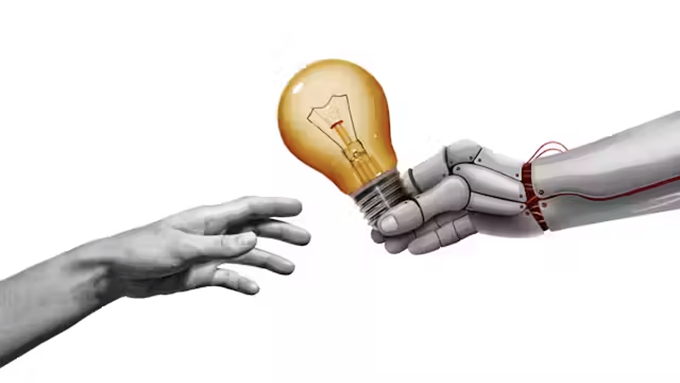
In 2008, The Atlantic magazine shocked the public with a controversial report entitled: Is Google Making Us Stupid ?
In a 4,000-word essay that later became a book , the author, Nicholas Carr, answered this poignant question.
The short answer is yes: Technologies like search engines impair the ability to think deeply and acquire knowledge.

July/August issue of The Atlantic magazine. Wikimedia Foundation
Carr’s core argument is that technology is making humans “dumb” because people no longer need to memorize or learn certain facts. We can easily look them up on the internet at any time.
Carr’s argument has some truth to it . However, search engines still encourage us to think critically about interpreting and adapting search results to specific contexts.
Times have changed rapidly. Technology has advanced rapidly. We now live in the era of artificial intelligence (AI). The use of generative AI like ChatGPT, Gemini, and DeepSeek has forced us not only to stop memorizing information but also to stop thinking.
Generative AI not only displays information but also generates, analyzes, and summarizes existing data. This AI capability is fundamentally changing the way we think and seek information.
It can be said that generative AI is the first technology that can “replace” human thinking and creativity.
With these AI developments, a question arises: is ChatGPT (or other generative AI) making us stupid?
As a professor of information systems who has been exploring AI for over two decades, I witnessed the early stages of this technology’s profound transformation. Now, as more and more people begin to entrust their thinking to AI, I believe it’s crucial for us to understand its benefits and risks.
AI and the Dunning–Kruger effect
Generative AI is transforming the way we access and process information. For many, AI simplifies the information-seeking process by eliminating the need to consult multiple sources, compare different perspectives, and be overwhelmed by conflicting information.
AI delivers clear, ready-to-use information in just seconds. While the results are n’t necessarily accurate , the process is certainly efficient. This AI capability has revolutionized our thinking and work styles.
Unfortunately, this convenience has a downside. When we rely on AI to do our thinking, this process can diminish our ability to think critically, solve complex problems, and assimilate information.
Research on this point is still limited. However, consuming AI-generated content can indeed weaken curiosity, reduce concentration, and create dependency . In the long term, this consumption behavior can hinder cognitive development.
The negative impact of AI on our thinking abilities can be explained by the concept of the Dunning-Kruger effect .
This effect can be seen in situations where sometimes the most confident people are the least knowledgeable. This is because they don’t realize there’s more to understand.
Meanwhile, competent people often lack self-confidence. This is because they know there are many complex things they don’t yet understand.
The Dunning-Kruger effect is often seen in generative AI users. Some AI users have become completely dependent on AI because they don’t need to think hard .
For those who are “addicted,” they feel like they understand a topic, but in reality, they can simply repeat the readily available AI-generated information.
AI makes people feel “smart,” while their cognitive abilities are completely unused, leaving them dull.
This difference in AI usage has given rise to two groups. One group is trapped on the ” Mountain of Ignorance ” because it uses AI as the “brain” for critical and creative thinking.
However, there are also those who use AI to “feed their brains,” that is, to hone their thinking skills.
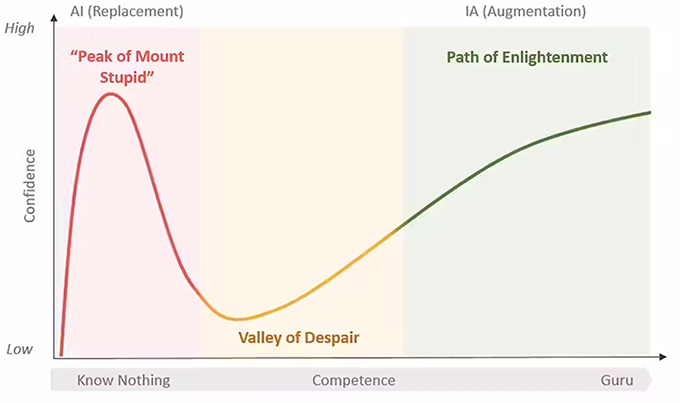
This image depicts the journey of an overconfident individual using AI as a substitute for thinking (the summit of the Mountain of Ignorance), down to the valley of disillusionment, and back to true value creation. Taken from ‘Artificial Intelligence to Augmented Intelligence: A Shift in Perspective, Application, and Conceptualization of AI’ (2024) by Aaron French and JP Shim.
In other words, the issue is how we utilize AI, not whether someone uses generative AI. If used raw, ChatGPT will degrade our intellectual capabilities.
This intellectual decline can occur when someone uses information from AI without testing it against personal assumptions, failing to consider alternative views, or adopting analyses that may be superficial.
However, when AI is used as a tool , it can stimulate curiosity, generate new ideas, and help us understand complex topics. AI can also be an intelligent conversation partner, helping us think critically.
How we use AI will determine whether we become stupid or become more expert in our fields. Generative AI should be used to enhance human reasoning, not replace it.
This means we use ChatGPT to support the answer-finding process, not as a shortcut. This means treating AI responses as brainstorming ideas , not final results.
AI, ways of thinking, and the future of productivity
The boom in generative AI usage is driven by the rapid growth of ChatGPT, which reached 100 million users in just two months after launch.
This ChatGPT craze has brought us to a crossroads. One path leads to intellectual decline as we let AI do the thinking.
Another path leads us to opportunities to expand our thinking abilities: working with AI, harnessing the power of technology to make us grow.
It’s often said today that AI won’t take our jobs, but someone using AI could . However, individuals who use AI without critical thinking are the ones most easily replaced.
By leveraging AI as a tool, we can produce results that neither humans nor AI alone can. This is where our future is headed.
This article began with the question of whether ChatGPT makes us stupid. However, I want to end it with a different question: How can using ChatGPT make us smarter?
The answers to both questions depend not on the technology, but on the user.
Author Bio: Aaron French is Assistant Professor of Information Systems at Kennesaw State University
