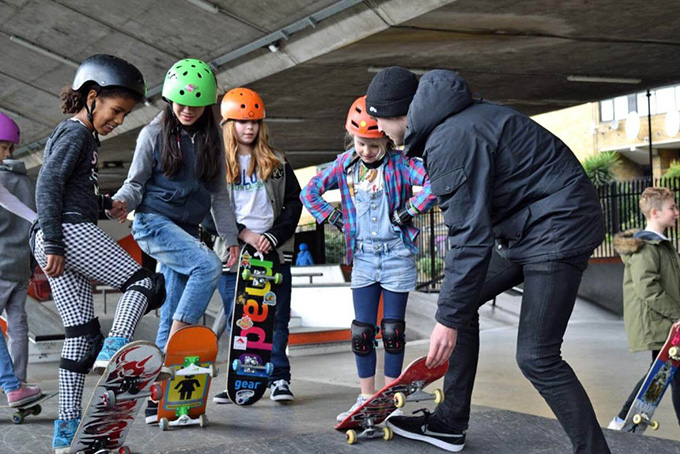
Skateboarding is about learning to perform difficult tricks in unfamiliar environments. And it can help young people master other types of skills, as experimented with in learning communities and, sometimes, even schools.
At a school in Malmö, Sweden, skateboarding is part of the curriculum. John Dahlquist, vice-principal of Bryggeriets High School , teaches skateboarding lessons and integrates it into other subjects. He finds that these moments of collective fun help make teenagers want to go to school. In a book I recently co-edited on skateboarding and teaching , he notes that some students even look forward to returning to class after the weekend.
Skateboarding is a creative activity that requires ingenuity to adapt to new environments. It also has a collective and social dimension: when it comes to learning something new, skaters encourage each other, recognizing that everyone has a different level and faces distinct challenges.
When done properly, skateboarding allows for individual growth within a supportive and caring community. It’s an activity that also requires embracing failure. It’s impossible to master a trick without repeating attempts—that is, failing, over and over again.
My colleagues and I conducted research into the value of skateboarding philosophy in schools and how teachers can integrate it into their lessons.
Take Dahlquist’s teaching in Malmö, for example. He notes that integrating skateboarding with other subjects has many notable effects. Physical activity improves concentration. Some students even claim that they would not have been able to achieve this in a different learning environment because they would have been unable to focus on the task at hand.
Developing a skater mentality – that is, being willing to learn difficult tricks in unfamiliar environments – also allowed students to acquire the ability to master other types of new skills.
Able to face failure
The process of overcoming the fear of failure is crucial. If they want to learn new tricks, skaters cannot afford to be afraid of falling . The motivation to repeat one’s efforts to learn also helps skaters in other areas of life. Bryggeriets students are not so concerned about getting bad grades, precisely because they see it as an opportunity to learn and move forward.
“At the end of my classes, I usually have to send students out. ‘I’m almost there, let me try three more,’ some of them beg me.”
This approach reduces the importance of grades in education and, by extension, improves students’ mental health. My colleague Esther Sayers , who conducted field research in Bryggeriets, discovered another effect. Teachers help students develop the skills needed to motivate themselves and achieve a state conducive to inspiration.
Bryggeriets High School isn’t the only place where skateboarding helps teach how to learn. Beyond its historical status as a self-disciplined urban culture, skateboarding now plays an important role in creating engaged learning communities around the world. The Berlin-based organization Skateistan organizes skateboarding lessons, provides youth access to education, and provides funding to promising young leaders.
The Concrete Jungle Foundation builds skateparks in collaboration with young people in Peru, Morocco, and Jamaica to enable knowledge exchange and foster local ownership and learning. Similarly, the New York-based Harold Hunter Foundation runs skate workshops with mentoring and professional support.
Focus on the learning process
Our colleagues Arianna Gil and Jessica Forsyth studied groups of Black and Latino working-class skateboarders led by gender-diverse community organizers. They found that groups like Brujas and Gang Corp mobilize skateboarders around the motto “For us, by us.”
Challenging institutional models of authority, these skateboarding groups develop services rooted in the hopes and aspirations of their communities, ranging from information sessions to recreational programs. These include a lecture on the history and significance of hoodies, as well as modules on the power of storytelling and the dangers of propaganda. The key here is to learn from the things we encounter in everyday life.
Skateboarders living in poverty and oppression are creating their own ecosystem to learn from each other, outside of a top-down educational system. This means creating a grassroots school model where groups of skateboarders choose what they want to learn and how they want to learn it. Rather than grades and diplomas, education here is structured around the process of peer-to-peer learning—with the constant goal of passing on the knowledge acquired in the near future.
The effects of this approach are threefold. First, it emphasizes mentorship and the learning journey, which promotes the exchange of knowledge between generations. Second, the DIY ( Do it yourself ) spirit of skateboarding can help overcome barriers to accessing training. By adopting popular teaching practices and formats, education can be tailored to the specific needs and desires of a community, rather than following standardized learning objectives.
Third, rather than focusing on memorizing information for assessments and grades, this new ecosystem is structured around problem-based learning. In a world facing challenges, such as human rights violations and hostile environments , skateboarders learn not only to analyze their environment, but also to confront and engage with oppressive social structures.
As education faces increasing budget cuts and political influence, skateboarding is paving the way for new ways to organize our learning spaces. Schools and teachers can foster student engagement by incorporating this learning culture that decentralizes judgment and celebrates attempts rather than successes.
Author Bio: Sander Hölsgens is Assistant Professor, Leiden Institute of Cultural Anthropology and Development Sociology at Leiden University
