Today, 40% of unemployed people over 50 report having experienced age discrimination , according to the International Center on Ageing (CENIE). Meanwhile, the WHO warns that one in five people over 50 has experienced ageism in the health sector.
In Spain, the term ageism appears for the first time in the latest annual report of the Ombudsman (2024) and, since 2022, it has been included in the Dictionary of the Royal Spanish Academy of Language.
We live with a subtle form of benevolent discrimination that infantilizes older people and deprives them of their autonomy and voice, even when the intentions are good. This situation leads to lower self-esteem, rejection, and social invisibility. However, all of this is part of a recent cultural construct.
Valuable for their experience
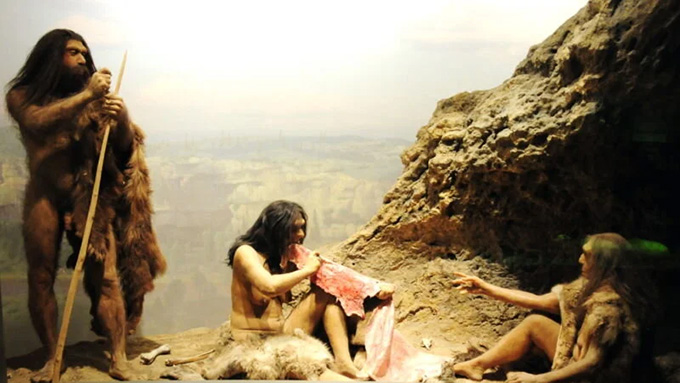
This rejection of aging contrasts with the survival of the elderly in prehistory. The elderly, as well as those seriously injured or with genetic problems, undoubtedly contributed to the group. If they could not contribute physically, their social value would be related to their capacity as custodians of memory and knowledge.
In primitive societies, old age was not associated with stigmas, but rather with experiences. Osteological, dental, and archaeological studies confirm caring practices, increased longevity, and the social value of elderly people and survivors of serious accidents. In these cases, the entire group must have participated in an adaptation of diet and mobility.
Old at 40
In many prehistoric contexts, reaching the age of 40 could already be considered a significant longevity. Therefore, some specialists refer to a person as “elderly” from this age onwards , if functional physical decline is evident.
In prehistory, it’s difficult to establish an absolute chronological threshold to define old age, as we do today. We must apply osteological and functional criteria to determine this state of advanced age.
These include extreme wear of molars or complete loss of teeth without replacement. In some cases, there is also remodeling of the jawbone, indicating that the individual survived for a long time without functional teeth.
Likewise, skeletal changes associated with osteoarthritis, osteoporosis, vertebral degeneration, or the formation of additional bone in response to joint stress (exostoses) are indicative of age. Other circumstances, such as comparison with mortality patterns within a group, can also be used. If the average lifespan of a human group is 25-30 years and a 45-50-year-old individual appears, that individual can be considered relatively elderly.
Famous prehistoric ancients
One of the most recognized prehistoric ancient humans is the Homo erectus from Dmanisi, Skull 4 , dating back more than 1.8 million years. We know that it survived for several years with virtually no teeth (endetulism). This meant severe chewing difficulties and the need for feeding assistance or other forms of social care.
On the other hand, Nandy or the Shanidar 1 fossil , a Neanderthal from more than 50,000 years ago, has been one of the most studied. It is estimated that he survived with severe disability until he was 40 or older. He had suffered a lateral blow to the face, fractures and amputation of his right arm at the elbow, injuries to his right leg, systematic degeneration, and deafness.
Surviving all of this in a hunter-gatherer society is undoubtedly evidence of prolonged care by their group.
Surviving in difficult times
At the site of Dolni Vestonice (present-day Czech Republic), the remains of a young adult with severe developmental abnormalities were found . The person known as Doln V-stonice 15 was found. Bone examination reveals the presence of osteoarthritis. His bone structure is consistent with repetitive and intense carrying practices or the dragging of heavy loads. These data indicate the group’s ability to keep a severely affected individual alive, but also emphasize the need for all individuals to participate in the highly mobile Paleolithic populations.
Both Dolni Vestonice and Gran Dolina (Atapuerca ), where a Neanderthal girl with Down syndrome named Tina survived to the age of 10, show how humans tried to leave no one behind. Helping others became fundamental to the group’s survival .
Grandmothers of the caves
In this context, ancient women remain virtually absent from scientific and educational discourses about the human past. This is partly due to the limited availability of the remains themselves, which are usually jaw or skull fragments that do not allow sex determination.
However, modern prejudices should not influence our studies of the past. While our society tends to associate old age with deterioration, passivity, or dependence, a new line of study was already opening up in 1998: the so-called “grandmother hypothesis . “
With this hypothesis, American evolutionary anthropologist Kristen Hawkes and her colleagues explained how menopause could have significant significance for the human species. For them, female aging is associated with our later maturity, with implications for the social organization of our habitat and the importance of extended learning.
On the other hand, Cat Bohannon, in her recent work, Eva (2025), emphasizes the greater longevity of women. Different biological mechanisms protect women so they can outlive their partners. And their value lies in their knowledge: about previous crises, about setbacks during childbirth, about solutions to food difficulties.
Making prehistoric women visible is not only a pending scientific task, but also an educational one. We need to construct new narratives about the past that include all individuals (women, children, and the elderly), to enrich, by extension, the narratives of the present.
Author Bio: Cristina de Juana Ortín is a member of Teaching and research staff, member of the ART-QUEO research group at UNIR – International University of La Rioja
