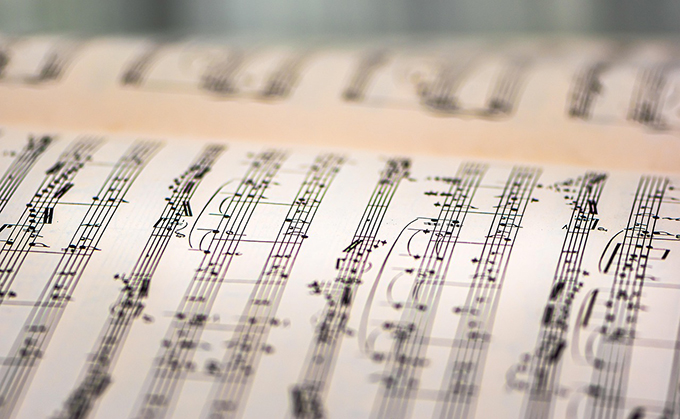
Are you ready to open the secret language that all musicians use?
It’s true! Reading music is not as hard as it looks.
The dots and lines on the page can be intimidating. It can feel like there’s some kind of special code you need to crack before you can get started.
But here’s the good news…
It’s actually really easy!
Once you get the basics of music notation down, it all starts to make sense. And it’s so worth it. Research shows that 78% of Americans believe that learning music makes students better at other subjects too.
This article covers everything you need to know, including…
- The basics of the Staff & Clefs
- How to read Notes and Rhythms
- How to understand Time Signatures
- Practical tips to learn more quickly
- Avoidable Mistakes to watch out for
The Basics of the Staff & Clefs
Before you can read music, you need to know what a staff is.
You might have seen these if you’ve looked at any sheet music before. It looks like a set of 5 parallel lines with four spaces in between.
When you first start reading music, all the notes are written on the staff. The staff is the foundation for everything else.
Okay but there’s a catch…
There are different kinds of staffs. The thing you need to be aware of is the clef at the start of the staff. This tells you which notes are which on the staff.
The treble clef (which looks like a G with a spiral at the bottom) is the most common. This is what you’ll use for piano right hand, guitar and most wind instruments.
The bass clef (looks like a C with two dots at the top and bottom) is used for lower pitched notes. This is what cellists, trombonists and bass players use.
If you want to practice, find some printable sheet music and start trying to identify the notes on each line and space. Nothing beats the hands-on approach when it comes to reading music.
Here’s the best thing about the staff and clefs…
They’re the same everywhere in the world. If you can read a middle C, it looks the same whether you’re in New York or Tokyo.
Musical notation is a language all of it’s own. It’s the most widely spoken language in the world!
Reading Notes and Rhythms
Now let’s look at what each note does.
Notes have two jobs – they tell you which pitch to play AND how long to play it for.
The shapes of notes (filled in, hollow, with stems, with flags) all have different durations.
Here’s the quick version
- Whole notes last four beats
- Half notes get two beats
- Quarter notes get one beat
- Eighth notes? Those are half a beat each.
Phew, that’s a lot to take in. Right?
Hang on… Don’t forget the other half of music – the silence. That’s right. You also need to be able to read the rests in music.
Rests look similar to the notes but are different shapes and represent different durations.
Timing is important too, and you need to master that as well. Practicing clapping out rhythms is the best way to cement this in your brain.
Time Signatures
There’s one more little number puzzle to get right before you can read music.
Time signatures look like this:
You’ll see this at the start of most songs or pieces of music. People used to learn this by heart but actually, they’re doing you a favor here.
The top number tells you how many beats are in a measure. The bottom number tells you which note gets one beat.
4/4 time is the most common (four quarter-note beats per measure). You see it everywhere. Musicians even have a special name for it. It’s called “common time”.
3/4 time gives you that “oompah” waltz feel (three quarter-note beats per measure). “The Blue Danube”, “Happy Birthday” and lots of other songs use this.
The really cool thing about time signatures is once you understand them you can know how a piece of music will feel before you play it.
Why learning to read music matters
It’s a surprise to many people but…
Learning to read music does not make you less creative.
In fact, it makes you more creative. You gain access to thousands of years of musical history. You can play music that was composed hundreds of years ago. You can talk to other musicians in the universal language of notation. You can write down your own musical ideas to remember them forever.
Think about it. Just because you know how to read doesn’t mean that writers can’t be creative. The same is true of music.
Learning to read also has benefits for your brain. A study from Northwestern University found that children who learn music read better than their peers who do not.
Practical tips to learn more quickly
Here are some practical ways to speed up your progress.
- Don’t try to read an entire page of music. Focus on one or two measures at a time. Get those under your belt then move on.
- Practice every day. Just 10 minutes a day is better than nothing at all. The regularity of this will massively speed up your progress.
- Use mnemonic devices. Remember “Every Good Boy Does Fine” for the lines on the treble clef? It works. Try creating your own for notes you struggle to remember.
- Sing or hum the notes. This creates a direct link in your brain between the symbol and the note. It’s one of the most effective learning techniques out there.
- Digital platforms are helping too — with 78% of learners now preferring online over offline tools for their flexible timetables. These apps give instant feedback and make practice fun.
Avoidable Mistakes
And here’s where most people slip up…
- Trying to skip the basics. This is a trap you must avoid. You need a good solid foundation to build on. You will get there in the end but skip the fundamentals and you’ll end up falling over.
- Neglecting Rhythm. Many people focus on getting the right notes and completely overlook the timing. Both pitch and rhythm are important.
- Not counting out loud. This might feel a bit embarrassing at first. But counting out loud really helps to solidify rhythms in your brain. Do this until it becomes second nature.
- Expecting too much, too soon. Learning to read is hard work. If you feel like it’s not happening after a week of practice, don’t worry. Keep going. It will come.
- Don’t compare yourself to others. Everyone learns at a different pace. Don’t feel bad if your best friend can read better than you.
The secret to really understanding music notation?
Use it.
Yes, reading books and theory is great. But you need to put it into practice. Play real music. Join an ensemble. Perform in front of your friends and family. The more you use music notation in real life, the more second nature it becomes.
Begin with pieces you know well. When you can hear the melody playing in your head, then it’s easier to match up the notation on the page to the real music. You’ll build confidence much faster this way.
And one last piece of advice. Relax and have fun. Playing music is meant to be enjoyable. If you’re getting frustrated, take a break and come back to it later.
Final Thoughts
Music notation is the key to unlock a whole world of music.
Music is a language. Learning how to read that language opens the door to communication with musicians everywhere in the world.
It lets you play Bach, Mozart, Beethoven, The Beatles, Radiohead and John Williams. It connects you to all of them.
Learning to read music does take time. When you first start, it can seem overwhelming. Notes and rhythms just look like gibberish.
But persevere. Practice every day, and use the tips from this guide.
Before long, reading music becomes second nature. As automatic as reading words on a page. It becomes effort-free and fast.
That’s when the real magic begins.
Why wait? Get a piece of sheet music and start reading!
