Digital technologies have revolutionized teaching methods , communication dynamics between students and teachers, and access to information. Teaching digital natives presents a series of challenges, especially regarding the scope and presence that this technology should have in schools.
Although some studies warn that screen exposure before the age of two can affect cognitive and linguistic development, it remains to be determined whether this is due to screen use itself (or how and which screens are used) or to other factors such as socioeconomic status . It seems clear that the impact of screens on young children is complex and intertwined with other aspects of their lives.
Several studies support the integration of certain technological tools in the classroom, arguing that they foster more interactive learning and promote the development of digital skills. Furthermore, they maintain that these tools offer parents and , above all, educators new ways to obtain information about their students’ progress and thus better adapt their teaching strategies.
Understanding how the use of emerging technologies influences learning, in order to maximize their benefits and minimize their potential adverse effects, is what we have tried to do with our recent research on the use of assistant robots for vocabulary learning in another language in the 4-6 year stage.
Learning English in preschool
We know that learning a foreign language not only opens academic and professional opportunities, but also stimulates cognitive development, strengthens memory , and improves communication skills . For young children, the challenge is to capture their attention, spark their curiosity, and maintain their interest.
To achieve this, teachers must develop creative methods and innovative resources . This is where assistant robots take center stage, becoming allies of teachers in their teaching strategies.
Robots assisting in education are presented as promising solutions . These devices do not seek to replace the work of teachers, but rather to complement it, integrating into classrooms alongside traditional educational methods.
Linguistic skills
Assistant robots can enhance children’s language skills , such as verbal comprehension and communication through gestures.
The period between the ages of 4 and 6 is crucial for language development, as children consolidate the linguistic foundation during this time that will enable them to thrive in educational, social, and later, professional settings. Exposure to bilingual environments during this stage has been shown to improve second language acquisition .
One of the areas where assistant robots can contribute the most is in vocabulary acquisition , by creating different communication contexts , making learning more dynamic and attractive for children.
English vocabulary assistant robots
We explored how a robotic assistant can improve English vocabulary learning in children of this age whose native language was Spanish. The research was conducted in two preschools with a total of 40 children, divided into two groups. We assessed both the acquisition of new words and the children’s ability to form sentences.
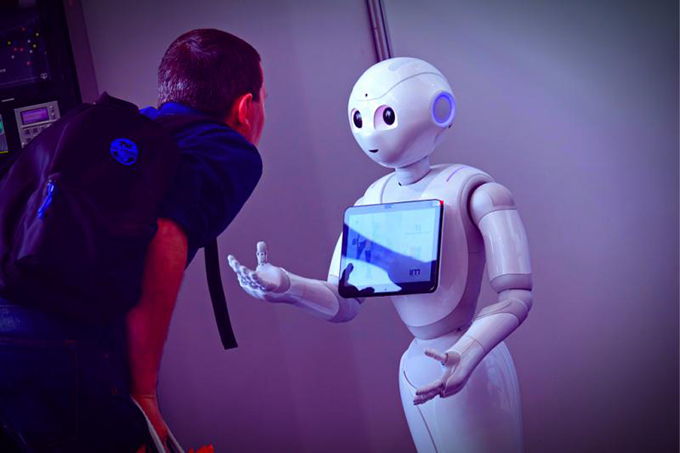
The robot developed by our team has a microphone, speakers, and a user-friendly interface that simulates facial expressions to facilitate communication with children.
23% more vocabulary
The results indicate that the robot creates a more interactive and motivating learning environment, facilitating the acquisition of new vocabulary. Children who interacted with the robot learned 23% more words than those who followed traditional methods, especially during the first few months of exposure. Furthermore, they not only learn words but also become more actively involved in the activities.
The study also highlighted some challenges. Many children were easily distracted by the robot, requiring constant supervision from the teacher. Even so, parents and teachers agreed in the surveys that thanks to the robot assistant, the children integrate more easily into the school routine, increasing their interest and motivation to learn. Specifically for teachers, it represents a support tool, easy to use and integrate into the classroom as another teaching aid.
The key is to integrate innovation as an aid in education, capable of supporting both children in their learning and teachers in their work.
Author Bios: María Dolón Poza is a PhD candidate in Systems and Services Engineering for the Information Society (DISSSI) and Assistant Professor in Telematics Engineering at Polytechnic University of Madrid (UPM) and Santiago Berrezueta is a Postdoc at the Technical University of Munich
