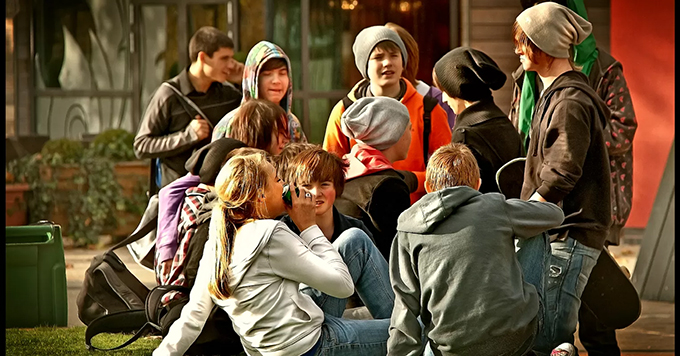
“But what were you thinking? How could you not have considered the consequences this would bring?” These are phrases that have probably been uttered more than once in any home where teenagers live.
Beyond the ability of the adults (parents, relatives, teachers) who surround us at this stage of life to educate us, when we look back we often remember actions that today make us feel ashamed or that ” cringe “ that social networks talk so much about.
“He was just a teenager,” we often think, as if it justifies everything. But why do we make so many mistakes at this stage of life? Do we really make them, or is it just a misconception?
The media image of adolescence
It is common to find news stories in the media related to undesirable situations involving teenagers and young adults: alcohol or drug use, unprotected sex, or antisocial or criminal behavior.
Recent data on alcohol and drug use in Spain indicate that, although there has been a decrease among minors aged 14 to 18, 51.8% admit to having consumed alcohol in the last 30 days, and 17.2% admit to having been drunk. 21% have tried cannabis, and 29.9% report some form of polydrug use in the last 12 months.
24.6% of Spanish teenagers who have had sexual relations report not using safe contraception during their last encounter. Criminological studies confirm that participation in criminal activity is highest during adolescence (around 16-18 years old), decreasing with age.
When teenagers and young adults are asked if they are aware of the negative consequences and risks of their behavior, most say yes . We might then ask ourselves, why do they engage in this type of behavior?
Decision-making in adolescence
Behind such behaviors lies a complex decision-making process . Neuroscience, psychobiology, and social psychology point, respectively, to neurocognitive, emotional, and social factors.
When facing any situation, humans have two distinct decision-making systems, according to dual-process theory : one “cold”, characterized by a rational and controlled reaction, and another “hot”, which is intuitive and automatic and routinely uses heuristics or quick reactions without reflection.
Adolescents, like adults, are capable of resorting to either of these two systems, but in their case social and emotional factors weigh more heavily, since there is a maturational mismatch between the brain mechanisms involved in decision-making.
The first system is based on the activity of the dorsolateral prefrontal and posterior parietal regions of the cerebral cortex and is associated with the ability to self-regulate behavior and, therefore, have greater control over decision-making processes. This system is usually more developed in older adolescents, as its development progresses gradually until early adulthood.
However, in younger individuals, a second neural pattern predominates, one that is more sensitive to socio-emotional incentives and gives greater weight to these types of stimuli in their decisions. This second system depends on brain regions linked to rewards and social information, namely the ventral striatum and the medial prefrontal cortex. This is why younger adolescents are more sensitive to affective stimuli and more susceptible to rewards, seeking sensations and immediate benefits at the expense of long-term considerations.
Rewards and equals
A perfect cocktail then appears: at this stage of development, in which emotional and social factors prevail in decision-making, peers or friends acquire great relevance and the family takes a “secondary” role as a reference group.
Specialists in developmental and life-span criminology often consider peer influence to be decisive in the emergence of antisocial behavior. Peer influence makes them more sensitive to rewards .
Other factors involved
But all this analysis should include other processes that also influence adolescent behavior and, therefore, their decision-making: gender (men seem to take more risks); personality ; the family dynamics to which they have been exposed, since excessively rigid or permissive practices lead to behavioral problems ; their school experiences ; or the acquisition of values and attitudes, which often have an impact on behavior .
Nor should we underestimate contextual factors such as social norms, opportunities, or expectations about what is to be expected in a given social situation.
In any case, the next time our son or teenage student “gets into trouble”, instead of lamenting what is not possible or is especially difficult (a thoughtful and calm decision-making process about the behavior that he is going to carry out), let’s take the opportunity to reflect with them on what prompted them to do it.
Author Bios: Ginesa Torrente Hernández is Full Professor of Social Psychology, José María Martínez Selva is Professor of Psychobiology and Juan Pedro Sánchez Navarro is Professor of Psychobiology all at the University of Murcia
