
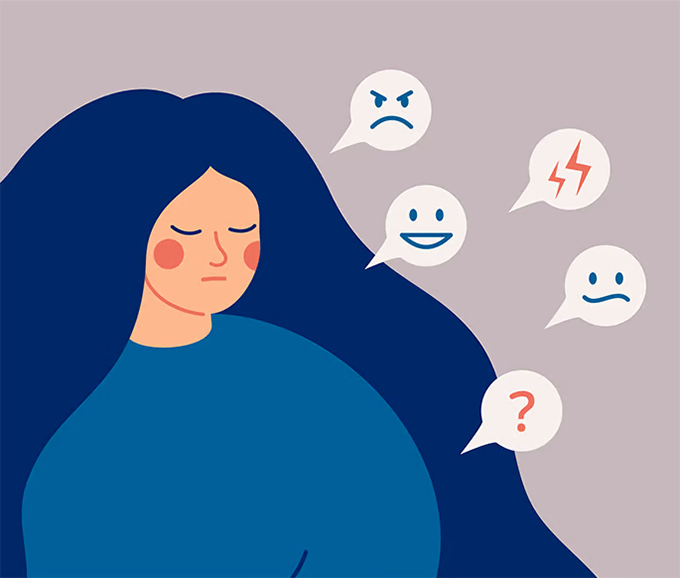
Alexithymia refers to major difficulties in identifying, processing, and expressing emotions. Studied for several decades in various fields of psychology, this personality trait remains little known to the general public. A better understanding of it would help to include those affected in society.
Emotions are part of us and influence us while shaping our relationships with others, even though they often remain a mystery. For some people, the difficulty in identifying and understanding them can have repercussions on their health.
We often tend to think that we understand our emotions quite well. However, using certain measuring instruments (the Toronto scales), it is estimated that between 17 and 23% of the population encounters major difficulties in identifying and expressing their emotional states. This is what is then called alexithymia.
Despite its frequency, this particularity remains little known to the general public, although it can negatively impact mental health, interpersonal relationships and, more generally, the quality of life of those affected.
Note that alexithymia is not currently considered a medical condition. It is not listed in the latest edition of the Diagnostic and Statistical Manual of Mental Disorders (DSM-5), the American Psychiatric Association ‘s manual that classifies mental illnesses, nor in the World Health Organization’s (WHO) International Classification of Diseases (ICD-11).
Etymology and history of the word “alexithymia”
The term “alexithymia,” derived from the Greek a (without), lexis (word), and thymos (mood, emotion), means “absence of words for emotions.” It was introduced in the 1970s by psychiatrist Peter Sifneos . It refers to a set of difficulties in identifying, describing, and processing one’s own emotions.
To illustrate this, imagine being asked to describe a color you’ve never seen before—this is a situation quite similar to what someone with alexithymia experiences when trying to explain how they feel.
Difficulty identifying and describing emotions
Research shows that alexithymia is linked to specificities in brain functioning , particularly in areas involved in emotional processing and self-awareness, such as the anterior insula and prefrontal cortex.
Neuroimaging studies have revealed reduced connectivity between these regions in alexithymic people, which could represent a clue to explain, in part, their difficulty in identifying and processing emotions .
Two main types of alexithymia are identified . Primary alexithymia is considered a stable personality trait. Genetic or neurobiological and developmental factors appear to play a major role.
Secondary alexithymia, on the other hand, appears as a result of trauma, psychological stress, illness, or mental health disorders such as depression. It develops later in life and affects previously intact emotional processing.
Emotions in relationships with others and in the body
Alexithymia thus represents either a primary personality factor that conditions an inappropriate reaction to stress, or a secondary factor to stressful situations, in which case it has a more defensive value. In all cases, this emotional disconnection can affect interpersonal relationships .
It can be difficult for an alexithymic person to emotionally support a loved one even when they don’t understand their own feelings. However, not understanding one’s emotions does not necessarily mean that one is alexithymic, and it does not systematically have repercussions on physical or psychopathological health.
People affected by these emotions know they exist, but they struggle to identify or express them. Rather than describing specific emotions like sadness, joy, or anger, they often talk about a general malaise or feeling out of step, without knowing why.
Sometimes, they even experience physical symptoms related to these misunderstood emotions. Even though they struggle to verbalize their emotions, people with alexithymia do feel them. These unrecognized emotions can manifest as physical symptoms such as headaches, stomach pain, or fatigue—a phenomenon called somatization .
Indeed, when emotions cannot be expressed in words, they often manifest themselves in the body, through discomfort or more or less localized pain. Moreover, certain studies have shown that alexithymia is a vulnerability factor that affects general health, promotes depression , anxiety , and can constitute a risk factor for alcohol dependence, for example.
Lack of emotional warmth or defense mechanism?
A common misconception is that alexithymia is a lack of emotional warmth. Difficulties encountered on an emotional level constitute two components of alexithymia (the first is related to the identification of emotions, the second is related to their description), both associated with a third component (outward-looking operational thinking). The latter corresponds to a way of thinking focused on the operational rather than the emotional.
Although affected individuals may appear detached, this is not a deliberate choice. Alexithymia is a cognitive difficulty that makes recognizing and expressing emotions inherently complex. These individuals do not intentionally avoid their emotions; their brains process them differently. While research on the brain’s involvement in alexithymia has produced conflicting results, recent meta-analyses support the hypothesis of a neurobiological basis for alexithymia .
In its secondary design, it could even constitute an unconscious defense mechanism , used to alleviate negative and painful emotions and/or to counteract the problematic consequences of certain stressors.
“Heal” it or learn to live with it?
Although alexithymia is generally not curable since it is not a disease but a personality trait, just like the hypersensitivity with which it is associated , there are ways to live better with it.
Among the work on the subject, some studies highlight that psychotherapy, particularly skills-based therapies , shows promising results. These therapies help individuals recognize their emotions by focusing on their physical sensations and observable behaviors.
Additionally, group or individual therapy can teach alexithymic people to observe their internal states without judgment, gradually helping them connect their bodily sensations to their emotions. Research continues on other therapeutic approaches.
Other studies are looking at therapies that are less focused on verbal expression, such as art therapy or music therapy. These approaches could offer alexithymic people a way to better explore and understand their emotions, while freeing them from the sometimes intimidating nature of traditional therapies .
Understanding alexithymia for a more inclusive vision
A better understanding of alexithymia, its causes, and its consequences, is a step toward a more inclusive and nuanced view of emotional diversity. While emotions are universal, how we experience and express them is highly individual. Recognizing these differences helps create caring and supportive environments for those who struggle to connect with their emotions.
Raising awareness about alexithymia can also help us better understand the unique challenges this characteristic brings, particularly in interpersonal relationships, and trying to understand its origins would help us better understand its effects.
Author Bios: Jimmy Bordarie is a Doctor, Lecturer, Alizée Richalley is a Doctoral student in developmental psychology and Caroline Giraudeau is a University Professor of Developmental Psychology all at the University of Tours
This article was co-written by Alizée Richalley, Jimmy Bordarie, Amandine Deloustal and Caroline Giraudeau.
