
● Research findings on the effects of brain rot are still inconsistent and their significance is questionable.
● Brain rot could be a reflection of changes in human thinking.
● The impact of social media on cognition and mental health tends to be small and unstable.
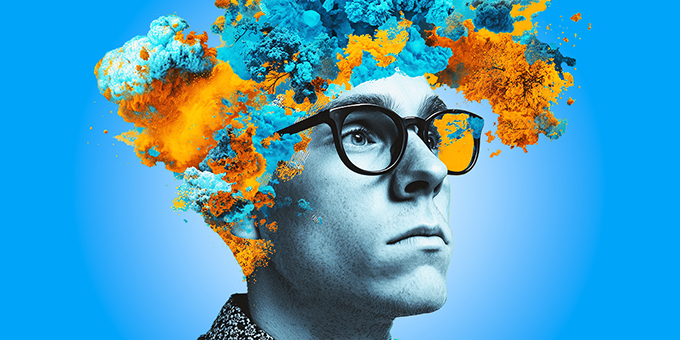
Brain rot is a metaphor to describe the negative impact of consuming too much trivial content on social media.
People who watch too much of this content are said to experience decreased thinking and memory. They experience reduced concentration, become easily distracted, and have difficulty focusing for long periods.
The popularity of “brain rot” has led to the development of memes due to its combination with artificial intelligence (AI). Examples include the Italian “Ballerina Cappuccina” meme and the local “Tung Tung Sahur” meme.
In fact, last year, in 2024, the vocabulary brain rot became the most popular word on the internet according to Oxford.
This vocabulary has indeed lost its meaning. But the real question remains: are the effects of social media on memory and concentration decline really real?
The evidence for brain rot is not yet strong.
Numerous studies and anecdotal narratives link brain rot to poor memory and technology dependency.
However, these studies tend to confirm anti-technology bias, namely the tendency to be suspicious of new technology ( technophobia ) and consider it detrimental.
Some skeptical researchers, such as Lorenzo Cecutti and his team from the University of Toronto, emphasize the importance of reviewing research methods related to brain rot .
In one study, researchers measured brain rot by presenting participants with specific statements and asking them to memorize them. For digital technology users, they frequently displayed words associated with technology (e.g., Google keywords or prompts for AI).
From these findings, researchers concluded that people unconsciously rely on technology, such as using digital media such as Google, ChatGPT, or social media to find answers.
Additionally, when participants realized that information could be retrieved, they were less likely to put effort into memorizing it in detail.
However, what was overlooked was that participants still remembered the location of the information . They might, for example, remember a specific folder or website page, even if they didn’t remember the details of its contents.
This research shows changes in the way we remember as a result of technology and social media use. However, this doesn’t mean these changes are negative and permanent.
Instead, we need to open up to the possibility that this change is occurring due to a shift in the way the brain processes information, including enjoying entertainment through short videos.
Is our memory diminishing? Not necessarily. We probably just remember things differently.
Instead of memorizing content, we tend to memorize locations or AI prompts . This shift has occurred with the advancement of search engine technology and the proliferation of AI.
Are our brains not affected?
So, what about attention span? Is it difficult to focus because of brain rot ?
There may be changes in cognition (the activity or process of acquiring knowledge) due to exposure to technology and social media. However, is that enough to accuse trivial content and short videos of brain rot ?
This accusation seems too hasty. Moreover, a meta-study of various studies shows that the effect of digital media on concentration is relatively small, only 13% .
Furthermore, the effect of social media on mental health is also insignificant . A 2020 study using three large-scale social data sets (with a total sample size of 355,358) found a negative association between mental health and social media. However, the effect was very small, explaining a maximum of 0.4% of the variation in well-being , making it unsuitable for reference.
Even if there is, it can’t be viewed rigidly. This is because individual differences , age ranges , and cultures influence social media use .
As a result, the influence of social media on the thinking ability and mental health of its users is not the same.
Cursing for not knowing
So, why do people condemn social media (especially its trivial content) for being the mastermind behind brain rot ? It could be because we’re not yet accustomed to new technology.
Moreover, since the rise of artificial intelligence (AI), technological change has been rapid and difficult to keep up with. This is considered a major threat to society.
Just look at the numerous “resistance” efforts from various parties. For example, the ban on ChatGPT in academic settings, and the ban on social media for children under 16 in Australia. Indonesia also has restrictions on social media use for children and adolescents under 18 .
It’s common knowledge that mass disruption is often fraught with conflict . Some groups in society reject or are suspicious of the changes. Conversely, others support the changes.
However, this doesn’t mean we can ignore the negative effects of excessive social media use or AI. Self-control, awareness, and accommodating rules are key to avoiding distractions and over-reliance on technology.
Hopefully, we can receive maximum benefits without getting carried away by the euphoria of social media.
On the other hand, this critical attitude can be interpreted as an ethical warning for technology companies and policy makers not to arbitrarily pursue profits, while ignoring the potential negative impacts of social media.
Author Bios: Abdul Hadi is a Junior Researcher and Anastasia Purwanti Putri Wahyu is a Research Assistant – Doctoral Student in Psychology both at Atma Jaya Catholic University of Indonesia
