
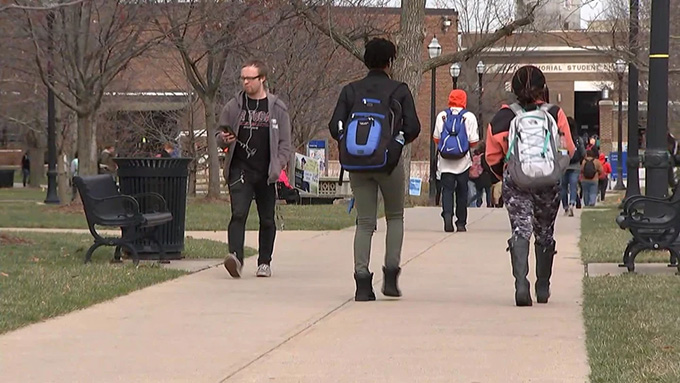
The number of international students on U.S. campuses is estimated to have declined by 150,000 this fall due to policies implemented by the Trump administration. This reversal of fortune will weigh heavily on campuses and their local economies.
It’s the time when students are returning to college, and like every year, campuses across the United States, from Tucson, Arizona, to Tallahassee, Florida, are buzzing with activity. However, a new trend is emerging.
Compared to the 2024-2025 academic year, an estimated 30 to 40 percent fewer international students are expected in the fall of 2025, according to the NAFSA-Association of International Educators – a non-profit organization specializing in international education – and JB International , a for-profit company specializing in educational technology.
In total, an estimated 150,000 fewer international students are expected to arrive in the coming weeks due to new visa restrictions and the cancellation of administrative appointments at U.S. embassies and consulates in many countries, including India, China, Nigeria, and Japan.
There were more than 1.1 million international students —more than half of them from China or India—in U.S. universities during the 2023-2024 academic year, according to the Institute for International Education , which monitors programs for international students and shares the most comprehensive recent data.
This sharp decline in international students could cost the U.S. economy $7 billion during the 2025-2026 school year, according to NAFSA estimates.
For every three international students in the United States, one new American job is created , or supported, by the average $35,000 these students spend locally on housing, food, transportation, and other expenses.
As a research fellow at the Fletcher School of Law and Diplomacy at Tufts University and a former Under Secretary of State for Public Diplomacy in the Obama administration, I oversaw numerous student exchange programs involving many countries around the world. I believe that major economic consequences are looming as a result of this student mobility crisis, and that they could last for years.
A rapid inversion of the curve
International students began coming to the United States in the early 20th century , when philanthropists such as the Carnegie, Rockefeller, and Mott families sought to send American scholars abroad. They helped establish international scholarships that were later often funded by the federal government, such as the Fulbright Program , which provides grants to American students to spend time and conduct research abroad.
By 1919, non-profit organizations, such as the Institute for International Education , served as intermediaries between foreign students and American universities.
The number of foreign students enrolled in the United States steadily increased after the end of World War II, as a world emerged in which travel became easier and less expensive. While 26,000 foreign students came to the United States during the 1949-1950 academic year , this number had grown to 286,343 three decades later.
In the 1990s, over 400,000 international students attended U.S. institutions each year. This number continued to increase, surpassing 500,000 by the early 2000s. The number of international students enrolled in the United States surpassed the 1 million mark for the first time in the 2015-2016 academic year .
While international students accounted for only 1% of the 2.4 million students in the United States in 1949-1950 , they will represent about 6% of the 18.9 million students in 2023-2024, according to the Migration Institute, a nonpartisan research organization. This percentage, however, is relatively small compared to the proportion of international students at universities in other countries.
International students accounted for 38% of total enrollment at Canadian universities, 31% of all university students in Australia, and 27% of all students in the United Kingdom in the 2024-2025 academic year.
Trump’s warnings to foreign students
Within 90 days of returning to office, President Donald Trump invoked the Immigration and Nationality Act of 1952, which gives the secretary of state the authority to expel foreign students whose behavior could threaten U.S. foreign policy interests .
Since then, the U.S. government has revoked the visas of 6,000 foreign students , the State Department reported in August 2025.
There have also been several high-profile arrests of international students, including that of Rumeysa Ozturk , a Turkish student at Tufts University in Massachusetts. Immigration and Customs Enforcement agents detained Ozturk in March 2025, shortly after the administration revoked her visa. Her arrest came a year after she co-authored an op-ed calling for Tufts University to recognize the genocide in the Gaza Strip and divest from all businesses with ties to Israel.
Secretary of State Marco Rubio supported Ozturk’s arrest, saying in March that the government will not grant visas to people who come to the United States with the intent to “vandalize universities, harass students, occupy buildings, cause trouble.”
In May 2025, a federal judge ruled that there was no evidence to suggest Ozturk posed a credible threat to the United States. She was then released from immigration detention.
But his arrest coincided with those of other foreign students in high-profile cases, such as that of Mahmoud Khalil , a graduate student at Columbia University in New York and a permanent resident of the United States, who was arrested after participating in campus protests in support of Palestinian rights. These arrests sent the message to foreign students, ” It is not as safe to come to the United States as it used to be .”
The administration announced other changes that will make it harder for foreign students to stay in the United States, such as a travel restriction policy starting in 2025 that blocks or restricts the entry of people from 19 countries , primarily from the Middle East and Africa.
The administration also announced in August its intention to limit the length of stay for international students to four years. Currently, they have 60 days after graduation to stay in the United States before needing to obtain a work visa or other type of authorization to remain legally in the country.
A simple mathematical equation
New York University, Northeastern University in Boston, Massachusetts, and Columbia University welcomed the largest number of international students in 2023-2024. But these students are not concentrated solely in large, Democratic-leaning cities.
Arizona State University hosted the fourth-largest number of international students that year, and Purdue University in Indiana and the University of North Texas also ranked among the top ten institutions with the largest number of international students .
All of these institutions, as well as others, such as the universities in Kansas City, Missouri —which welcomed far fewer international students than expected in the spring, some of whom were unable to obtain visas—will suffer the financial consequences of the refusal to accept international students in the United States.
Because of all these assessments, I believe there is a strong case for increasing the number of international students admitted to the United States rather than reducing it.
Author Bio: Tara Sonenshine is the Edward R. Murrow Professor of Practice in Public Diplomacy at Tufts University
