
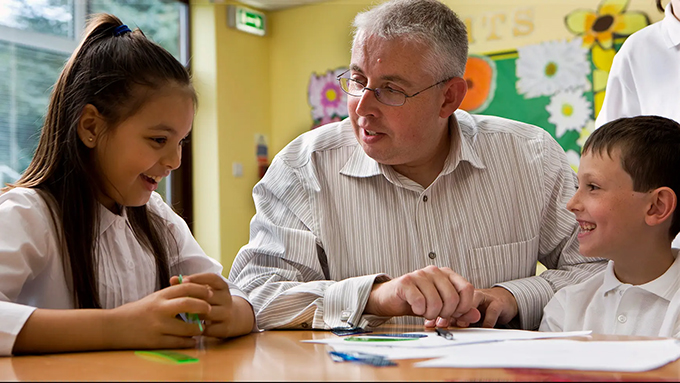
If we’re asked about the best teachers we had during our time as students, it’s likely that those who come to mind first have one thing in common: beyond their ability to teach and motivate students, teachers with the best social and emotional skills are often the ones we remember most fondly. Remembering a teacher fondly is often also synonymous with having learned and grown in their classes.
Empathy is one of the most important emotional competencies in the classroom. It not only involves the ability to understand another person’s point of view; it also involves a deep understanding and appreciation of their experiences, thoughts, or emotions, and a thoughtful and sensitive response to them.
That is, you don’t just have to feel it: you also have to express it. How can we achieve this?
Empathetic messages in the classroom
There are three types of messages that convey empathy: emotional, evaluative, and contextual.
Emotional empathy messages express understanding for what students are feeling. They are aimed at minimizing the fear of failure and show optimism, hope, and emotional support. For example: “Don’t be afraid, I’ll explain it to you step by step.”
Messages like “There’s no one here who can’t get good grades” exemplify a message of empathy and appreciation. They reinforce the teacher’s confidence in a student’s ability to achieve a goal.
Finally, contextual empathy messages are based on teachers’ experiences. Thus, “Do you have a test now? Then we’ll leave it here” reflects teachers’ understanding and knowledge of the events their students experience.
How to use messages in a conflict-ridden classroom
All three types of messages foster positive relationships and quality teaching. However, teachers aren’t always motivated to show empathy. It isn’t automatic; it’s a choice that requires emotional effort.
Sometimes, a tense or chaotic classroom environment or the inability to follow a planned task translates into frustration and hinders the ability to connect with students. Prioritizing student well-being over content whenever possible, reducing teacher workload, and having specific training in the use of messages can enhance the use of empathetic messages.
For example, after an argument or a tense classroom environment, the teacher can normalize negative emotions by saying, “I know this has been a difficult time for everyone, and it’s normal to feel this way,” or “We’re all tense. Let’s take a few deep breaths.” If a student is feeling frustrated, the teacher can also provide emotional support: “I understand you’re angry or frustrated, but I’m here to help you,” always in a calm manner and without downplaying the students’ emotions.
The larger the class, the more emotional messages
In a recent study , we analyzed secondary school teachers’ use of different types of empathy messages through audio recordings of their classes. We also examined their relationship with class size, teacher enthusiasm, and student academic performance.
The results indicate that the type of empathic message most used by teachers is emotional. This is done to convey their understanding to students, reduce their fear of failure, and foster a climate of trust and support.
Furthermore, teachers convey more emotional empathy messages in larger classes. The heterogeneity and diversity of these classes presents a major challenge. Managing them is more difficult because there are more students who need emotional support and understanding. In these cases, teachers adapt to the class they are teaching and use more emotional messages precisely to achieve greater emotional control. This is an excellent way to prevent conflicts, reduce anxiety, and improve student participation.
Enthusiasm and empathy: are they related?
Although one might intuitively expect that more enthusiastic teachers use more empathy messages, the results show the opposite. As teacher enthusiasm increases throughout the course, their use of emotional empathy messages decreases.
Why does this happen? Many teachers convey positive emotions, and their students catch on to that “good vibe.” Some teachers have a proactive teaching style, anticipate problems, and create a very supportive environment; that’s why they don’t use many emotional empathy messages.
On the contrary, less enthusiastic professionals try to compensate by communicating more empathetically with students to maintain a positive environment. They deal with conflicts or students with significant needs, which would lead them to use more emotional messages.
Understanding this relationship allows us to understand how the emotions of those in charge of the classroom influence the way they communicate and how this, in turn, impacts student learning and well-being.
Sometimes, empathy messages are modified according to students’ academic needs and diminish as they reach higher levels of performance, since the use of empathy messages is not perceived as necessary when they achieve good grades.
Listening and understanding students
Putting yourself in someone else’s shoes isn’t easy. It takes some effort to know and understand what students think, feel, and need. But simply expressing your desire or intention with simple phrases (What do you need? What’s worrying you? Is everything okay?) can improve your relationship with them and improve academic performance. Becoming aware of your own communication style and using the three types of empathic messages from the beginning of the school year also help build a positive emotional climate.
The idea is to always keep a channel of communication open. Starting classes by asking students about their needs and feelings, setting a goal of using one or two emotional messages in each class, or recording sessions to identify empathetic messages will improve both students’ well-being and academic results. The key to building trust is for students to feel they are being taken into account and their emotions are being sincerely validated.
Author Bios: Juan Luis Núñez is Professor of Developmental and Educational Psychology, Elisa Santana Monagas is Professor in the area of Developmental and Educational Psychology and Jaime Leon is a Professor all at the University of Las Palmas de Gran Canaria
