
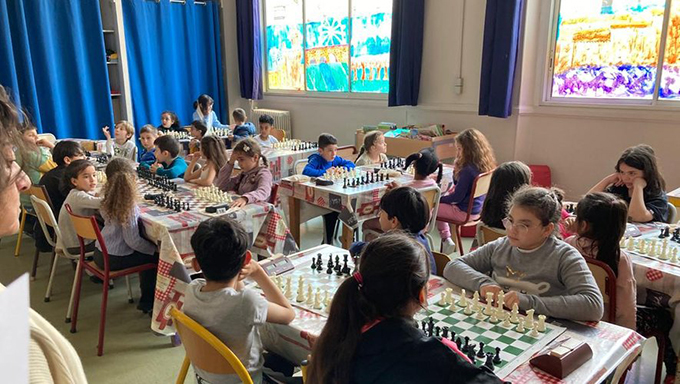
Chess, which has long suffered from a dusty image in society, is now enjoying a surge in popularity among young people thanks to series like The Queen’s Gambit (2020), the growth of esports , and initiatives by French NBA star Victor Wembanyama. Last July, Wembanyama proposed combining basketball and chess in a single competition, emphasizing: “We need a variety of things to grow.”
Thus, since the 1970s, initiatives, initially isolated, have multiplied to bring chess into classrooms, with the conviction that practicing this game would develop many skills in students and promote academic learning.
Do initial field reports confirm this? What approach to knowledge does the use of chess allow?
Local experiments before widespread implementation
The interest in chess for school learning is not new. Traces of it can be found as early as the 19th century, such as a letter from a reader to a specialized journal suggesting a ” noble pastime” for students during recess . However, it wasn’t until the 1970s and 80s that concrete initiatives emerged, often in the form of school chess clubs .
In a few “pilot schools ,” chess is sometimes integrated into students’ timetables with mandatory hours. That said, a thesis defended in 1988 shows that chess still often remains an extracurricular or after-school activity.
When teachers take it up in the classroom, with the agreement of their superiors, some point out that they feel that chess develops skills such as intuition and spatial reasoning , but that they are not certain that students’ progress in these areas is attributable solely to learning chess.
In 2007, when an American study showed the benefits of chess for students struggling with mathematics and solving complex problems, the French Chess Federation, which has become a sports federation, signed a framework agreement with the national education system to officially regulate and authorize the practice of chess in the classroom.
These projects, however, remain the preserve of teachers who are passionate about chess, often club players, who pedagogically convert their chess experience in the classroom.
The Class’Échecs program
Throughout the 2000s, numerous international studies demonstrated the benefits of playing chess for students. Some countries integrated chess into school curricula or implemented significant programs .
In France, in 2022, the French Chess Federation (FFE) launched the Class’Échecs program and signed an amendment to the agreement to promote its development in primary schools. Four principles were thus highlighted:
- the program is aimed at all teachers, regardless of their level in chess;
- The game of chess becomes a means of developing academic skills and is not an end in itself;
- the program is cooperative, to promote the development of social and relational skills;
- The content is designed from a didactic perspective, for classroom use, and all materials are provided free of charge to teachers. The FFE also offers discounted game kits so that schools can equip themselves at a lower cost.
The operation was a rapid success, with approximately 2,000 teachers participating in the first year and by 2025 there were more than 8,000, representing 160,000 students introduced to chess each year.
The survey conducted in 2022-2023 among teachers offering Class’Échecs (Chess Classes) sheds light on their interest in the project. They see it as a way to teach mathematics differently. They observe strong student engagement and interest, and also believe that these sessions develop skills in moral and civic education . However, 87% of these teachers have very little or no knowledge of chess and therefore offer this instruction without fully understanding its content, even though chess is often considered a complicated game.
The keys to success: a form of holistic education
Why do primary school teachers who are not trained to teach chess and do not understand its fundamentals embark on this adventure? Some possible answers are suggested in the 2022-2023 survey and refer to a form of holistic education whose roots go back to the 19th century .
First, the project-based approach transcends the boundaries of academic disciplines, which is particularly relevant in primary education where teachers are multidisciplinary. It offers teachers undeniable advantages because it gives meaning to learning, fostering stronger student engagement and leading them to associate school more closely with the joy of learning.
A more holistic view of the student is promoted, where different skills linking body and mind are developed within the same learning time. Chess, as a teaching tool, appears particularly well-suited: the playful aspect stimulates interest and engagement, and the manipulation of the pieces facilitates the transition from experimentation to abstraction.
Language skills are not a prerequisite for success, as the visuospatial nature of the situations directly engages cognitive functions, without requiring mastery of the linguistic code, a real obstacle for some students. Furthermore, the possibility of creating open-ended problems allows chess to become grounded in mathematics , a genuine institutional necessity, while simultaneously challenging students’ disciplinary awareness .
Finally, at a time when AI and the Internet are making knowledge accessible to all, the project invites teachers to change their approach to promote exchanges and argumentation, encouraging students to collectively build learning.
Author Bios: Fabien Groeninger is Senior Lecturer, Faculty of Education, LIRDEF (Interdisciplinary Research Laboratory in Didactics, Education and Training) at the University of Montpellier and Yves Léal is Senior Lecturer in Educational Sciences at the University of Toulouse
