
Education has historically been one of the fundamental pillars for the development of societies, constantly evolving to adapt to the social, economic, and cultural changes of each era. In recent decades, the acceleration of technological transformations and globalization have generated a new educational paradigm that transcends traditional concepts of when and how learning occurs. The knowledge society has driven a reconceptualization of educational processes, where the acquisition of knowledge can no longer be limited to specific stages of life.
Formal, non-formal and informal education
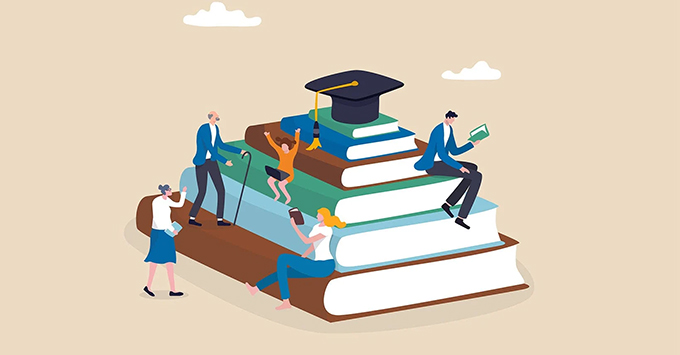
Lifelong learning transcends the traditional boundaries of formal education and integrates it with non-formal and informal learning.
In this sense, any activity we undertake “ with the aim of improving knowledge, skills and abilities from a personal, civic, social or employment-related perspective ” is lifelong learning.
Continuing education in formal education
There are multiple alternatives for those seeking to continue their education. Within formal education, there are continuing education programs such as university programs for adults that provide specific degrees tailored to profiles with professional experience; advanced vocational training that allows for advanced technical specialization linked to the productive sector; and master’s and postgraduate programs that provide specialized training that combines theory and professional practice.
All of them have experienced a 32% increase in enrollment over the last five years, with the technology and healthcare areas particularly notable.
Non-formal education: MOOCs and Professional Certificates
Non-formal education consists of MOOCs (Massive Open Online Courses). Platforms such as Coursera, edX, and Udemy have democratized access to quality content. In 2021, approximately 220 million students used MOOCs, offering approximately 19,400 courses .
There are also professional certifications, i.e., specific accreditations recognized by the industry in fields such as technology, management, or digital marketing. Examples include Professional Certificates such as “Application Development with Web Technologies,” “Administrative Management Activities,” or “Real Estate Commercial Management.”
Also included in non-formal education is in-company training: internal professional development programs that represent an investment of approximately 2.8% of the total payroll in European companies.
Informal learning
Informal learning can take place in communities of practice or groups of professionals who share knowledge and experiences. It can also take place through self-education using digital resources such as podcasts, tutorials, specialized blogs, and other open-access sources. And let’s not forget mentoring from experts in specific areas.
Increasing demand for training
It’s worth noting that the demand for continuing education has grown exponentially in recent years. Fifty-four percent of workers participated in some form of training during the past year, compared to 38% in 2015. This increase is due to several factors:
- Automation and digital transformation: According to the World Economic Forum (2023), 50% of employees will need to be significantly reskilled by 2027 due to the integration of new technologies into production processes.
- Changes in career patterns: The average number of career changes has increased to 12 over the course of a person’s working life, compared to 7 a decade ago.
- Longer life expectancy and longer careers: Active aging has increased the need for continuous training to maintain employability in later life.
What technology offers
In this sense, the continuing education market has responded to this growing demand with significant expansion. Examples of this are the following training modalities, which are currently on the rise:
- Hyperpersonalized learning: Platforms that use artificial intelligence to create personalized learning paths based on specific needs, prior skills, and career goals. A prime example of this type of platform would be Coursera, which uses artificial intelligence and machine learning algorithms to create personalized learning paths tailored to specific needs, prior skills, and career goals.
- Micro-credentials: short-term certifications focused on specific competencies , with an annual growth of 83% . This format is aimed at both graduates’ integration into the labor market and at workers who wish to ensure their employability and career progression, with or without a prior university degree. This training is offered within the university’s own degree programs.
- Immersive training: The use of virtual and augmented reality has shown learning outcomes 76% higher than traditional methods in certain technical areas.
A growing market
Overall, lifelong learning currently represents a global market valued at approximately $350 billion , with annual growth projected at 14% through 2028. In Europe, investment in upskilling and reskilling programs has increased by 27% over the past three years .
Spain shows a similar trend, with a 41% increase in participation in continuing education activities since 2020, although it remains below the European average.
The data show sustained growth in both the demand and supply of these training alternatives, driven primarily by digital transformation, changes in the labor market, and the need for constant adaptation.
The future points toward increasingly flexible, personalized, and results-oriented training models, where the ability to learn how to learn will be the fundamental skill for navigating an ever-changing environment.
Author Bios: Francisco Javier Gago Valiente is Professor in the Department of Nursing, Faculty of Nursing and Emilia Moreno Sánchez is Full professor at the Faculty of Education, Psychology and Sports Sciences both at the University of Huelva
