
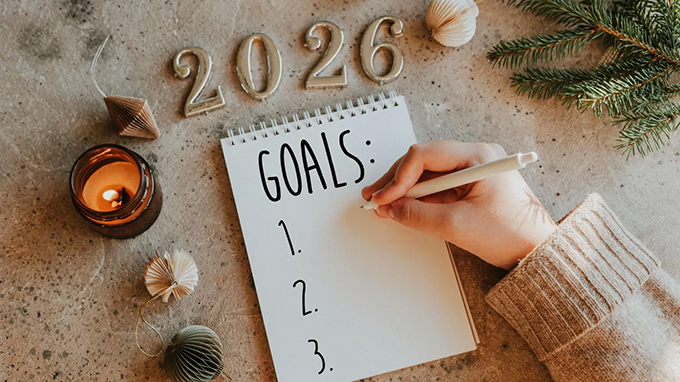
January 1st has something of a “psychological switch” about it. Suddenly, it seems easier to imagine and commit to an improved version of yourself: more active, more organized, healthier. It’s as if the calendar offers a clear starting line and, with it, a sense of control: “I’m starting from scratch,” “this is the time,” “this year I’m going to do it right.”
It’s not just a feeling. The so-called ” fresh start effect” shows that temporal milestones—new year, birthdays, the beginning of a month, or even a week—act as “markers” that propel us toward goals because they make it easier to mentally leave past mistakes behind and look ahead. In other words, these breaks in time make it easier to activate the intention to change because they increase the salience of our ideals (how we would like to be) and momentarily reduce the weight of inertia.
The problem is that starting is the easy part. Maintaining it, on the other hand, is difficult. The initial impulse to “restart” usually lasts only as long as the novelty: a few days, maybe a few weeks. Then the routine, the fatigue, the rush, and the same old distractions return. And when we fail, we tend to explain it with a single word that masks everything: a lack of “willpower.”
From a psychological perspective, however, it’s usually not the will that fails: the design of the change fails. If the purpose isn’t translated into concrete actions, if there’s no plan for overcoming obstacles, and if the environment continues to push back toward old habits, the intention is left alone against a system (your daily life) that’s optimized for “business as usual.”
We turned a desire into a slogan, not into a behavior
“This year I’m going to take care of myself” sounds good, but the brain doesn’t respond to headlines. It responds to concrete actions: what I do, when, where, and for how long. Research on goals has shown for decades that specific goals (with a degree of realistic challenge) work better than vague ones because they focus attention and allow us to measure progress.
There’s a helpful rule: if you can’t write your goal as an observable action, it’s not a plan yet. “Exercise” doesn’t compete with the couch. “Walk for 25 minutes on Mondays, Wednesdays, and Fridays after work” does compete, because it’s already taken shape.
We underestimate the power of habit and environment.
We like to think we make decisions rationally, but much of what we do is automatic. Habits are triggered by contextual cues (places, times, routines, people). And, when they are deeply ingrained, they can be activated even if the conscious intention is otherwise.
That’s why change fails when it tries to happen “in the air,” without addressing the surrounding environment. If your goal is to eat better, but your pantry remains the same and you do your grocery shopping at the last minute when you’re hungry, the old pattern wins. Not because of a lack of values, but because of too much friction.
We are asking the self-regulatory body to do a job that is not its responsibility.
Self-control exists, of course. But it’s more reliable as an occasional boost than as a way of life. The practical conclusion is simple: the more you rely on “toughing out,” the more vulnerable your resolve will be during weeks of stress, irregular sleep, or heavy workloads.
In contrast, when change is based on previous decisions (for example, preparing sportswear for a run, planning simple dinners, uninstalling an app, agreeing on a plan with someone), you reduce the need to negotiate with yourself every day.
We formulate purposes in the negative: “to leave” and “to avoid”
Many resolutions are prohibitions: “don’t eat sweets,” “don’t smoke,” “don’t procrastinate.” The problem is that “don’t” doesn’t tell you what to do when the trigger strikes. What will you do when someone offers you dessert? What will you do when you feel anxious? What will you do when the urge to postpone arises?
A detailed experiment on New Year’s resolutions found that approach goals (adding a desired behavior) are better sustained than avoidance goals (giving up or avoiding something).
It doesn’t mean that “giving up” is impossible; it means that it’s better to translate “giving up” into an “action.” For example: not “giving up sugar,” but “eating fruit after meals” or “eating natural yogurt with cinnamon” (concrete alternatives).
We want quick results, but habit is slow (and not linear).
Herein lies another pitfall: expectations. A classic study on habit formation observed that automaticity increases over time, but at very different rates depending on the person and the behavior. On average, we’re not talking about “a week of motivation,” but rather several weeks or months of repetition.
And there’s a reassuring detail: a single slip-up doesn’t “break” the habit you’re building. What breaks it is abandoning the repetition for too long. Put simply: a bad day doesn’t ruin you; what ruins you is turning that bad day into “it doesn’t matter anymore.”
Intention is not action: the bridge is missing.
In therapy, we often see this: the person knows what they want, but can’t achieve it at the crucial moment. To build that bridge, there’s a surprisingly simple tool with solid evidence: implementation intentions , plans of the type “if X happens, then I will do Y”.
For example, “If it’s Tuesday and I’m leaving late, then I’ll order a ‘plan A’ dinner (salad + protein)” or “If I find myself opening social media accounts out of habit, then I’ll close them and set a 10-minute timer to start the task” or “If I’m offered a second drink, then I’ll order sparkling water.”
A useful complement is mental contrasting : imagining the desired benefit, but also the realistic obstacle that is likely to arise, and planning your response. In educational studies, combining this approach with “if-then” plans has shown improvements in performance and persistence.
“Borrowed” goals: when the change is not yours
Finally, there are goals that arise from external pressure (“I should,” “so I don’t feel guilty,” “to fit in”). Self-determination theory distinguishes between autonomous motivation (aligned with one’s own values) and controlled motivation (driven by external pressure or reward). The former is better at sustaining effort in the long term.
There is a useful, simple, and revealing question: “If no one were watching, would I still want this change?” If the answer is “no,” perhaps the purpose needs to be reformulated so that it connects with something personal.
Let’s try writing the purposes in three lines:
- Behavior: “I am going to ___ (specific action)”.
- Context: “I will do it ___ (day/time/place)”.
- If-then plan: “If ___ (obstacle) appears, then I will do ___ (alternative).”
This approach doesn’t promise perfection. It promises something more realistic: less daily negotiation and more consistency. And, in the end, lasting change tends to look less like a grand gesture in January and more like a sum of small, well-designed decisions.
Author Bio: Oliver Serrano León is Director and Professor of the Master’s Degree in General is Health Psychology at the European University
