
For years, social media has operated under a clear premise: participation means being visible. Posting photos, opinions, achievements, or snippets of daily life has become an implicit norm of digital presence. In many contexts, not doing so can even be interpreted as absence, disinterest, or social disconnection.
However, a behavior that breaks with this logic is becoming increasingly common: people with active social media profiles who consume content, interact privately, and remain connected, but don’t post anything. This phenomenon, known as zero posting , invites us to rethink how we relate to digital visibility and what psychological costs we are willing—or not—to bear.
Being on social media without exposing yourself
Zero posting doesn’t mean disappearing or disconnecting completely. Accounts remain active, and users respond to messages, participate in private conversations, and consume other people’s content, but they deliberately avoid public posting. In many cases, this decision is related to the emotional and cognitive overload generated by intense digital consumption , a phenomenon widely studied under the concept of social media fatigue .
Excessive stimulation, notifications, demands for attention, and social expectations can ultimately overwhelm many users’ capacity for self-regulation. However, this weariness or fatigue with digital platforms doesn’t always lead to complete disconnection.
For some people, the solution isn’t to abandon social media, but to redefine how they use it, reducing the practices that cause the most strain. One of the key mechanisms that explains this strain is constant social comparison .
Anxiety about social evaluation
Social media tends to show carefully selected and optimized versions of other people’s lives, which fosters distorted perceptions about the success, happiness, or well-being of others.
Added to this is the pressure to present an idealized version of oneself . Posting ceases to be a spontaneous act and becomes an identity management task: deciding what to show, how to do it, and what image to project. For many people, this constant effort ends up eroding their sense of authenticity and control over their own digital experience.
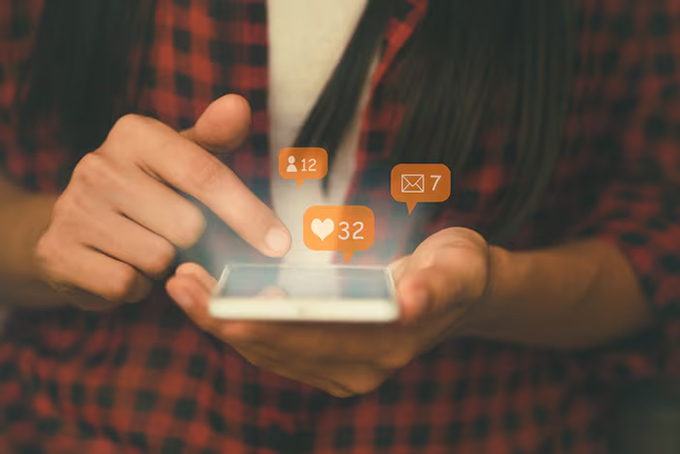
Posting also means exposing yourself to the judgment of others. Every like , comment, or view acts as a form of social evaluation. It’s no wonder, then, that anticipatory anxiety arises when reactions arrive .
The expectation of a response—or the lack thereof—can generate anxiety, rumination, and excessive focus on one’s social performance. From this perspective, ceasing to post is not indifference or withdrawal, but a direct way to eliminate a specific source of psychological pressure.
Digital self-care and emotional regulation
It’s best to avoid alarmist interpretations. Scientific literature links intensive social media use with stress and anxiety , but it also points out that the effects depend on the type of use, life context, and individual characteristics. Not everyone reacts the same way, nor do all digital practices have the same impact on mental health.
In this context, zero posting can be understood as a form of emotional self-regulation : a strategy by which individuals adjust their behavior to reduce stimuli perceived as excessive, without completely relinquishing the benefits of social connection and access to information. This form of adjustment connects with the rise of active strategies to protect mental health, such as digital breaks , reducing notifications, or voluntarily limiting public exposure.
The concept of the Joy of Missing Out (JOMO) also fits within this framework : the joy of disconnecting in the digital age. Giving up being everywhere or showing everything isn’t necessarily experienced as a loss, but rather as a way to regain control, tranquility, and well-being. Zero posting fits well into this logic: it doesn’t imply total disconnection, but a way of being without the constant obligation to be visible.
Between overexposure and silence
From a sociocultural perspective, this phenomenon can be interpreted as a reaction to the culture of exposure and the logic of performative identity on social media, where visibility becomes a value in itself. These platforms not only facilitate communication but also actively incentivize the constant production of content and the monetization of attention.
In this context, not posting can be a way to reclaim private spaces and affirm that personal experience doesn’t depend on the gaze of others for validation . This idea makes even more sense when zero posting is placed at the opposite extreme of overexposure.
As I discussed in a recent article, oversharing can increase emotional vulnerability and blur the lines between private and public life. In contrast, silence can act as a protective boundary.
Perhaps this visible silence is not an anomaly, but a sign that more and more people are learning to regulate their presence on social media, without allowing it to completely define their well-being or their identity.
Author Bio: Oliver Serrano León is Director and Professor of the Master’s Degree in General Health Psychology at the European University
