
Visa restrictions for foreign researchers and students, political attacks targeting some of the world’s leading research universities, and sudden suspensions of public funding, particularly in the fields of climate and the environment: since Donald Trump’s re-election in November 2024, these decisions have generated considerable media surprise. They are often presented as a radical break with the American model of supporting science. Alarmist headlines in the international press speak of an “open war on universities ,” an “accelerated drying up of scientific funding,” or even “science under siege . “
However, while their form and speed are striking, their logic is far less novel. These measures are part of underlying and now structural trends. They accelerate long-identified weaknesses: a relative and discontinuous disengagement of public investment, an increasing reliance on private funding, a concentration of resources in a few sectors and institutions, and above all, a lasting dependence on foreign doctoral students and researchers for the advancement of many scientific frontiers.
American scientific leadership is the product of a specific historical trajectory. Beginning in the 1950s, within the context of the Cold War, the federal government invested heavily in research and higher education, alongside the efforts of numerous private philanthropic foundations. Public funding, academic autonomy, and international openness then formed a coherent whole, serving American soft power. For several decades, the indicators converged : dominance of scientific output, capacity for innovation, exceptional international appeal, and an accumulation of Nobel Prizes.
More erratic public funding
This balance, however, began to weaken in the 1990s. In absolute terms, the United States remains the world’s leading funder of research, with domestic R&D spending representing approximately 3.4% of GDP in the early 2020s. But the distribution of this effort has changed dramatically: nearly 70% of American R&D is now funded by the private sector , while federal research spending has stagnated at around 0.7% of GDP. This dynamic contrasts sharply with that of several Asian countries, particularly China, where public R&D spending has increased significantly since the 2000s as part of ongoing national strategies.
Public funding is becoming more erratic: universities are increasingly relying on tuition fees and private partnerships, while extended programs and scientific careers are becoming less accessible for some American students. The latest reform, initiated in 2026 by the Trump administration, which significantly caps federal loans for master’s and doctoral programs—loans that previously covered the entire cost of studies—will further reduce universities’ capacity to provide long-term training, particularly in scientific and technological disciplines requiring several years of study.
The film Ivory Tower , directed in 2014 by filmmaker Andrew Rossi and drawing on the analyses of sociologist Andrew Delbanco, already warned of the signs of exhaustion in the American university model. It is in this context that the reliance on foreign students and doctoral candidates is increasing sharply, particularly in mathematics, technology, and data science.
A dependence on foreign students
The National Science Foundation’s annual reports show that, as early as the mid-2010s, temporary visa holders constituted a significant—often majority—of doctoral students in several key disciplines: nearly two-thirds of computer science PhDs, and more than half in engineering and mathematics. The vast majority of them (80%) then remain in the United States if immigration policy allows.
This dependence, which has only increased , is not marginal: it now constitutes a pillar of the daily functioning of American research. The immigration restrictions implemented under the first Trump administration, and then tightened in 2025, only serve to fully expose a strategic vulnerability for the country’s future .
The developments in American science have taken place in a global context that has been profoundly transformed since the 1990s. Research and development spending is increasing rapidly in Asia, while the relative share of the United States and Europe tends to stabilize or even decrease in many OECD countries.
China’s trajectory is central in this regard . For over thirty years, China has pursued a continuous strategy, combining massive investments, long-term planning, the development of “key laboratories,” a redefinition of the rules of the game for international rankings, the upgrading of doctoral programs, and active policies promoting publication and the return of expatriate researchers. This trajectory is not simply a matter of technological catch-up, but rather a selective appropriation of models of training, organization, and scientific governance, partly inspired by the American experience.
China, a major player in scientific production
The results are tangible today: rapid growth in scientific publications – in 2024 China became the world’s leading country in terms of the volume of articles indexed in the Web of Science database , with nearly 880,000 annual publications, compared to around 26,000 in the early 2000s – and above all a growing presence in patent filings: nearly 1.8 million applications in a single year, more than three times the American volume, according to the World Intellectual Property Organization ( WIPO ).
In addition, targeted policies are being implemented to attract or bring back Chinese researchers trained abroad, gradually reducing the historical asymmetry with the United States. Far from producing political openness, this controlled circulation of models contributes to the modernization of the state while strengthening the power’s ability to control and legitimize scientific and administrative elites .
The recent New York Times article highlighting the relative decline of Harvard and other American universities in certain global rankings was interpreted as a wake-up call, a sign of sudden decline. In reality, these rankings primarily reveal gradual shifts in relative positions, indicative of long-standing restructuring. American universities remain prestigious and selective, but they are no longer alone at the top in a scientific landscape that is now multipolar.
International innovation indicators confirm this observation: in absolute terms, the United States remains one of the world’s leading investors in research and development. However, its relative lead is eroding: since the early 2000s, the growth of its R&D efforts has been significantly slower than that of many competing countries.
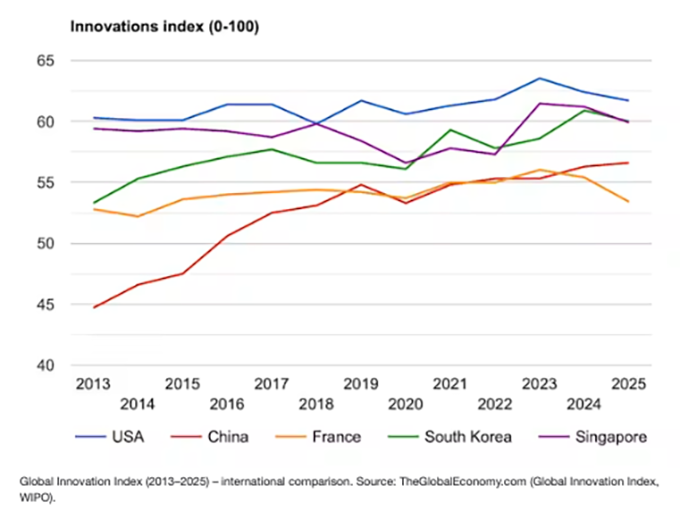
Beyond the decisions of the Trump administration, the causes are structural: continuity and level of public investment, capacity to train and retain talent, coherence of scientific priorities, and the emphasis placed on fundamental research. While China and several Asian countries have integrated science into long-term national strategies, the United States has allowed inconsistencies and imbalances to accumulate, relying on the gains of its past attractiveness. Nevertheless, it retains universities of exceptional standing, significant funding and innovation capabilities, and a still largely dominant power of attraction.
In the short term, there is no indication of a sudden decline. However, the sustainability of this leadership can no longer be taken for granted. It is now directly affected by explicit challenges to academic autonomy and the ordinary operating conditions of universities.
This leadership will depend on the ability of universities to freely recruit their teachers and researchers globally; to maintain policies and training and research programs that are immune to political cycles; to protect their leaders from partisan pressures; and to guarantee students and researchers stable intellectual working conditions and career prospects.
It is precisely these conditions that Donald Trump’s recent decisions have rendered permanently uncertain.
Author Bio: Alessia Lefébure is a Sociologist, member of the UMR Arènes (CNRS, EHESP) at the School of Advanced Studies in Public Health (EHESP)
