Asking this question when many French people, who are lucky enough to be able to take a vacation, have just finished it feels somewhat untimely. Even if vacations are never exactly what we had imagined they would be, even if their end is often accompanied by a little nostalgia (“Farewell, bright light of our too-short summers!” said Baudelaire), it is legitimate to hope that these days and nights of July or August when we are a little more in control of our time than in other months have allowed many of us to reconstitute what we could call the water table of the self.
May those who were exhausted in June indeed have found in the nap or in the game, in swimming or in card games the resources (the new sources of vitality) that they lacked. Like old Faust regaining his youth, are there not many who can say:
“Already I feel my strength increasing; already I sparkle like a new liquor: I feel the courage to risk myself in the world, to bear its pains and its prosperity.”
But how can we not guess that this state of affairs will not last long? That if we are not tired today, we will undoubtedly be tomorrow? Since there have been paid holidays, this situation must have repeated itself many times, and must be more or less the common lot.
However, it seems that, in recent years, fatigue has ceased to be a purely seasonal phenomenon and has become more lasting and more deeply felt in people, and that, although fatigue is part of the human condition as such, it has now taken on certain colours which make what we could call “good fatigue” rarer.
Good and bad fatigue
As examples of good fatigue, we could take that of the Sunday cyclist returning from his 30 km, or that of the worker who loves his job and who, at the end of the day, the week or the year, who, although tired, experiences what Kant would call the moral pleasure of work well done or of duty accomplished. Fatigue of the body but not of the soul, rejuvenated by this joy, by this pleasure. Fatigue without weariness in short.
We hope for this kind of light, spring-like fatigue from our contemporaries.
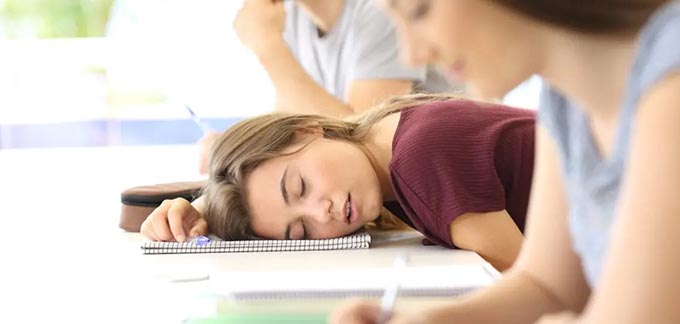
But we must recognize that they seem to have become less common than these bad fatigues – the extreme form of which is exhaustion that sometimes leads to burnout , which are not only fatigues of the body but also of the soul, bad in that even rest is not the remedy. For if the being who knows good fatigue goes to sleep as if to a reward, the one who knows bad fatigue goes to it as if to a refuge – a refuge where unfortunately the hoped-for peace is not found, because his sleep is not the one into which a Montaigne slipped voluptuously, but the one into which he “falls like a mass” before experiencing painful moments of insomnia, those that Baudelaire called “those vague terrors of our dreadful nights that compress the heart like crumpled paper.”
It is said that the French are sleeping less and less and less and less well.
Certainly, the insomniac always exaggerates the seriousness of the existential situations – personal or professional – in which he is caught, and upon waking from a restless night he often finds himself empowered to act, the loss of consciousness of which was precisely one of the causes of his insomnia. But when the course of his day confirms the debility of said power, how could he not find the following night the Baudelairean “vague terrors” mentioned above, that is to say his anxieties (because anxiety is very precisely what “compresses the heart like crumpled paper”, for this reason that the word comes from the Latin angustia which meant: narrowness, constriction)?
The hypothesis that this article would like to submit to criticism is that this alteration of sleep and the resulting fatigue are largely due to the climate of lasting uncertainty in which we now live.
A life saturated with uncertainty
As the philosopher Hannah Arendt said , in this ocean of uncertainty that is, by definition, the future, we need islands of certainty. But no sooner have we seen one that seems to be floating than the sea of worrying information submerges it: climate change , war in Ukraine and the Middle East , Trumpization of the world… For there to be a feeling that life is good, must there not be a balance between certainty and uncertainty, habit and novelty, organization and improvisation, the return of the same and the resurrection of the other, fidelity and freedom, circularity and linearity, or even, as Simone Weil would say, rooting and uprooting?
The need for this balance stems from the fact that, without a minimum of certainties, we cannot welcome uncertainty like a spice, that we must have habits to see novelty as an opportunity and that, without a minimum of rootedness, we would not experience uprooting as a happy liberation. Saturated with certainties, habits and loyalties, life is boring; but hellish is the life where nothing is certain and where everything is constantly renewed.
But there is little doubt that we have lost this balance.
Lost is what the writer Jean Giono called the “roundness of days,” that is, the restful return of the same, the sequence of those habitual tasks that an obscure force deep within us—the force of habit as second nature—called, invoked, implored that we accomplish. Let there be no mistake: this is not at all about giving in to nostalgic temptation, for the reason that the nostalgic gesture, whose origin is often the insufficient effort to understand one’s present, is always preceded by a gesture of idealization of the past. No, the life of peasants at the beginning of the last century was no less tiring than ours, which Brassens described so well in Pauvre Martin :
“To earn his living,
From dawn to dusk,
In all places, in all weathers!
He turned over other people’s fields,
Always digging, always digging.”
But as George Orwell says in A Little Fresh Air :
“People had something then that they don’t have today. What? It’s simply that the future didn’t seem terrifying to them. They didn’t feel the ground shifting beneath their feet.”
A stitch in the soul
Too many uncertainties are tiring, sometimes ending up discouraging those who try to understand their world, so little masters of their time that they experience something like the feeling of temporal alienation. A liquid and even gaseous world, which technical progress is constantly transforming, to the point that the neoliberal system seems to require today’s workers to permanently readjust to an impermanent world.
Those who, after chasing this world where everything is accelerating, feel a stitch in their soul and are tempted to let themselves slide by the wayside deserve to be understood.
We do not think that, like the essayist Paul Lafargue , we should advise them, as a remedy for their fatigue, this laziness which in small doses is good, but which, becoming a way of being, is selfishness – because for the lazy person to be able to laze around, many people must be active. But that the organization of work allows them to rediscover the good fatigue we spoke of above seems urgent to us, and, in a sense, one of the possible inspirations for a reorganization that is both political and social in the world of work.
Happy new school year to all!
Author Bio: Eric Fiat is Professor of Philosophy at Gustave Eiffel University
