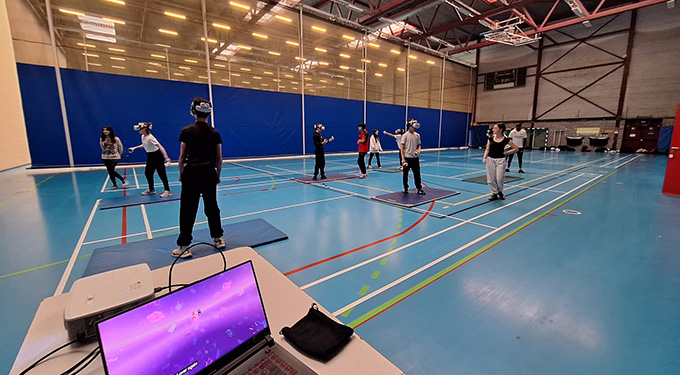
Today, technology has changed many aspects of our lives, from what we do every day to how we learn at school. Even physical education is changing thanks to new tools that blend the physical with the digital.
According to our recent research , virtual reality, augmented reality, and mixed reality can help students feel more motivated. They can also improve the way they communicate and learn. They can also engage all students, regardless of their needs, making the classroom more inclusive.
Virtual, augmented and mixed reality in physical education
Before explaining how to apply these technologies, let’s define what we mean by each of them:
- Virtual reality creates a fully digital and immersive world where the person can move and interact with what they see.
- Augmented reality adds digital images or sounds to the real world. It doesn’t change the surroundings; it just enhances them. This way, people see more details and feel more interest.
- Mixed reality combines the best of both: it blends digital objects with the real environment. Everything happens simultaneously and interactively.
Their use in Physical Education doesn’t mean replacing exercise with technology, but rather the opposite. These technologies serve to make physical activity more fun and varied, helping us move more .
How to use them?
There are programs that allow you to run, do yoga, or correct posture. They also help measure your performance. It’s even possible to turn exercise into a game.
All of this is done while we move, with the help and guidance of a virtual assistant. The experience is active, realistic, and very engaging.
For example, FitXR offers the ability to work out without leaving home using virtual reality headsets . This app is an ideal option for those who don’t have time to go to the gym or don’t feel comfortable in that environment. Meanwhile, Jumpr, FunFit, and Starri use augmented reality to perform physical exercise using a mobile phone. Another app that uses mixed reality is Holofit , which allows you to run or exercise in virtual environments superimposed on real space.
The benefits for Physical Education
- Improving movement skills. Several studies show that using these tools helps improve movement. For example, with augmented reality, students can see in real time whether they are positioning their bodies correctly and can correct mistakes.
- Creating safe places for practicing difficult or dangerous sports, such as skiing or climbing, thanks to virtual reality.
- Increased motivation and desire to participate. Technology can make exercise more fun, as it introduces playful and interactive elements. In this sense, some video games that require movement have also been found to increase interest and commitment to sports.
- Help for students with special needs. These technologies allow all students to participate, even those with disabilities. Activities can be tailored to be safe and effective for each individual. Several studies show that using virtual and augmented reality improves motivation , memory, and body control in students with disabilities.
- More personalized class design, adapting the activity to each student, according to their pace and level.
- Cognitive benefits. This type of activity improves attention and memory , promotes interaction, and stimulates creativity. It also creates a good context for using active methodologies in physical education classes .
Challenges and issues to consider
Using this technology in physical education classes, or for exercising at home, shouldn’t simply involve putting on virtual reality headsets and starting to exercise, or giving them to students. It’s essential to have specific technologies, something not everyone can afford, and to have sufficient understanding of the software . Ample space is also required to use them properly, and many of them have paid options that limit their potential for teaching physical education.
Author Bios: Salvador Pérez Muñoz is Professor in the area of Physical Education and Sports Sciences, Alberto Rodríguez Cayetano is Professor of Racket Sports Fundamentals and Physical Activity and Sports Didactics, Paula Teresa Morales Campo is Professor at the Faculty of Education and Raimundo Castaño Calle is Dean. Professor, Faculty of Education. Area: Attention to Diversity and Inclusive Education all at Pontifical University of Salamanca
