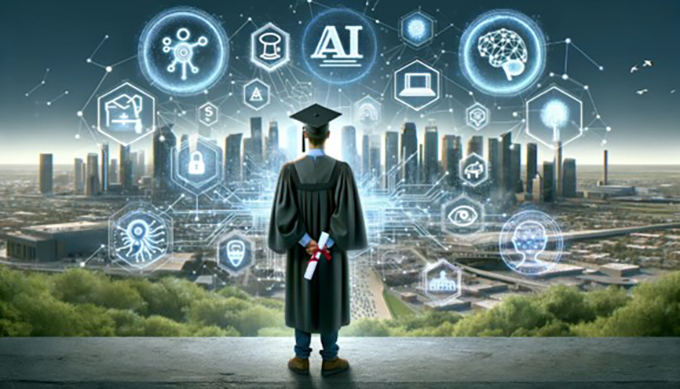
Is artificial intelligence proving to be the revolution in education it was predicted to be? How much and how is it being used by students and teachers? In a recent article, we analyzed its integration into universities from two perspectives: scientific (i.e., research on its use at universities) and social (the perception of its use at universities).
While researchers highlight the opportunities and challenges posed by personalized learning, public perceptions reflect slower and uneven adoption, particularly in Europe.
Personalization, virtual tutors and administrative tasks
In recent years, artificial intelligence has begun to make its way into the educational field , particularly in areas such as learning personalization , the creation of virtual tutors, and the automation of administrative tasks.
Platforms like Smart Sparrow, Knewton, Century Tech, and Khan Academy use AI to adapt the pace and content of learning to individual students’ needs through adaptive learning systems. These systems use artificial intelligence to analyze student performance (correct or incorrect answers, response time, error patterns); automatically adjust the level of difficulty, type of content, or pace; and recommend additional exercises, videos, or readings.
Another application is tutoring systems: these are conversational agents ( chatbots or virtual assistants) that interact with students as a human tutor would and whose typical functions are to answer questions about content, propose exercises, give explanations, solve problems step by step, motivate and accompany the student in their progress.
Some examples include Khanmigo (Khan Academy + GPT-4), which helps with math, writing, and science; Duolingo Max, an artificial intelligence for personalized language tutoring; Socratic (by Google), which answers questions with visual explanations; and Mika (Carnegie Learning), an AI tutor for math.
All of the aforementioned platforms use machine learning models that recognize student strengths and weaknesses. This technology is already being used successfully in disciplines such as medicine, electronics, and linguistics, areas where large-scale data analysis and automation are essential for teaching and research.
Finally, this technology allows for efficient management of administrative processes such as exam grading and grade management.
Limitations and challenges
However, despite the expectations generated, the real impact of artificial intelligence on higher education remains modest . Globally, its use in universities is still in its infancy, and its adoption varies greatly across regions and disciplines . While significant progress has been made in some areas, such as health sciences, other, more humanistic areas have only just begun to explore the possibilities of this technology.
One of the main challenges is the lack of adequate training for teachers and administrators in the use of artificial intelligence tools. Many teachers lack the technological skills necessary to integrate these solutions into their classrooms, which limits their adoption. Furthermore, the lack of clear policies regarding student data privacy and the ethical use of this technology poses significant barriers.
Low scientific production in Europe
In our recent study, we sought to compare research devoted to the use of artificial intelligence in education with the social perception of its use through mentions on social media.
Despite being a leader in regulations on the ethical use of technology, Europe is lagging behind in terms of scientific production on how to integrate it into educational methods, with the exceptions of the United Kingdom—with very solid ethical research on educational artificial intelligence and adaptive teaching models and automatic assessment—and Germany and the Netherlands, where EU projects with interdisciplinary approaches combining education, cognitive sciences, and computer science are led.
The United States leads the way in scientific publications, patents, and the development of educational technologies based on this technology, while China has seen a significant increase in publications and applications of educational AI, especially in adaptive learning and facial recognition in smart classrooms. The state’s massive investment in ” Smart Education ” is part of its leadership strategy in AI.
Latin America (especially Brazil, Chile, and Mexico) has an emerging scientific output, with advances in adaptive educational platforms and learning data analysis, and a growing interest in using this technology to reduce educational gaps and improve access in vulnerable areas.
Social perception
The use of artificial intelligence in education has also generated a social debate. We have found that social media reflects a neutral perception or even a lack of awareness about its impact on universities. Despite its growing presence in conversations about educational technology, most mentions express neither unbridled enthusiasm nor significant concern.
While scientists are focusing more on the development and academic impact of AI, social media users are primarily focused on AI tools, like ChatGPT, that help students with more practical, everyday tasks.
Where is AI heading in education?
Learning personalization and task automation are just the tip of the iceberg of what this technology can offer. To harness its true potential, it is crucial to invest in teacher training, develop clear policies, and promote greater collaboration between researchers, educational institutions, and society.
AI is opening new doors in education, but its adoption still faces significant barriers, especially in Europe. Despite advances in medicine, electronics, and linguistics, its widespread implementation in other areas requires both scientists and society to close existing gaps and take full advantage of its opportunities.
Author Bios: Angel Bartolomé Muñoz de Luna is Professor of Creativity and Sonia Martín Gómez is Professor of Business Organization both at CEU San Pablo University
