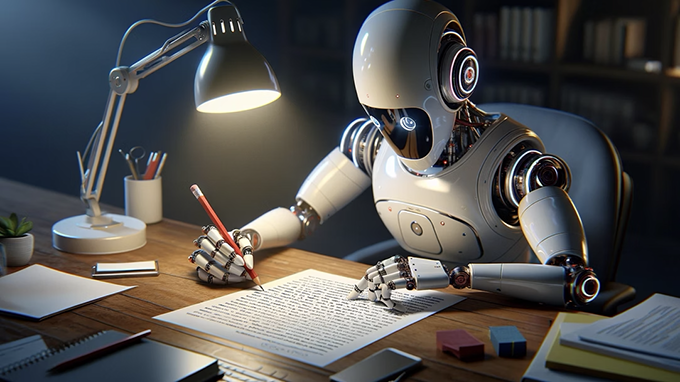
For centuries, before the advent of automatic spell checkers, proofreading depended on professionals such as scribes, copyists, copyeditors, typographers, or simply people with a good understanding of spelling.
This continued until the 1970s and 1980s, with the advent of personal computers. Then, the way we wrote and corrected documents changed. Writing began to be digitized, and automatic spell-checkers emerged as systems based on simple rules and comparisons with dictionaries or predefined lists.
One of the first was SPELL , designed in 1971 at Stanford University (United States). This program analyzed English texts and detected misspelled words by comparing them with a dictionary. It also suggested corrections for common errors such as single-letter substitutions or transpositions. However, it did not interpret the context or the meaning of words.
In the late 1980s and early 1990s, programs like Microsoft Word began to include integrated spell checkers in their text creation and editing applications. For example, in 1995, Microsoft Word introduced the familiar red underlines that flagged errors in real time. Yet, these tools still failed to interpret the context or intent of the message.
Despite the limitations, these advances facilitated the text revision process.
Writing well in the digital age
Although we have many tools available today to help us write correctly, the reality is that, in an environment where we constantly write texts—emails, reports, social media messages, applications, and so on—we often adopt bad habits for convenience or speed. For example, it’s common to see questions that only have a question mark at the end or omit accents.
For this reason, automatic spell checkers remain essential. While many already offer effective solutions for simple spelling errors (such as confusing “v” with “b” or forgetting an accent mark) and basic grammatical or style errors, the real challenge arises when more complex errors arise that vary depending on the context.
Can artificial intelligence (AI) detect and correct these types of errors? Can it, for example, identify incorrect uses of the pronoun “you” in formal texts, where an impersonal form should be used?
Limited contexts
Currently, many AI-based tools are equipped to correct basic spelling and grammatical errors . For example, systems like Grammarly , LanguageTool , and Microsoft Editor use a combination of linguistic rules and statistical or machine learning models. This allows them to detect misspellings, common confusions between simple homophones (such as “echo” and “hecho”), and grammatical or mood agreement errors.
However, they have limitations when faced with errors that require a more comprehensive understanding of the text. One of the main reasons is that they tend to process content in fragments, with a limited number of tokens (linguistic units that can be words, parts of words, or symbols), known as the ” context window .” Therefore, they don’t capture the relationships between different parts of the document well.
Furthermore, many of these tools rely on predefined rules and patterns learned from limited examples, which limits their ability to detect changes in tone, variations that depend on the type of text or the recipient, or stylistic redundancies, among other difficulties.
The challenge: correcting complex errors with AI
An example of a difficult-to-detect error is the incorrect use of the gerund. In sentences like ” I left home, forgetting my backpack ,” its use is incorrect because the gerund can only express actions that occur before or at the same time as the main action, but not after.
In this case, the forgetting occurred before leaving, so that use is temporally inconsistent. To correct this, the AI must look at the context and the relationship between the actions.
To this end, in research projects like PALABRIA-CM-UC3M, we are working on new ways to detect complex errors, such as the use of the impersonal “tú” in formal contexts, the non-normative gerund , and discourse markers . These are errors in register, syntax, or cohesion that require a thorough understanding of the text.
To address automatic correction, various approaches have been proposed , including rule-based methods, statistical approaches, and neural models. Our project combines linguistic rules with artificial intelligence models. Specifically, several types of deep learning-based models are being tested, including generative AI with a transformer -like architecture .
Advantages of generative AI
With this approach, longer texts can be processed and all the words in a sequence can be analyzed simultaneously—using a mechanism known as self-attention —unlike previous models. This allows it to better capture the relationship between different parts of the text and detect complex errors related to register, syntax, or cohesion.
Another advantage of generative AI is its ease of use. It works based on instructions written in natural language, called prompts . That is, simply by clearly and effectively expressing what is needed—for example, to review a text and correct certain errors—the model can generate an appropriate response.
Finally, we must remember that the use of AI in writing does not replace creativity or communicative intent. On the contrary, if used consciously, it can be a very useful tool, especially in educational settings. It can detect errors, suggest improvements, and encourage clearer writing.
Author Bios: Pedro Manuel Moreno-Marcos is Professor in the Department of Telematics Engineering, Marina Serrano-Marín is Assistant Professor in the Department of Humanities and Natalia Centeno Alejandre is a Specialist Technician in Artificial Intelligence all at Carlos III University
