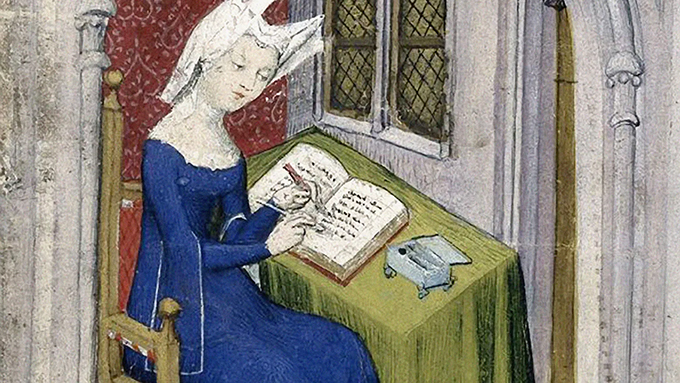
The Middle Ages often appears as a dark period for women: cloistered in obscure monasteries or subject to their husbands, they were supposedly kept away from power and any form of written culture.
This cliché, like many others about the so-called Dark Ages, emerged during the Renaissance and developed within the Enlightenment. However, during the six centuries following the fall of the Roman Empire, the status of women was very different from this collective imagination. In the spheres of power and knowledge, some women held prominent positions, though not quite the same as those that would emerge between the 12th and 15th centuries.
The Middle Ages is a long period and many political, economic or religious reconfigurations changed and affected the condition of women: those at the end of the period are better known because we have more sources, but those at the beginning sometimes had access to unexpected economic or cultural resources.
Women also participated in the culture of their time, as demonstrated by the research highlighted in * The Life of Women in the Middle Ages: Another History, 6th-11th Centuries* (Perrin, 2026). In an era of low literacy, it was sometimes through women that the skills of reading and writing were passed down.
Learning to write
To write, one must of course have learned the technical skill of tracing letters on parchment. Today, reading and writing are learned together, but in the Middle Ages, many people could read without necessarily being able to write, except perhaps their own name.
Medieval literacy was conceived as a spectrum: there was a world of difference between knowing how to read and being able to compose a complex text in Latin. Consequently, complete mastery of writing was reserved for a small elite, both lay and ecclesiastical, and increasingly for writing professionals such as notaries, whose importance grew from the 12th century onward. Furthermore, laypeople most likely to have learned to read and write also employed secretaries: in the early Middle Ages, for example, aristocrats did not write their letters themselves but dictated them to secretaries, or sometimes only gave them a few instructions.
Women were not excluded from these systems; quite the contrary. In the secular aristocracy of the first half of the Middle Ages, it was not uncommon for them to receive a thorough education.
The reason is simple: they are often themselves in charge of the education of their children. Queen Matilda, wife of King Henry I of Germany ( 919-936), for example, could read and write, which was not the case for her royal husband and, in the Ottonian family (named after their son, King and later Emperor Otto I ) , it is often the women who are the most literate.
Copyists and authors
Yet it is not among lay people but within women’s monasteries that one finds the most women who know how to write. The most common activity is copying manuscripts: before the invention of printing, it is this tireless work that allows the dissemination of works.
It is estimated that approximately 1% of medieval manuscripts were copied by women . This may seem insignificant, but it’s important to remember that the vast majority of manuscripts are not signed by their scribes, and therefore, it is rarely possible to know the gender of the scribe. In any case, the work of nuns was far from being disregarded: at the end of the 8th century, the nuns of Chelles were the primary suppliers of copies of Augustine of Hippo, one of the most widely read Church Fathers in the Middle Ages. They received commissions, notably from the bishops of Cologne and Würzburg.
It is therefore logical that monasteries are also where we find the most female authors, that is to say, women who do not simply copy existing works but compose new ones. No literary genre is forbidden to them: they write hagiography – the lives of saints, both men and women – annalistic texts, treatises, poetry, and even plays.
The playwright and poet Hrotsvita , who lived at the monastery of Gandersheim (in Saxony) around 960, is thus considered the “first German poetess” even though she wrote, like most of her contemporaries, in Latin.
A “feminine” style of writing?
These texts by women have been studied in various ways by historians, initially with a touch of suspicion: when Hrotsvitha’s works were rediscovered in the 19th century, eminent scholars doubted their attribution and sought, in vain, to assert that the nun had never existed, or never written…
It was only in the 1980s that medieval scholars truly began to take an interest in the writings of medieval women before Christine de Pizan. This work is marked by the idea that men’s writing differed from women’s. This difference does not refer to handwriting or paleography, since gender distinctions only emerged in the 18th century, but rather to style.
Women, even in the Middle Ages, were said to speak more readily about their emotions and their families. This is undoubtedly true in some texts, but in reality, texts written by women show more similarities than differences with those written by men. This is due, in part, to the influence of ancient models on medieval writing: when the nun Baudonivia wrote the life of Saint Queen Radegund around 600, she had in mind the quintessential model, the Life of Saint Martin , just as her contemporary Venantius Fortunatus did, who also dedicated a text to the saint.
However, particularly from the 12th and 13th centuries onward, it seems that women’s writing was increasingly restricted, sometimes confining them to certain types of writing. The great reform of the Church known as the Gregorian Reform sought to better regulate the practices of the faithful and redefine women’s relationship to the sacred. The development of universities—reserved for clerics and therefore for men—also excluded women from a whole area of knowledge.
It is within this context that female mystics flourished, their writings extolling a special closeness to the divine. But here again, the reality is complex: these women’s visions were often written down by their confessor or a man who could rework the material transmitted by the mystic. Even Hildegard of Bingen, the great scholar and abbess of the 12th century, used a secretary. In the Middle Ages, the idea of a single author rarely held true, and the writings of both women and men often involved a multitude of contributors.
Author Bio: Justine Audebrand is Associate Researcher at the Laboratory of Medieval Studies in Paris (UMR 8589), postdoctoral researcher at the German Historical Institute at the University of Paris 1 Panthéon-Sorbonne
