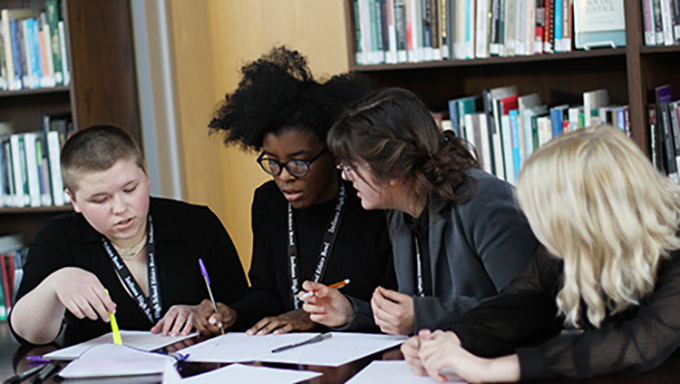
As Canadian federal election candidates prepared for their final debate in April 2025, youth across the country were preparing for collaborative conversations around timely and potentially divisive issues for the National Ethics Bowl at the Canadian Museum of Human Rights in Winnipeg.
Ethics Bowl Canada is a non-profit organization that hosts competitions where high school and university students explore complex ethical issues through respectful dialogue in teams.
Rather than trying to undermine their opponents’ arguments, as in traditional debates, Ethics Bowl competitors win by engaging constructively, responding positively to reasonable criticism and refining or amending their views.
Polarization and engaging with disagreement
The Public Policy Forum’s 2023 report Far and Widening: The Rise of Polarization in Canada documented serious issues around how young people think about their futures. It highlighted that, among young people’s concerns like pandemics, climate emergencies and a declining economy, their deepest fear for Canada’s future is growing political and ideological polarization.
The erosion of trust in institutions like government, industry and media contributes to people seeking alternative sources of information.
Alternative sources sometimes contribute to healthy social empowerment and democratic participation. But we are also living with cascading misinformation — sometimes sewn by groups seeking to destabilize society — with harmful effects. Through algorithmic filtering we’ve seen a growth of ideological echo chambers.
Philosophers like John Stuart Mill, John Rawls and Seyla Benhabib have long proposed that engaging with diverse and sometimes contrary points of view is part of what legitimizes democracy.
Conflict and disagreement are healthy parts of a democracy. But these need to be engaged with productively.
How the Ethics Bowl works
The Ethics Bowl is a “gamified” way of engaging in deliberative dialogue about civic issues. More than 1,500 high school and university students now participate in Ethics Bowls each year.
Ethics Bowl teams conduct research on cases created by philosophers and subject matter experts, and then form their opinions and arguments on them. Teams of three to five students then participate first in regional competitions, where they present their arguments, listen to other arguments, provide comments and respond to feedback.
A panel of judges (including philosophers, subject matter experts and community members) scores the teams. Their rubric rewards acknowledging nuance, refining positions and being respectful. Regional winners then compete nationally.
Evidence shows thinking and talking about ethics alone can be a driver for social change. The Ethics Bowl is also an intervention that allows participants to develop their civic discussion skills.
Research shows that engaging in this kind of dialogue can help participants acquire civic virtues, such as tolerance, respect for diverse viewpoints and willingness to engage in conversation.
Vaccines as a timely topic
While the legitimization of anti-vaccine rhetoric continues in the United States, Canada is not immune to divisiveness around vaccines.
Since the pandemic, Canada has seen a rise in vaccine hesitancy, a resurgence of measles and a shift in COVID-19 vaccine accessibility.
Among young people in Canada, vaccination is now one of the most polarizing topics of discussion.
To support young people reflecting upon ethical tensions around vaccines, Ethics Bowl Canada partnered with the Bridge Research Consortium (BRC), a national consortium of social scientists and humanity scholars. BRC scholars have a broad range of expertise to support public trust and equitable access to new vaccines.
Vaccine case studies
BRC Bioethicists developed timely case studies for the National Ethics Bowl:
- One case deals with family disagreements around vaccine mandates.
- Another case centres on navigating the use of preventative health measures on farms, including preventive vaccinations for farmers and the culling of animals, if an avian influenza (H5N1) outbreak leads to a pandemic. This case was inspired by the first confirmed positive case of H5N1 on an ostrich farm in British Columbia, which made worldwide headlines.
Participants in the National Ethics Bowl found these cases the most challenging in the competition. One participant said:
“Public health is not something we often think about.”
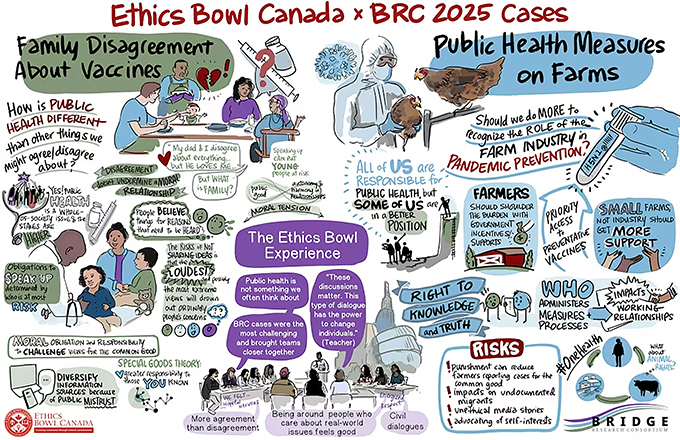
A graphic illustration visually captured the many themes and reflections emerging from six teams discussions, and a version with links to the case studies is available on the Ethics Bowl website.
An illustration visually captured the rich themes, takeaways and experiences emerging from six teams’ discussion of both vaccine cases. (Ethics Bowl Canada), Author provided (no reuse)
Engaging in civil dialogues is a transformative experience for students. As one teacher explained:
“These discussions matter. This type of dialogue has the power to change individuals.”
They also contribute to a sense of belonging. One high school student shared:
“Being around people who care about real world issues feels good.”
An educational model to train scientists
Scientists have also been caught in the crosshairs of political partisanship on vaccines. Despite a decline of trust in many institutions, scientists are still trusted sources of information by the public globally.
As evidenced by the COVID-19 pandemic, confidence in and the adoption of immune-based innovations moves at the speed of trust. Yet, rather than a loss of trust, scientists are losing influence to other information sources.
The need for scientists to strengthen trust and resonate with the public among the sea of other voices was addressed by a second mini Ethics Bowl with science graduate students in Montréal in June 2025. Before the event, 86 per cent of the science graduate students indicated they rarely or sometimes discussed the ethical implications of their work.
Student participants were part of RAMP-UP, a Québec-based research initiative developing reliable, scalable and adaptable biomanufacturing processes to produce vaccines and immunotherapies ahead of a future health emergency.
This mini ethics bowl was a teaching and learning tool to support students’ deeper engagement with the moral and ethical implications of their work, and to instil more socially informed science engagement.
Science researchers deliberate ethical concepts
As part of the full day of the mini Ethics Bowl training, students were introduced to ethical and philosophical concepts and engaged with experts in multiple disciplines. They competed in an Ethics Bowl with their peers discussing the above described vaccine-related case studies.
As captured in an illustration of events, not only did students feel stimulated and learn new knowledge, they came away calling for more integration of the social sciences and humanities in their education.
They also reflected on other ethical tensions in their work — like pharmaceutical companies profiting from their research.
We recommend this novel model of learning be introduced into curricula for scientists working on polarizing topics like immunology.
How to engage in productive dialogue
From election periods to holiday dinners with family, here is a blueprint for how people can collectively engage in productive dialogues:
1. Disagreement isn’t a failure: Instead of viewing someone disagreeing with you as having failed in some way (perhaps by being irrational), view them as an intellectual equal. Rational processes can result in more extreme (farther in content from other opinions) and radical (more strongly held) opinions. The processes that produce more extreme and radical opinions can also work on you.
2. Listen and try to understand: Be curious about, and interested in, interpreting what your conversation partner is saying with empathy. This can allow you to evaluate their points more fairly. Empathizing might allow you to better understand where others are coming from.
3. Set realistic expectations: People rarely change their minds during a conversation. But if sustained conversation focuses on practical issues, as opposed to foundational values, parties change their minds more often while reflecting between conversations.
Author Bios: Rackeb Tesfaye is the Knowledge Mobilization Lead and Senior Scientist at the Bridge Research Consortium and Nicolas Fillion is Assistant Professor, Philosophy both at Simon Fraser University
Cem Erkli, program co-ordinator for Ethics Bowl Canada, and Pierre-Jean Alarco, knowledge mobilization officer for RAMP-UP, co-authored this article
