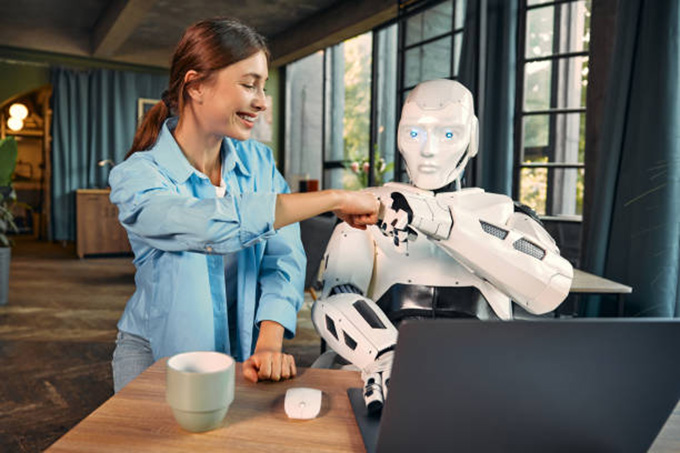
Robots make headlines when they imitate us: they converse in almost human voices, write texts that sound like ours, or “read” emotions on a screen. But the truly important leap is another: to stop copying us and start complementing us, designing capabilities that fill in our gaps—attention, biases, fatigue—and valuing machines for their impact on people, not for how human they appear.
Cognitive robotics: digital humans?
Maybe, if we hear about cognitive robotics , we don’t know what it is. But we’ve probably read some news about Neuralink , Elon Musk’s company that seeks to connect brains and computers; or we’ve seen clumsily dancing androids ; or we’ve heard about Amazon robots that roam warehouses loaded with packages.
Cognitive robotics seeks to give machines more than just strength and precision: abilities similar to those of humans or animals. It’s not just about moving motors and sensors, but also about enabling them to perceive, remember, learn, anticipate, and adapt when things change. Its goal is to move from a “robot that repeats” to one that understands context. To achieve this, it integrates disciplines such as artificial intelligence, cognitive science, and biology.
Drones and brain prostheses
Within this field, there are very different strategies. For example, swarm robotics, inspired by ants or bees, studies how simple robots can accomplish things together that a single robot couldn’t: from drones that coordinate rescues to machines that share tasks in a warehouse.
Instead, approaches such as neurorobotics or developmental robotics seek to mimic human cognition by modeling the brain or copying children’s learning mechanisms.
What began as an academic challenge is now moving beyond the lab. We see social robots in classrooms and hospitals, swarms in the logistics industry, and prosthetics controlled by brain signals. They are advancing, but with limitations: they still depend on controlled environments, lack common sense, and don’t generalize well what they’ve learned.
Author Bio: Nagore Osa Arzuaga is Professor and Researcher in Industrial Design Innovation, specializing in Human-Robot Interaction Design and Human Factors at Mondragon University
Collaborators: Ganix Lasa Erle is Professor and Researcher at Diseinu Berrikuntza Zentroa (DBZ), specializing in Interaction and Technology Design and Maitane Mazmela Etxabe is a PhD. Researcher and Lecturer in Industrial Design both at Mondragon Unibertsitatea
