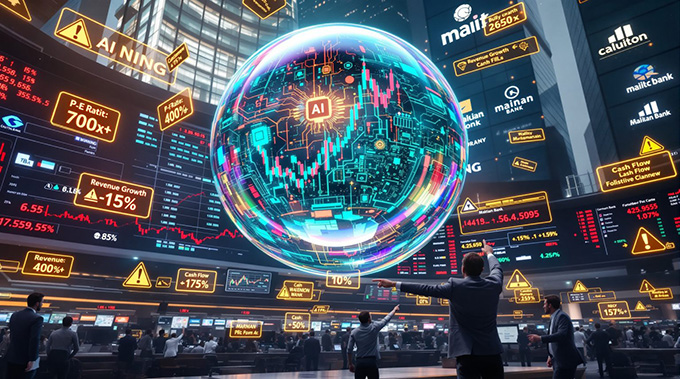
Booms and busts are a recurring feature of the modern economy , but when the value of an asset becomes excessively inflated, a boom quickly turns into a bubble.
The two most recent episodes of this kind were the dot-com bubble in the United States (1996-2000) and the housing bubbles that emerged around 2006 in various countries. Both ended in recession: the first relatively mild, the second catastrophically severe. The recent, dizzying increases in the stock prices of AI-related companies have led many investors to wonder: “Are we witnessing another asset price bubble?”
It’s important to put the current AI boom into context. The share price of Nvidia, which makes many of the computer chips powering the AI industry, has increased 13-fold since the beginning of 2023. Shares of other AI-related companies, such as Microsoft and Alphabet, Google’s parent company, have increased 2.1-fold and 3.2-fold, respectively. By comparison, the S&P 500 index , which tracks the performance of the largest US companies, has only increased 1.8-fold over the same period.
It’s important to note that these AI-related companies are included in the S&P 500 , further widening the gap with non-AI companies. Therefore, it appears there’s an AI bubble, but this doesn’t necessarily mean a repeat of what happened in 2008.
How a bubble forms
The price of any stock can be broken down into two components: its fundamental value and the inflated value of the bubble. If the stock price is above its fundamental value, a price bubble exists.
The fundamental value of an asset is the discounted sum of its expected future dividends . The key word here is “expected.” Since no one, not even ChatGPT, can predict the future, the fundamental value depends on each investor’s subjective expectations. They may be optimistic or pessimistic; over time, some will be right and others wrong.
Optimistic investors expect AI to change the world and for the owners of this technology to reap (almost) unlimited profits. Unsure which company will ultimately succeed, they invest in all AI-related businesses.
Conversely, pessimistic investors think that AI is just a complex computer program, rather than a truly innovative technology, and they see bubbles everywhere.
A third possibility is the more sophisticated investors. These are people who think, or know, that there is a bubble, but continue investing in the hope of riding the wave and getting out before it’s too late.
The last of these possibilities recalls the infamous quote from Citigroup CEO Chuck Prince before the 2008 housing bubble burst: “As long as the music is playing, get up and dance.”
As an economist, I can confidently say that it’s impossible for all AI-related companies to ultimately dominate the market. This undoubtedly means that the value of at least some AI-related stocks has a significant bubble component.
Asset shortage
Asset price bubbles can be the market’s natural response to asset shortages . When demand for assets exceeds supply (especially for safe-haven assets like government bonds), there is room for newer assets to emerge.
This pattern explains the emergence, for example, of the dot-com bubble of the 1990s and the subsequent real estate bubble of the 2000s. In that context, China’s increasingly important role in financial markets increased the demand for assets in the West : money was first directed to dot-com companies in the 1990s and, when that bubble burst, to finance housing through mortgage-backed securities.
In the current context, a combination of factors has paved the way for the AI bubble: enthusiasm for new technologies, low interest rates (another indication of asset scarcity), and huge amounts of cash flowing into large companies.
The bursting of the bubble: good, bad, and ugly scenarios
At the very least, some of the soaring value of AI-related stocks is a bubble, and a bubble cannot stay inflated forever. It has to burst on its own or, at best, be carefully deflated through targeted government or central bank measures. The current AI bubble could end in one of three scenarios: good, bad, or ugly.
The good news: boom, not bubble.
During the dot-com bubble, many bad companies received too much money; the classic example was Pets.com . But the bubble also provided funding for companies like Google, which (arguably) helped turn the internet into a productivity-enhancing technology.
Something similar could happen with AI, since the current avalanche of investment could, in the long run, create something good: a technology that benefits humanity and, over time, generates a return on investment. Without the cash flow levels typical of a bubble, it wouldn’t be financed.
In this optimistic scenario, AI, while it may displace some jobs in the short term (as is the case with most technologies), will ultimately be beneficial for workers. I also assume that, obviously, it will not lead to the extinction of humanity . For this to be the case, governments must introduce appropriate and robust regulations. It is also important to emphasize that countries do not need to invent or invest in new technologies, but rather adapt them and provide applications to make them useful.
The bad one: a soft explosion
All bubbles eventually burst. As things stand, we don’t know when this will happen, nor the extent of the potential damage, but a market correction is likely to occur when enough investors realize that many companies are overvalued. This stock market crash will inevitably lead to a recession.
Let’s hope it’s short-lived, like the 2001 recession that followed the bursting of the dot-com bubble. While no recession is painless, this one was relatively mild and lasted less than a year in the United States.
However, the bursting of the AI bubble may be more painful because there are more households participating (either directly or indirectly through investment funds) in the stock market than there were 20 years ago.
Although central banks are not meant to control asset prices, they may need to consider raising interest rates to deflate the bubble before it grows too large. The more sudden the collapse, the deeper and more costly the subsequent recession will be.
The ugly one: collapse and fall
The bursting of the AI bubble would be serious if it shared more characteristics with the housing bubble of the 2000s than we currently imagine. On the positive side, AI stocks are not houses. This is good because, when housing bubbles burst, the effects on the economy are larger and longer-lasting than with other assets.
The housing bubble not only caused the 2008 financial crisis, but it also triggered the collapse of the global financial system. Another reason for optimism is that the role of commercial banks in AI finance is much smaller than in housing, since a large portion of each bank’s money is perpetually tied up in mortgages.
However, a key caveat is that we don’t know how the financial system will react if these large AI companies default on their debt. Alarmingly, this appears to be how they are currently financing new investments : a recent Bank of America analysis warned that large tech companies rely heavily on debt to build new data centers, many of which are intended to meet a demand that doesn’t yet exist.
Author Bio: Sergi Basco is Associate Professor of Economics at the University of Barcelona
