Every day, almost every hour, we use code from various programming languages. We do this when we use apps on our mobile devices to cook, entertain ourselves, listen to music, even navigate from one place to another using a map or get restaurant directions. We depend on them for the most basic activities of our lives, but we don’t understand their inner workings.
Sometimes, relying so heavily on technology without understanding how it works results in bigger and, in some cases, less manageable problems. Take privacy and security, for example: we accept the terms and conditions of an app or website without reading them, and we give away our personal information, such as our location, photos, or contacts.
Students and technology
In the academic world, students at various educational levels use artificial intelligence to enhance learning strategies. Not only to generate text, but also to analyze large databases and text, and subsequently convert them into podcasts or mind maps , among other products that facilitate understanding and reflection.
Their use is often automatic and thoughtless, leaving aside the critical aspect and the cognitive and metacognitive processes necessary for their implementation to truly involve learning.
Knowing the technology inside out
One of the best ways to avoid this automatic and uncritical use is to learn programming early in education. Understanding how technology works allows us to develop critical thinking skills and discern which technologies best suit our needs, both academic and everyday.
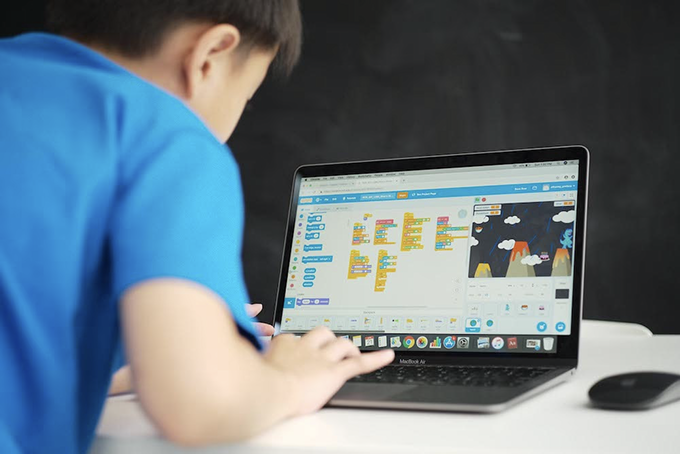
Programming can be learned from the earliest years, with specialized activities and robots for preschool students. Children can learn through play, whether through interactive activities, video games, or child-friendly interfaces. For example , Scratch allows them to program animations and virtual robots using only an internet browser.
When and why to learn programming?
Constructivist thinkers since Seymour Papert ( as early as 1980 ) have argued that everyone should develop specific computational thinking skills. Thinking computationally involves automating, evaluating, decomposing, and thinking abstractly and algorithmically.
In fact, computational thinking can be developed with or without the use of technology. Any playground game, even traditional ones, that involves solving problems and overcoming obstacles in a structured way, such as flowcharts or mazes, contributes to its development.
Gamification is a great way to develop this kind of “unplugged” computational thinking , which seeks to cultivate a critical and reflective approach.
The QWERTY phenomenon
To understand the effect that technology dependence can have on our minds if we don’t understand how it works, let’s use the metaphor of the QWERTY phenomenon . Have you ever wondered why the letters on the top row of the keyboard, starting from the left, are arranged in that order? In the past, the order of the keys on a typewriter had to be carefully calculated, because if two keys were pressed one after the other, they could get stuck, so the letter order was decided to be in an unusual, “QWERTY” order.
Over time, it was decided to leave it that way on computer keyboards, mobile devices, and other devices. We call the use of technology without knowing its origin or the logic behind it the “querty phenomenon.”
QWERTY in education
The QWERTY phenomenon can be applied to ways of thinking. For example, traditional education used to place greater emphasis on memorization and following step-by-step procedures to solve problems. These methods are comparable to the QWERTY keyboard layout: a solution from the past that persists out of habit, even though we now know there are more efficient ways to learn and think.
Today, greater emphasis is placed on understanding, logic, and innovative problem-solving. Abandoning the inertia of old methods to adopt a more dynamic thinking approach is a clear example of how to overcome that passive attitude of accepting what is because it is what it was.
When children learn from a young age that they can develop programming skills without technology, through simple games, we prevent them from falling victim to the QWERTY phenomenon.
What programming brings
The reasons why students benefit from studying programming in the primary stage are the following:
- It allows students to develop cognitive skills that enable critical, ethical, and responsible use of artificial intelligence. By understanding how the technology works, they also understand the risks involved in its various uses, thus developing ethical sensitivity toward technology.
- Understanding and using automation: By programming, students learn to streamline commands given to robots (much like in math, we use formulas to streamline addition, subtraction, averaging, etc., in a spreadsheet). Automation is a key skill for making our activities simpler and faster.
- Understanding data processing. For example, when programming a robot, students teach it to use information from its sensors to make decisions, such as turning when it detects an obstacle. Learning to organize and use this information logically helps them develop a way of thinking that they can then apply in other classes, making it easier for them to create graphs, tables, or diagrams, since they now understand how information is structured.
- Promote critical, abstract, and algorithmic thinking. A student who programs is a critical learner, as they understand that there are many solutions to the same problem. Programming invites us to find different ways to solve the same situation.
What the evidence says
Some studies show that developing computational thinking is an essential element of curriculum, as it helps develop key skills for creative thinking at any stage of education.
Even programming simple educational robots provides useful knowledge and learning, such as identifying patterns, solving problems, and working as a team.
Author Bio: Luis Daniel Lozano Flores is Research Professor in Education at the University of Guadalajara
