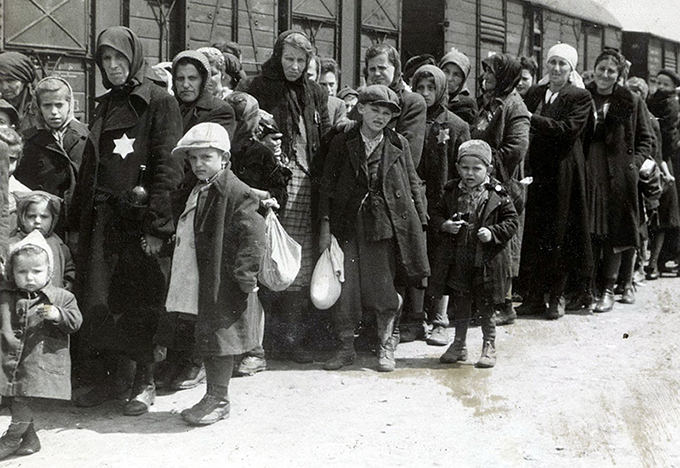
How can we teach the Holocaust and transmit to younger generations the desire to act against forgetting? With literature and work on corpora of testimonies, the historical investigation on the traces of missing persons invites students to combine knowledge and experience, allowing them to forge another link with history, according to the principle of the pedagogy of resonance dear to the philosopher Hartmut Rosa.
When discussing the events of the Second World War in class, particularly the Holocaust, reading literature by survivors, such as Primo Levi’s essential text, If This Is a Man , sparks in students the desire to act against forgetting .
Many teachers and institutions like the Shoah Memorial in Paris design workshops where, for example, passages from Art Spiegelman ‘s graphic novel Maus are studied , tracing the lives of his parents as Polish Jews during the persecution and deportation of Jews to extermination centers, or texts by third-generation descendants like Daniel Mendelsohn, The Lost , which recount the family’s historiographical investigation.
The aim is to address in the classroom a specific form of persecution, leading to the murder of people for “who they are,” which particularly affects adolescents in the process of developing their identity. When students connect with a particular element of a narrative, this teaching can begin as a form of self-directed learning. Its content is necessarily historical, specific, and grounded in scientific research, but it is also emotional, particularly affecting due to the importance young people attach to it.
The narrative fosters a sense of recognition of the other that resonates with oneself. The goal is not simply to elicit compassionate identification with the victims, which would render students vulnerable and incapable of developing critical thinking based on this knowledge; rather, it is to empower them to integrate these human catastrophes into their own lives. By questioning and investigating what the narrative means to them today, it resonates with their own experiences.
As a high school German teacher and associate researcher in philosophy, I examine the methodological and ethical implications of this approach, one key concept of which deserves to be mentioned: the concept of resonance of the contemporary philosopher Hartmut Rosa , which allows us to define and understand the experience of students.
Hartmut Rosa reflects on the phenomenon of acceleration that characterizes our era and paradoxically does not allow us to have more time, time that is nevertheless necessary to connect with the world, with others, and with objects. According to Rosa’s model, these relationships are situated along axes of resonance and open up a shared space.
The experience of a living tribute
The project presented here began with the reading of excerpts from accounts by survivors, their children, and grandchildren. Several groups of students successively conducted research in their town and in the departmental archives, then organized a commemoration ceremony. They were inspired by the work of the German artist Gunter Demnig, who brought to life the concept of a decentralized, citizen-initiated memorial called Stolpersteine , placed in front of the last freely chosen homes of those deported in 1992 in Cologne. The ceremony was held in April 2024. Since then, the students have maintained these stones, visiting the sites on symbolic dates, such as January 27, the day of the liberation of the Auschwitz camp, where most of the Jewish people deported from France were murdered.
Gunter Deming laid over 100,000 Stolpersteine , symbolically reuniting families scattered and murdered during the persecution of Jews in Europe. Their footsteps seem to echo once more in this freely chosen final resting place where they lived as families and citizens. When we look at these stones, reading the inscribed names of the people who lived here, we experience a living tribute and understand why the artist refuses to see them as tombstones.
Thus, the high school students were able to gather biographical information about the Aszendorf couple , tracing their journey from Lviv, a Polish city at the time. Isaac, a cheesemaker who came to France in 1930, married Bronislawa during a visit to Lviv in 1936, and efforts were made to allow her to finally join him in 1939. She worked as a seamstress. Gradually, the students became involved in the research and developed a connection with the couple. Reconstructing their life became important to everyone, as did writing and telling their story. This process aligns with the logic of inquiry, according to the educational philosopher John Dewey.
Dewey emphasizes the intimate and necessary link between experience and education ; the process of laying the paving stones meets all the criteria of a process that generates living knowledge. This “fruitful,” “creative” experience is part of an ” experimental continuum “: encounters with deported individuals constitute a living memory that is part of their world. By resonating, this memory spreads to other future experiences. Two years after the paving, it is remarkable that the effects of this project persist and are amplified. We can attempt to understand this through Rosa’s concept of resonance.
To experience oneself as a citizen responsible for one’s actions
Hartmut Rosa distinguishes two possible relationships to the world: either the world becomes unavailable and the axis remains mute, closed, or I am situated on an axis of resonance, the world is amplified and a reciprocal transformation ensues.
The Stolpersteine project begins in front of a computer screen: the Memorial to the Deportation of Jews from France allows one to search for deportees in the town where the high school is located. Hartmut Rosa rightly criticizes this single access point to the world via a computer screen. It is essential to diversify access channels by visiting the departmental archives to examine the files of the immigration police, the identity photos that emerge among the forms, and then going to the address of the Aszendorf family’s last residence, which was also the place of their arrest in July 1942.
A paving stone was laid flush with the pavement on the public street by Gunter Demnig, invited by the students and assisted by the mayor. While the ceremony took place, and some students read their speeches, the artist worked with his trowel to insert them into the pre-prepared hole. Each Stolperstein bears the same inscription: “Here lived, was born, arrested, interned, murdered…” The sidewalk corresponds precisely to this horizontal line , which recalls Hartmut Rosa’s concept: “The horizontal axis of resonance of family, friendship, and politics.”
Anchoring the paving stones (96x96x100 mm) in the ground creates a vertical axis of resonance that grounds the fundamental dimensions of love and meaning. This emotional engagement allows individuals to experience themselves as responsible agents of their own actions and to produce memories, texts, speeches, and/or visual, iconographic, or sound works based on personal images. During the laying ceremony, the high school students experience not only the rehabilitation of the deceased within the community but also their own capacity to connect with others. Hartmut Rose evokes a form of co-presence where history is lived through a diachronic resonance connecting generations.
The diagonal axis remains, representing the world of objects, but also institutions, the essential foundations of a society. It traverses the cubic space of the paving stone from one side to the other. The school, the departmental archives, and the municipality are all part of this space. Hands and things come together to concretely lay the paving stone, by requesting permission to install it on the public thoroughfare and by publishing a biographical note on the Stolpersteine website .
In conclusion, it is worth noting that Hartmut Rosa also emphasizes a form of narrative resonance that echoes the literary approach used in the high school workshops, explaining the specific narrative characteristics of each excerpt. To quote him:
“When I read, human beings and things change their meaning. I immerse myself in a completely different relationship with the world […]. I can feel them, hear them, and smell them […] and this magically alters my relationship with myself, my self-esteem.”
Author Bio: Anke Bedoucha is an Associate Researcher, Associate Professor of German at the University of Rouen Normandy
