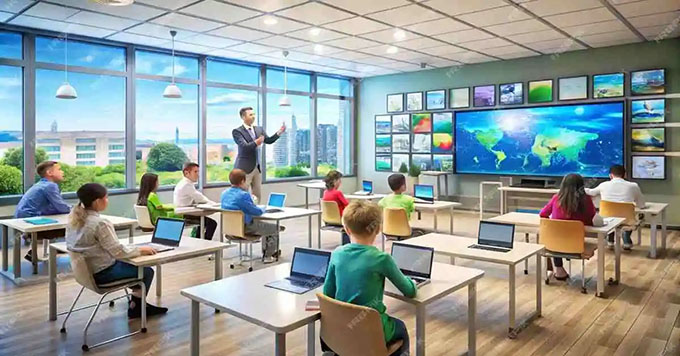
The digital transformation in all areas of life raises multiple questions about the relationship between technology and society. In the field of education, in particular, we see the need to prepare students for active digital citizenship. We want to educate citizens capable of using technology competently, appropriately, and responsibly in their daily lives.
This objective is called “digital competence,” and it has been introduced into institutions and educational centers through educational laws and curricula. For example, in the context of compulsory education in Spain, digital competence is part of the current LOMLOE curriculum .
In the university context, digital competence is part of some curricula. It is particularly prominent in teacher training, as is the case with digital competence for teachers . However, despite the definitions used for the term , it is often taught from an instrumental and neutral perspective on digital technologies. That is, we simply teach how to use them.
Beyond using them
But it’s also necessary to understand how, why, and for what purpose they are used. That is, to learn to do so in an ethical and critical manner, which also requires certain knowledge and attitudes, not just technical skills. We must move from being passive users of these technologies and recipients of the information that reaches us through them to selecting what we use, understanding why and for what purpose, and developing a sense of digital responsibility.
These are some of the objectives we are considering in our ongoing research, in which we propose concrete strategies to prepare future professionals to develop an ethical and critical perspective on technology in today’s society.
How do digital technologies and the Internet work?
Understanding the material aspects of the infrastructure behind the use of digital technologies and the internet would be one of the basic pillars for building critical digital competence.
For example, spending class time understanding what submarine telecommunications cables are and how they work , or the energy and water consumption involved in generative artificial intelligence, provides an essential practical dimension for understanding everything involved in having internet access and digital tools at the palm of your hand. Being aware of this complex framework helps children lay the foundation for responsible and sustainable use of digital technologies.
Pay attention to infrastructure
This level could be developed through observation and recording of technological infrastructure (cables, data processing centers). We could ask students to photograph elements that are part of this infrastructure, such as cell phone towers or antennas, in their everyday environment.
In a previous experience in the North American context , after reading and discussing the infrastructure required by our digital technologies, a group of university students spent 15 minutes walking around their campus, examining the digital infrastructure they found (buried fiber optic cables, servers, surveillance cameras) and taking photos of them with their cameras or cell phones. All the photos were reviewed as a group and discussed.
The metaphors surrounding technologies
Another way to foster a deeper and more critical understanding of the technologies they use in their daily lives could be through the deconstruction of metaphors, such as the cloud or data (digital and personal) as the new oil . In the classroom, students could explore the origin of these metaphors or create artistic interpretations of them.
The use of metaphors softens and reduces the complexity of digital infrastructures, so this deconstruction involves deeper investigation to bring to light many details (who is behind it, how it is maintained) that are often left in the background.
What technology do I use and why?
In their role as consumers, students must understand that there are different alternatives in the technology market, and how their decisions and purchases prioritize certain services, programs, and applications. We often prioritize the most popular tools (Microsoft, Google, etc.), which are seemingly free (in exchange for personal data) or semi-free and accessible online.
In this sense, another aspect that can help develop critical digital skills is identifying non- commercial, open, and free alternatives such as LibreOffice instead of Microsoft Office, or GIMP instead of Adobe Photoshop.
In class, technoethical audits of tools can be conducted by typology, which help address aspects of social, commercial, pedagogical, and environmental ethics. For example, the tool’s accessibility and inclusiveness (social ethics) or its ability to be used offline (environmental ethics) are factors that can influence decisions.
Explore the creative side
Young people and adolescents often adopt a passive role when faced with technology, and it is precisely understanding the possibilities for participation and creation that it offers that allows them to make the leap to a more critical use.
This facet can be explored through activities such as editing and translating articles through Wikipedia as an open and free collaborative platform , creating new content (such as web pages) that can be used by others , and using open Creative Commons licenses on that content to promote open, shared, and reusable knowledge.
In all of these cases, we are making deliberate and meaningful use of the material, the results of which go beyond the activity in question, as they may be useful to future students or others outside the class.
Developing critical literacy at all stages
In addition to these four aspects, our collection of educational practices develops many other proposals: working on data literacy linked to the biases of artificial intelligence; promoting digital citizenship and responsibility through the construction of an ethical digital footprint; critical content evaluation; and critical media production through digital cartographies for storytelling, among others.
While the project focuses on higher education, and especially on the initial training of teachers in schools and institutes, the proposals could be adapted to other educational levels.
Author Bio: Victoria Marín Juarros is Professor of Educational Sciences, Educational Technology at the University of Lleida
