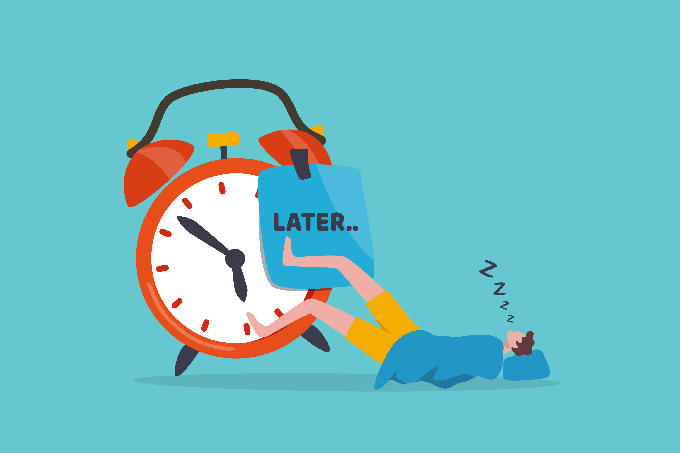
Procrastination often gets a bad rap in academic writing advice circles. It’s generally seen as a problem to be managed, a symptom of anxiety or perfectionism. In other words, it’s a productivity failure. Writing advice givers like me have designed entire systems to overcome procrastination – tomato timers, accountability partners, writing retreats, word-count targets. And yes, before we go any further, sometimes avoidance is just avoidance, and the answer is to sit down and write. But ‘procrastination’ is too broad a term to be helpful if it names all non-writing time as failure. Some of what’s called procrastination may be doing real work.
We can probably all recall the experience of leaving a stuck argument and going for a walk, or sleeping on a problem that won’t resolve. And then unexpectedly coming up with a solution. What is happening here? Well, the mind often keeps working on things during apparently fallow periods, making connections that focused, anxious attention tends to suppress. This is incubation, not delay.
The difficulty is that incubation can feel exactly like delay, especially when a deadline is approaching. But writers who have learned to trust the process often report that the paragraph they couldn’t write at 10 pm appeared almost fully formed the following morning. That’s not magic. The thinking was happening; it just wasn’t happening at the desk.
Resistance can also be diagnostic. When you find yourself avoiding a particular section – coming back to it, opening the file, closing it again, making another coffee – it‘s worth asking what the avoidance is telling you. Often it’s pointing at a real problem: the argument has a hole, the framing is off, the evidence doesn’t quite support the claim you’re trying to make. The section feels impossible because it is impossible as currently conceived.
And writers who push through regardless may well produce prose that looks like an argument. But it’s actually avoidance. The sentences are there, the paragraph is technically complete, but something is off. Something is glossed over. Something is missing. Sitting with the discomfort, or at least taking it seriously enough to diagnose it, can surface problems that need solving before any writing will really work well.
There is also the question of timing. Waiting until a theoretical frame has properly settled, or until you have really thought through what your data is saying, is not the same as avoiding the work. It is often quite reasonable to assume that writing now would be premature. The prose that comes from a more considered place is usually tighter and more authoritative than the prose produced by forcing yourself to write before you are ready. There’s a useful rough test here: if the not-writing time involves ongoing engagement with the material – reading, note-making, talking through ideas with a colleague – then putting off a draft is probably serving the work. Reading, notetaking and talking through ideas are still about the writing. Indeed they are the writing if you take writing in its broadest sense. But if waiting has drifted into a low-grade state of guilty non-engagement, something else is going on.
Guilt is worth naming, because academic writing culture feeds on guilt. The injunction to always be writing, to fill every available hour, means that ordinary rest gets experienced as failure. Writers who have absorbed this message often find themselves in a peculiar limbo: not writing, but not properly resting either, just hovering in a state of anxious non-productivity. Giving yourself explicit permission to step away tends to make the return easier. And I mean actual permission, not grudging acknowledgement to just stop for a bit. The fallow period becomes recovery rather than defeat.
Of course, none of this is an argument for indefinite delay. Avoidance that goes on well past any reasonable incubation period, paralysis driven by perfectionism, displacement activity that fills the day without touching the work are real, and they need addressing. Sometimes they even need expert support.
But a useful first question to ask yourself is not Am I procrastinating? It is What is this pause doing, and when does it stop being useful? That question which tends to produce more useful answers.
